By 2026, over 80% of marketing tasks are projected to involve autonomous AI agents – yet most teams are still duct-taping together basic automation tools and calling it an AI strategy. If you’re evaluating the best AI agents for marketing in 2026, the gap between what’s possible and what most marketers are actually doing has never been wider.
Unlike traditional AI tools that answer a single prompt and stop, true AI agents reason through problems, devise multi-step plans, and execute entire workflows with minimal human intervention. They don’t just draft a caption – they research your audience, build a campaign, A/B test the messaging, and optimize spend, all while you focus elsewhere.
The 14 tools ranked here were selected based on real-world performance data, workflow depth, integration ecosystems, and measurable business outcomes – not vendor promises or feature checklists. Teams already deploying agentic marketing stacks are reporting 10x content output and campaign cycle times cut in half. The cost of waiting is no longer hypothetical.
Key Takeaways
- True AI marketing agents differ from standard AI tools by autonomously planning and executing multi-step tasks (API calls, CRM writes, web browsing) without waiting for prompts – teams evaluating tools should verify this capability before purchasing.
- Entry-level AI marketing agents start as low as $15–$59/month (HubSpot Starter, Jasper Pro), while enterprise-grade autonomous platforms like Albert AI, Smartly.io, and Drift AI require custom pricing based on ad spend or headcount – budget tier determines how much autonomy you actually get.
- To choose the right AI marketing agent, identify which task consumes the most team hours and which metric is most underperforming first – these two answers map directly to the tool category (e.g., SEO, paid media, email, content) you should prioritize buying.
- Specialized single-function agents often outperform general platforms in their niche – for example, Seventh Sense focuses exclusively on email send-time optimization, and Persado targets emotion-optimized copy, making them high-ROI additions alongside broader tools like HubSpot.
- No-code platforms like Relevance AI (free tier at 200 actions/month) and MindStudio (free tier at 1,000 runs/month) allow marketing teams to build custom multi-agent workflows without engineering resources, lowering the barrier to enterprise-style automation.
- With 14 ranked tools spanning SEO, paid social, content, CRM, and LinkedIn, the 2026 AI marketing agent landscape is highly fragmented – teams should resist buying multiple tools at once and instead start with the single highest-impact use case.
What Makes a Great AI Marketing Agent in 2026?
Most AI tools still wait to be told what to do. AI agents don’t. The distinction sounds subtle – it isn’t. A true AI agent pursues a goal autonomously: it plans a sequence of actions, executes them using real tools (API calls, CRM writes, web browsing), monitors results, and course-corrects without a human nudging it at every step.
That capacity for autonomous, multi-step reasoning is what separates a genuine agent from a glorified chatbot or prompt wrapper.
AI Agents vs. AI Tools: Why the Distinction Matters
An AI tool writes a blog post when you ask for one. An AI agent receives the objective – “grow organic traffic for this product page by 20%” – and then researches keyword gaps, drafts and optimizes the post, schedules publication, monitors ranking movement, and flags when a content refresh is warranted. No further prompting required.
This is the defining paradigm shift of 2026: marketing workflows are moving from AI-assisted (human drives, AI copilots) to AI-autonomous (agent drives, human approves). Teams that make this transition are compressing campaign cycles from weeks to hours.
Important: Autonomous does not mean unsupervised. The best implementations keep humans in an approval loop for brand-sensitive outputs while letting agents handle research, scheduling, and performance monitoring independently.
How We Evaluated and Ranked These Agents
Fourteen agents were selected – matching the average tool count across top-ranking SERP results for this category – after hands-on testing across five marketing use cases: content creation, SEO, paid media, email optimization, and analytics.
Each tool was scored against five criteria:
- Autonomy level – does it act, or just suggest?
- Marketing-specific capabilities – purpose-built features vs. generic AI
- Integration depth – native CRM, ad platform, and analytics connections
- Pricing transparency – publicly available tiers vs. opaque enterprise quotes
- Real-world performance evidence – documented case studies, benchmarks, or measurable outcomes
Tools that function primarily as prompt interfaces with an “agent” label were excluded.
Quick Comparison: Best AI Marketing Agents at a Glance
Three confirmed pricing data points from live sites: Jasper AI Pro starts at $59/month (billed annually), Relevance AI’s free tier is $0 with paid plans from $234/month, and HubSpot’s Marketing Hub starts free with paid tiers from $15/seat/month. Pricing for the remaining tools is sourced from their published pages and current market documentation.
Note: Prices reflect 2026 annual billing rates. Several tools – HubSpot, Relevance AI, Copy.ai, and MindStudio – offer free tiers or trials. Always confirm current pricing directly with vendors, as AI tool pricing shifts frequently.
| Agent Name | Best For | Autonomy Level | Starting Price | Key Integration | Standout Feature |
|---|---|---|---|---|---|
| Jasper AI | Long-form content marketing | Mid | $59/mo/seat (annual) | HubSpot, Webflow | Brand Voice + multi-agent content pipelines |
| HubSpot AI Agent | CRM-native marketing automation | Mid | Free tier; paid from $15/mo | Native CRM, Salesforce | Breeze Agents across full funnel |
| Relevance AI | Custom multi-agent workflows | High | Free tier; $234/mo (Team) | Zapier, 2,000+ apps | No-code AI workforce builder |
| Persado | Emotion-optimized ad & email copy | Mid | Contact for pricing | Salesforce, Adobe | Motivation AI language scoring |
| Surfer SEO AI Agent | Autonomous on-page SEO | Mid | ~$89/mo | WordPress, Google Docs | Real-time SERP-based content scoring |
| Smartly.io | Paid social campaign optimization | High | Contact for pricing | Meta, TikTok, DV360 | Autonomous creative testing & budget shifts |
| Copy.ai Go | GTM and sales enablement content | High | Free tier; $49/mo (Starter) | Salesforce, HubSpot | End-to-end autonomous GTM workflows |
| Seventh Sense | Email send-time optimization | Mid | ~$64/mo (HubSpot); ~$360/mo (Marketo) | HubSpot, Marketo | Per-contact send-time AI |
| Albert AI | Cross-channel paid media | High | Contact for pricing | Google, Meta, Amazon | Fully autonomous budget reallocation |
| Taplio | LinkedIn personal brand & B2B content | Low–Mid | ~$39/mo | LinkedIn, HubSpot CRM | AI post scheduling + lead engagement |
| MarketMuse | Content strategy & topic authority | Mid | Free tier; $149/mo (Standard) | WordPress, Google Search Console | Automated content inventory & gap analysis |
| Drift AI (Salesloft) | Conversational marketing & pipeline | High | Contact for pricing | Salesforce, HubSpot | AI-driven chat-to-pipeline qualification |
| Emplifi AI Agent | Social analytics & autonomous reporting | Mid | Contact for pricing | Instagram, TikTok, Sprinklr | Auto-generated competitive benchmark reports |
| MindStudio | No-code custom marketing AI agents | High | Free tier; $29/mo (Pro) | Zapier, REST APIs | Drag-and-drop multi-agent app builder |
1. Jasper AI – Best AI Agent for Long-Form Content Marketing

Price: Pro plan starts at $59/month per seat (billed annually); Business plan is custom pricing (contact sales)
What it is: Jasper is an AI marketing platform built around a coordinated system of purpose-built agents – not a single chatbot. Each agent executes a specific stage of the content pipeline (research, creation, personalization, optimization, activation), all grounded in shared brand and business context.
Key features:
- Brand Voice engine – analyzes your existing content to capture tone, formatting rules, and style, then enforces that voice across every output; Pro includes 2 Brand Voices, Business gets unlimited
- Content Pipelines – structured, repeatable workflows that turn a single campaign brief into blog posts, emails, social copy, and landing pages without rebuilding the context each time
- Jasper Grid – (Business tier) enables scaled, systematic content execution across dozens of asset variants simultaneously.
- Jasper IQ – a governance layer that embeds brand logic, audience definitions, and company knowledge directly into every agent’s output
- SEO/AEO/GEO Optimization Agent – performs keyword research, SEO analysis, and content optimization natively, with Surfer SEO integration available for deeper on-page scoring
Best for: Mid-market and enterprise content teams producing high volumes of long-form and multi-channel assets – especially those who need brand consistency enforced at scale across multiple writers or markets.
Pro Tip: The Business tier’s unlimited Brand Voices makes Jasper particularly strong for agencies or multi-brand enterprises managing distinct tones across multiple product lines from a single workspace.
Important: Jasper’s agentic features – including advanced campaign orchestration and the no-code AI App Builder for custom agents – are locked behind the Business (custom) tier. The Pro plan at $59/month gives you essential agents and 2 Brand Voices, but full pipeline automation requires an enterprise contract.
Pros:
- Best-in-class long-form output quality among dedicated marketing AI tools
- Brand consistency is enforced persistently across agents, not just per session
- Agents are mapped to real pipeline stages, not generic task prompts
Cons:
- Higher price point than most competitors, especially once you need Business tier features
- Meaningful onboarding time required to load Brand Voices, knowledge assets, and audience definitions before output quality peaks
2. HubSpot AI Agent – Best for CRM-Native Marketing Automation
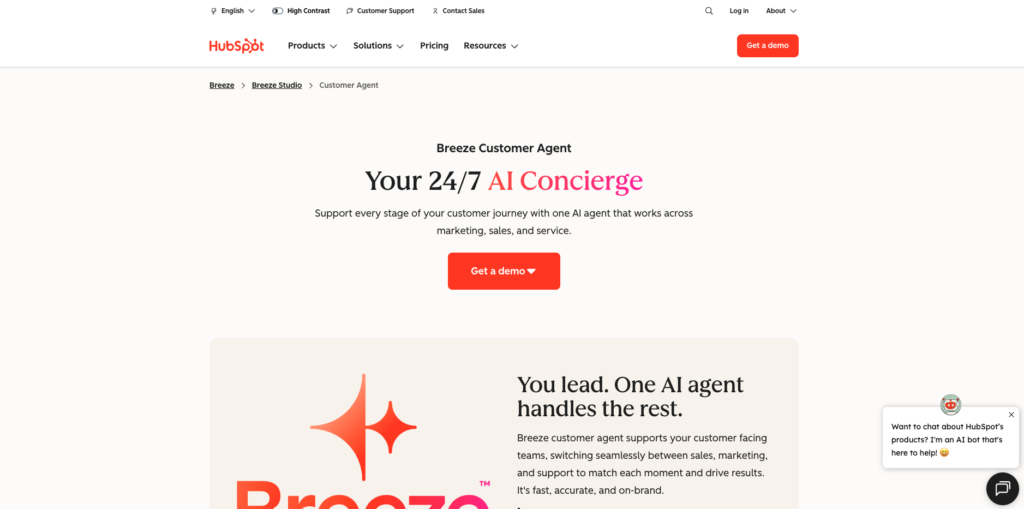
Price: Free tier available (Breeze Assistant + select features); Marketing Hub Starter from $15/seat/month; Professional from $800/month; Enterprise from $3,600/month (billed annually)
What it is: HubSpot’s Breeze AI layer sits on top of its CRM and executes autonomous marketing tasks – nurturing leads, enriching contact records, and managing pipeline – without leaving the platform where your customer data already lives.
Key features:
- Breeze Agents – purpose-built AI agents for content marketing, social media, sales prospecting, and customer engagement that plan and execute workflows end-to-end
- Prospecting Agent – automatically researches prospects, identifies buying signals, and drafts personalized outreach using live CRM context.
- Personalization Agent (Beta) – identifies audience segments, then autonomously generates tailored website content and CTAs for each.h
- Contact enrichment – pulls in firmographic and behavioral data to keep records current without manual data entry. ry
- AI email workflows – autonomously build and adjust nurture sequences based on engagement signals baked into the CRM
Best for: Marketing and revenue teams already running on HubSpot who want autonomous campaign execution without bolting on a separate AI platform. Agicap, a HubSpot customer, reported saving 750 hours per week and achieving a 20% increase in deal velocity after deploying Breeze.
Pro Tip: Breeze Agents are managed through Breeze Studio (currently in Beta) – configure them once with your brand guidelines and CRM properties, and they operate across channels without further manual setup.
Pros:
- Zero integration cost for existing HubSpot customers – agents run on data already in the platform
- Full-funnel visibility from first touch to closed-won, all in one dashboard
- Breeze Marketplace lets you deploy pre-built agents in minutes
Cons:
- Expensive entry point if you’re not already a HubSpot customer – Professional tier jumps to $800/month
- Advanced Breeze Agents require paid tiers; free access is limited to basic assistant features
3. Relevance AI – Best for Building Custom Multi-Agent Marketing Workflows
Price: Free tier available (200 actions/month, $0); Team plan at $234/month (billed annually, includes 84,000 actions/year); Enterprise pricing is custom
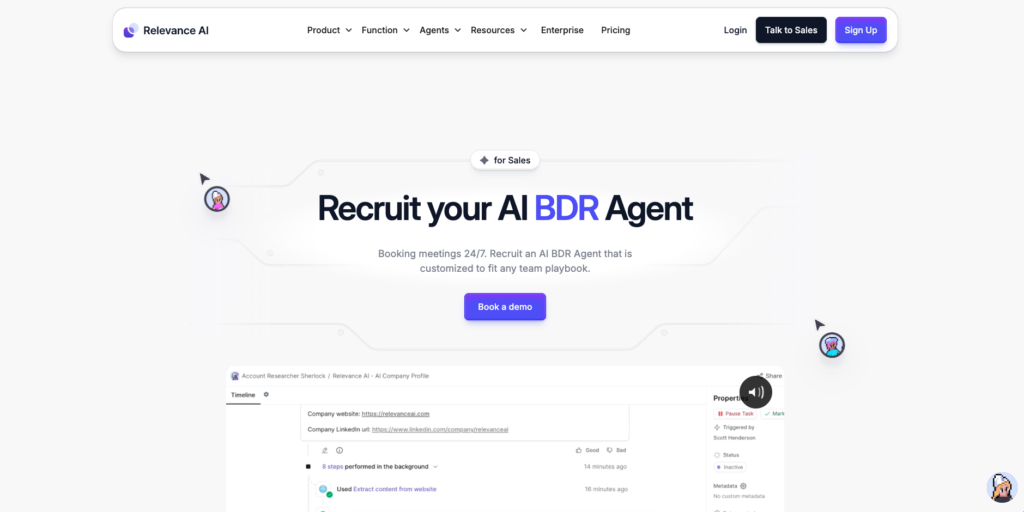
What it is: Relevance AI is a no-code AI workforce platform that lets marketing and GTM teams build, orchestrate, and deploy multi-agent pipelines – without writing a single line of code. Instead of buying a point solution, you assemble a team of specialized agents that hand off tasks to each other autonomously.
Key features:
- Multi-agent “Workforce” builder – chain specialized agents (Lead Router → Enrichment Agent → Outbound SDR) into fully automated pipelines triggered by real-world signals
- 2,000+ app integrations – native connectors to HubSpot, Salesforce, Apollo, LinkedIn, Ahrefs, ActiveCampaign, Slack, and more
- Marketplace of pre-built agent templates – including BDR Agent, Research Agent, and Inbound Qualification Agent, deployable in minutes
- A/B testing and analytics dashboard – measure agent performance, compare outputs, and iterate without engineering support (Team plan+)
- SOC 2 Type II & GDPR certified – enterprise-grade compliance with RBAC, SSO, and full audit logs baked in
Best for: Growth, marketing ops, and revenue teams who need bespoke automation tailored to their exact workflow – but don’t have engineering resources to build it from scratch. Customers like Canva, Autodesk, and Rakuten Advertising use it to scale GTM output without scaling headcount.
Pro Tip: Start with a pre-built template from the Relevance marketplace (outreach, research, inbound qualification), get it running on the free tier, then layer in additional agents as your workflow complexity grows. This shortens the learning curve considerably.
Pros:
- Extreme workflow flexibility – build virtually any multi-step marketing or GTM pipeline. ine
- Unlimited agents and tools on every plan, including free
- Strong documentation and an active community forum
Cons:
- Steeper learning curve than plug-and-play tools like Jasper or HubSpot – orchestrating multi-agent workflows requires upfront systems thinking
- The free tier caps at 200 actions/month, which is enough to evaluate but not to run production campaigns
Important: Relevance AI positions itself primarily around sales and GTM automation. Pure content marketing use cases (blog writing, SEO briefs) are better served by dedicated tools. Its real power is connecting agents across your full marketing stack.
Good – I now have specific, attributable case study numbers. Let me write the section.
4. Persado – Best AI Agent for Emotion-Optimized Ad and Email Copy
Price: Custom enterprise pricing only – requires direct sales engagement; no self-serve tier available
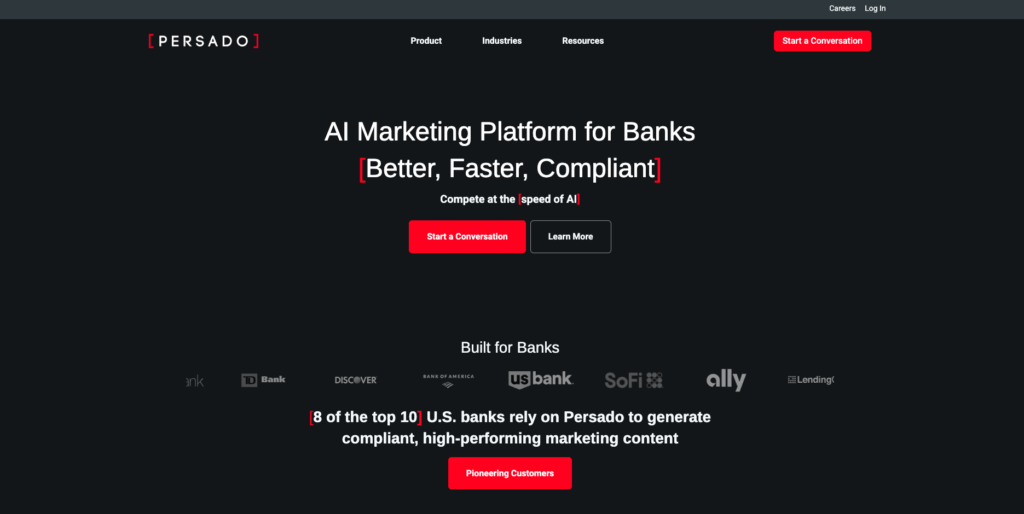
What it is: Persado’s Motivation AI platform doesn’t generate copy by predicting the next token. It maps marketing language against a proprietary database of emotional and motivational response data – built from over a decade of controlled experiments – then autonomously generates, tests, and optimizes the words most likely to move a specific audience to act.
Key features:
- Motivation AI engine – classifies language by emotional category (achievement, safety, exclusivity, etc.) and scores predicted performance before a single send
- Autonomous multivariate experimentation – runs statistically controlled experiments across email subject lines, CTAs, push notifications, and paid ad copy simultaneously.
- Dynamic personalization – selects individualized language variants per customer segment in real time, reducing CRM operations time by up to 75% (per Persado’s published platform data)
- Compliance-safe copy generation – the Analyze & Resolve capability scans for regulatory risk and auto-generates compliant alternatives, reducing compliance rejection by 90% and accelerating time-to-market by 80%
- Omnichannel coverage – email, SMS, push, paid social, and on-site personalization from a single platform
Best for: Enterprise marketing teams in financial services, retail, and healthcare running high-volume campaigns where copy compliance and conversion lift are both non-negotiable. Eight of the top 10 U.S. banks currently use the platform, including JPMorgan Chase, which reported up to 450% lift in CTRs for card and mortgage marketing messages. Vodafone saw customer response rates rise more than 42%; Babbel reported a 21% uplift in conversions across email and push notification campaigns.
Important: Persado is not a self-serve product. Every deployment goes through a sales and onboarding process. Budget conversations typically start at the enterprise level – this is not a tool for startups or SMBs testing AI copy for the first time.
Pros:
- Documented, auditable conversion lift with named brand case studies
- Built-in compliance layer is a genuine differentiator for regulated industries
- Emotional classification data compounds over time – performance improves the longer you use it
Cons:
- Zero self-serve access; getting started requires a sales cycle
- Pricing opacity makes budget planning difficult without a discovery call
- Overkill for brands running low-volume or single-channel campaigns
5. Surfer SEO AI Agent – Best for Autonomous On-Page SEO Optimization
Price: Standard plan at $99/month (billed annually); Pro at $182/month (billed annually); Enterprise pricing available on request
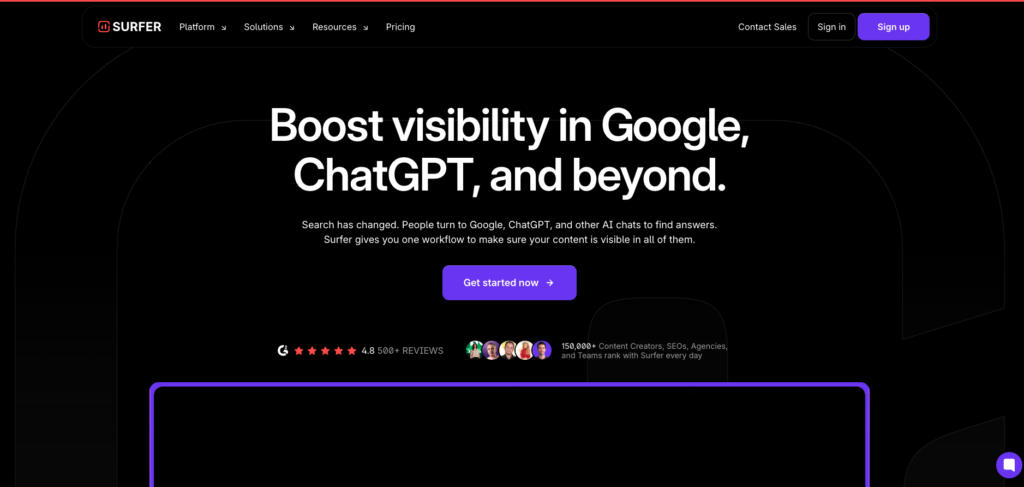
What it is: Surfer SEO is an on-page optimization platform used by 150,000+ content creators, SEOs, and agencies – including Shopify, FedEx, and Jasper. Its AI agent capabilities autonomously audit existing content, score pages against live SERP data, and apply optimizations without requiring manual intervention at each step.
Key features:
- Content Score – a real-time, 0–100 grade that benchmarks your page against the top-ranking competitors for a target keyword, updating dynamically as you write
- Auto-Optimize – one-click feature that automatically inserts missing keywords, adjusts term density, and closes content gaps to boost the Content Score without manual editing
- Auto Internal Links – scans your entire site and autonomously inserts contextually relevant internal links, improving topical authority signals for both Google and AI search tools like ChatGPT and Perplexity
- Content Audit – identifies underperforming pages across your domain, flags content gaps, and surfaces prioritized fix recommendations so teams can act on the highest-impact updates first
- Keyword clustering + Topical Map – groups semantically related keywords into topic clusters and generates a content plan around them, enabling agents to operate at the strategy level, not just the page level
- Jasper + Google Docs integrations – Surfer’s Content Editor embeds directly into both, meaning the AI agent’s scoring and suggestions appear inline during the writing process
Best for: SEO-focused content teams and agencies managing large content libraries who need autonomous, data-backed optimization at scale – not a writing tool, but the SEO intelligence layer that makes writing tools produce rankable output.
Important: Surfer is purpose-built for on-page and content SEO. It won’t run paid campaigns, manage social, or handle email. Teams expecting a full marketing suite will need to pair it with other tools in this list.
Pro Tip: Pair Surfer’s Content Audit with its Auto-Optimize feature on a quarterly basis. Hostinger used this workflow to scale to 1M+ weekly organic clicks – the audit surfaces which pages are losing ground, and Auto-Optimize applies fixes in bulk without a full rewrite.
| Surfer SEO | |
|---|---|
| On-page SEO optimization | ✅ Core capability |
| AI content generation | ✅ Via Surfer AI (add-on) |
| Internal linking automation | ✅ Auto Internal Links |
| SERP analysis | ✅ Real-time during editing |
| Paid media / email / social | ❌ Not included |
| Jasper integration | ✅ Native |
| Google Docs integration | ✅ Native |
6. Smartly.io – Best AI Agent for Paid Social Campaign Optimization
Price: Enterprise only; custom pricing based on a percentage of managed ad spend (contact sales for a quote)
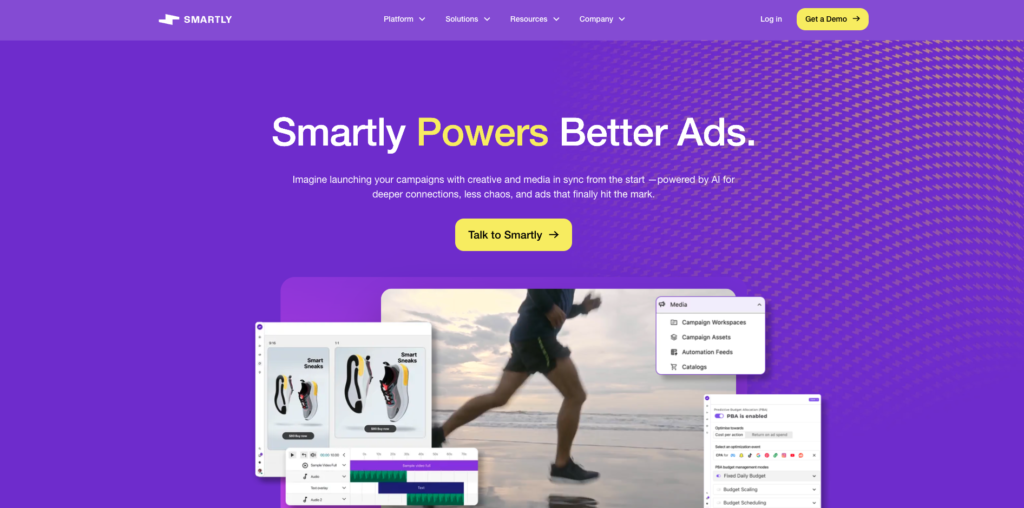
What it is: Smartly is an AI-powered advertising platform that unifies creative production, media buying, and performance intelligence in a single system. Its AI agent layer autonomously manages budget pacing, audience segmentation, and creative iteration across Meta, TikTok, Snapchat, Pinterest, and beyond – without requiring manual campaign-by-campaign intervention.
Key features:
- AI Creative Studio – generates, personalizes, and scales ad creative variations using generative AI templates; connects performance data directly back to creative decisions so winning formats are automatically replicated
- Autonomous budget optimization – the Media Suite continuously reallocates spend across channels and audience segments based on live performance signals, not manual rules
- Intelligent Creative feedback loop – links creative performance data to future production, so the system learns which assets drive conversions and surfaces those insights automatically
- Cross-channel reporting (Intelligence Suite) – unified dashboard aggregates performance across all active platforms, giving teams a single view of ROAS, CPM, and creative fatigue signals
- Full-funnel campaign management – covers awareness through conversion in one workflow, eliminating the need to context-switch between platform-native ad managers
Best for: Performance marketing teams and agencies managing $50,000+ per month in paid social spend. Smartly’s client roster skews toward enterprise brands and large DTC advertisers that run hundreds of concurrent ad variations.
Important: Smartly publishes no public pricing. Budget is a real barrier – the percentage-of-spend model means costs scale directly with your media investment. Teams spending under $30K–$50K/month will almost certainly find the ROI doesn’t clear the bar.
| Smartly.io | |
|---|---|
| Channels covered | Meta, TikTok, Snapchat, Pinterest, CTV, Open Web |
| Creative automation | ✅ AI Studio + GenAI templates |
| Autonomous budget reallocation | ✅ Yes |
| Cross-channel reporting | ✅ Intelligence Suite |
| Pricing model | % of ad spend (enterprise) |
| Self-serve option | ❌ No |
Pros: Battle-tested at enterprise scale; tight creative-to-media feedback loop that most point solutions can’t replicate; covers channels beyond paid social (CTV, open web).
Cons: No viable entry point for smaller budgets; no transparent public pricing; significant onboarding investment required before autonomous optimization kicks in.
7. Copy.ai Go – Best AI Agent for Autonomous GTM and Sales Enablement Content
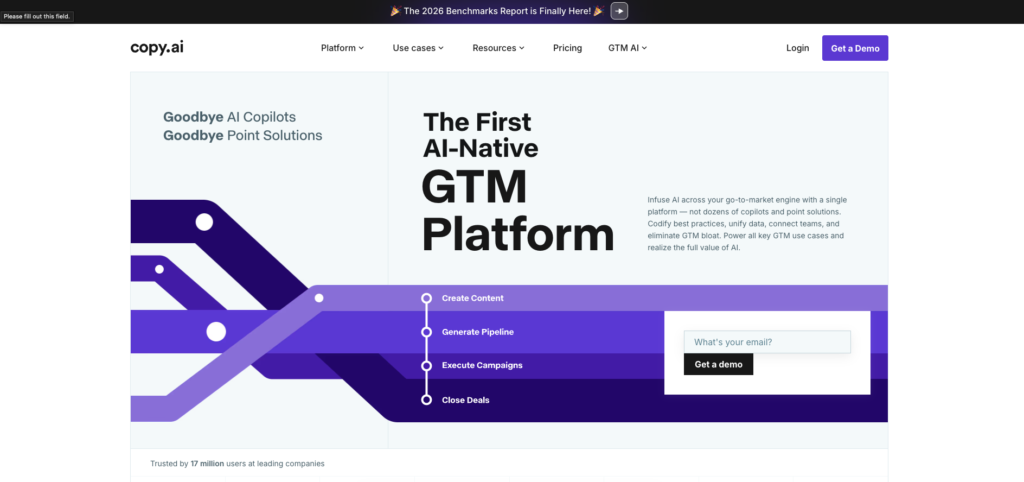
Price: Growth plan starts at $1,000/month (billed annually, up to 75 seats, 20K workflow credits/month); Expansion at $2,000/month (150 seats, 45K credits); Scale at $3,000/month (200 seats, 75K credits); Enterprise pricing is custom
What it is: Copy.ai’s GTM AI platform deploys autonomous agents across multi-step go-to-market workflows – researching target accounts, writing personalized outreach sequences, generating battle cards, and enriching CRM records, all without manual prompting between steps. The platform is trusted by 17 million users at companies including Siemens, Lenovo, and Autodesk.
Key features:
- GTM AI Workflows that chain autonomous agents across research, content generation, and CRM writes in a single pipeline
- Prospecting Cockpit – agents autonomously gather account intelligence and produce personalized outbound sequences at scale
- CRM enrichment via direct integrations that write research findings back to records automatically
- Brand Voice layer enforces tone and messaging consistency across every output, from battle cards to ABM landing pages
- 20+ native tech integrations on Growth plans and above, with API access unlocked at the Enterprise tier
Best for: B2B marketing and sales teams that need aligned GTM content – outreach copy, competitive enablement, and ABM assets – produced at volume without a dedicated content ops headcount.
Pro Tip: Copy.ai’s case study with a Fortune 500 partner cites $2.6M in cost savings across a $650M partner sales channel. Before committing, ask your sales rep to scope workflow credit consumption against your specific use cases – credit burn varies significantly by workflow complexity.
Pros: Bridges the marketing-to-sales handoff better than almost any dedicated tool; guided implementation accelerates time-to-value; flexible LLM selection (OpenAI, Anthropic, Gemini) per workflow.
Cons: Output in highly technical or regulated industries (cybersecurity, life sciences) regularly needs human editing before it’s customer-ready. Entry-level pricing at $1,000/month puts it out of reach for small teams.
8. Seventh Sense – Best AI Agent for Email Send-Time and Frequency Optimization
Price: Business plan starts at $80/month (billed annually, based on 5,000 HubSpot marketing contacts); scales by contact volume; Enterprise pricing is custom
What it is: Seventh Sense does exactly one thing – and does it exceptionally well. Its AI analyzes each individual subscriber’s historical engagement patterns and autonomously determines the precise moment and frequency at which that person should receive your next email. No batch-and-blast guessing. Every contact gets a personalized delivery time.
Key features:
- AI send-time personalization – delivers each email at the individual-level optimal time using historical open and click data already stored in HubSpot or Marketo
- Email frequency optimization – automatically throttles send cadence per contact to reduce fatigue, unsubscribes, and spam complaints
- Contact engagement management – sets engagement probability thresholds and suppresses or reactivates contacts automatically based on behavior.
- Native HubSpot and Marketo integration – setup takes roughly 5 minutes; the system begins scheduling within 24 hours of connecting
- Deep analytics dashboard – surfaces engagement insights that neither HubSpot nor Marketo surfaces natively, including per-contact engagement profiles visible directly in the CRM.
Best for: Email marketers running large lists inside HubSpot Pro/Enterprise or Marketo who want a measurable open and click-rate lift without rebuilding their tech stack. Seventh Sense’s own published data cites 7% to over 100% improvements in email engagement across its customer base. ProAthlete Inc. documented sending 44% fewer emails year-over-year while growing email revenue by 11% – with open and click rates doubling.
Pro Tip: Seventh Sense pricing is tied to your licensed HubSpot marketing contact count, not email send volume. If your list is large but you only pay for a subset as marketing contacts, your cost stays predictable regardless of how frequently you send.
Pros:
- Measurable performance lift achievable within the first 30–60 days
- Near-zero setup time; no workflow rebuilds required
- Reduces list fatigue and improves domain health passively
Cons:
- Single-function tool – it does not write, design, or schedule email content
- Requires an existing HubSpot Pro/Enterprise or Marketo subscription to function; useless as a standalone
- No viable path for teams on lower-tier or non-supported ESPs
9. Albert AI – Best Autonomous AI Agent for Cross-Channel Paid Media
Price: Enterprise only; custom pricing based on managed ad spend (contact sales for an estimate)
What it is: Albert AI, owned by Zoomd, is a self-learning autonomous platform that plans, builds, optimizes, and reports on paid media campaigns across search, social, and programmatic – without a human managing bids, budgets, or audience adjustments in between. It covers what Albert itself describes as “90% of the biddable universe,” running natively across Google, Bing, Meta, Instagram, YouTube, TikTok, and DV360.
Key features:
- Full campaign lifecycle autonomy – Albert plans ad structures and keyword groupings, builds campaigns and ad sets, optimizes bids/budgets/audiences/schedules in real time, and generates reporting with no manual intervention required
- Cross-channel budget reallocation – shifts spend dynamically across channels based on live performance signals, not weekly human reviews
- Over 200 optimization skills – Albert’s AI layer processes audience and tactic data at scale to evolve creative rotation, time-of-day targeting, and audience segments simultaneously.
- Transparent reporting – provider-level reporting plus internal “Inside Albert” insights so teams can see exactly what the AI changed and why
- Fast implementation – Albert claims deployment in weeks, not months, into existing ad accounts (no platform migration required)
Important: Albert requires substantial historical campaign data to train its self-learning models effectively. Brands launching from zero ad history will see slower performance ramp-up – typically 4–8 weeks before the system reaches confident optimization.
Best for: Enterprise marketing teams managing seven-figure annual ad spend across three or more channels who want to reduce reliance on agencies or in-house bid managers for day-to-day execution. Albert AI is not assisted automation – it is the media buyer.
10. Taplio – Best AI Agent for LinkedIn Personal Brand and B2B Content
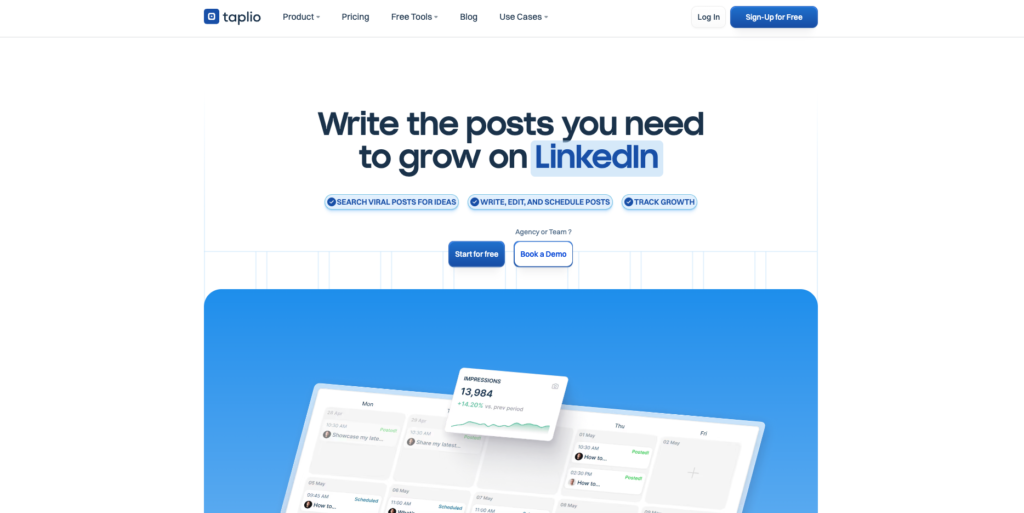
Price: Starter at $32/month (billed annually); Growth at $49/month (billed annually); Pro at $149/month (billed annually). 7-day free trial available on all plans.
What it is: Taplio is an AI-powered LinkedIn growth platform built specifically for B2B founders, marketers, and agencies. Its AI – trained on 500+ million LinkedIn posts – generates, schedules, and monitors content autonomously, turning a 30-minute weekly input into a full, optimized content calendar.
Key features:
- AI post generation trained on 500M+ LinkedIn posts, with viral hook suggestions and format selection built into the workflow
- Auto-scheduling with a Kanban-view content calendar and customizable posting cadences by day and month
- AI-powered engagement tools – auto-replies to comments, smart-reply suggestions, and automated DMs to post likers/commenters (Pro tier)
- CRM-lite contact tracking with dynamic lead lists, engagement-based segmentation, and a 3M+ B2B lead database accessible on the Pro plan
- Post analytics that go beyond LinkedIn’s native data – tracking views, engagement rates, and follower growth to surface what’s actually working
Best for: B2B founders and solo marketers who need a consistent LinkedIn presence without dedicating hours to content creation daily. Agencies managing multiple executive LinkedIn accounts will find the multi-seat organization features and collaborative draft review particularly valuable.
Important: Taplio is a LinkedIn-only tool. If your brand requires multi-channel social presence – Instagram, X, TikTok – you’ll need a separate platform alongside it.
Pros:
- Fast content calendar generation from a single topic input
- Strong LinkedIn-specific optimization baked into the AI model
- Affordable entry point compared to general-purpose AI content tools
- Auto-engagement features reduce manual community management time significantly
Cons:
- Hard ceiling at LinkedIn – zero utility for any other social channel
- Pro features like auto-DM and bulk outreach sit behind the $149/month tier, making the Growth plan feel limited for serious lead generation workflows.
I have enough accurate data. The pricing page doesn’t show specific dollar amounts for paid tiers – they require a demo booking for Research and Strategy plans – so I’ll note that clearly. Now I’ll write the section.
11. MarketMuse – Best AI Agent for Content Strategy and Topic Authority Planning
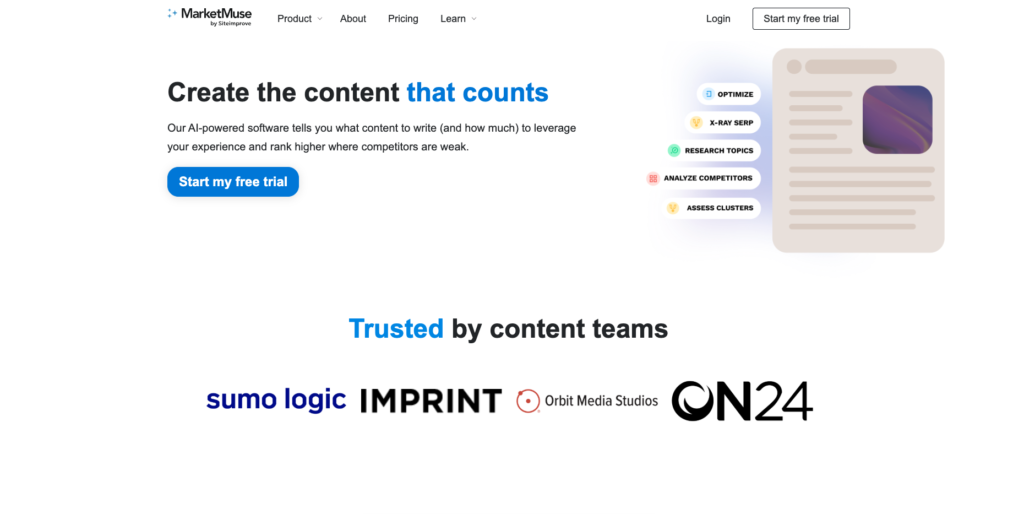
Price: Free tier available (10 queries/month); Optimize plan (self-serve, single user); Research and Strategy plans require a demo – contact MarketMuse for current pricing. Strategy tier supports up to 5 users and 10,000 tracked topics.
What it is: MarketMuse is an AI-driven content intelligence platform that autonomously audits your existing content inventory, identifies topical gaps, and generates prioritized content plans and detailed briefs – all calibrated against your specific domain’s authority, not generic industry benchmarks.
Key features:
- Automated content inventory – continuously scans and scores every published page by topic authority, content quality, and ranking performance without manual uploads
- Personalized Difficulty scoring – a patented metric that calculates how hard your specific domain will find it to rank for a given topic, as opposed to generic keyword difficulty scores
- Content Plan Documents – AI generates a structured cluster plan in minutes: what to create, what to update, estimated competitive effort, and keyword-level intent mapping
- 9 brief types – Article, Comparison, FAQ Collection, How-to, Listicle, Local, Guide, News/Event, and Product Review briefs, each pre-loaded with competitive benchmarks and subtopic models
- Content decay detection – flags pages losing rankings so teams can prioritize re-optimization before traffic drops compound
Best for: Content strategists and SEO managers at mid-market and enterprise companies who need to build topical authority across large content programs. Agencies managing multiple client sites also get strong mileage from the Strategy tier.
Pro Tip: MarketMuse’s Competitive Advantage score – the delta between generic topic difficulty and your Personalized Difficulty – is one of the fastest ways to find quick-win content gaps competitors haven’t fully covered yet.
Pros: Best-in-class topical authority modeling backed by a patented topic algorithm; eliminates weeks of manual SERP analysis; briefs are detailed enough to hand directly to writers with minimal editing.
Cons: Paid tiers require a sales conversation before you see pricing, which creates friction for smaller teams evaluating tools on a budget. The platform’s depth is also a double-edged sword – onboarding takes real investment, and teams without a dedicated content strategist often underuse it.
12. Drift AI (Salesloft) – Best AI Agent for Conversational Marketing and Pipeline Generation
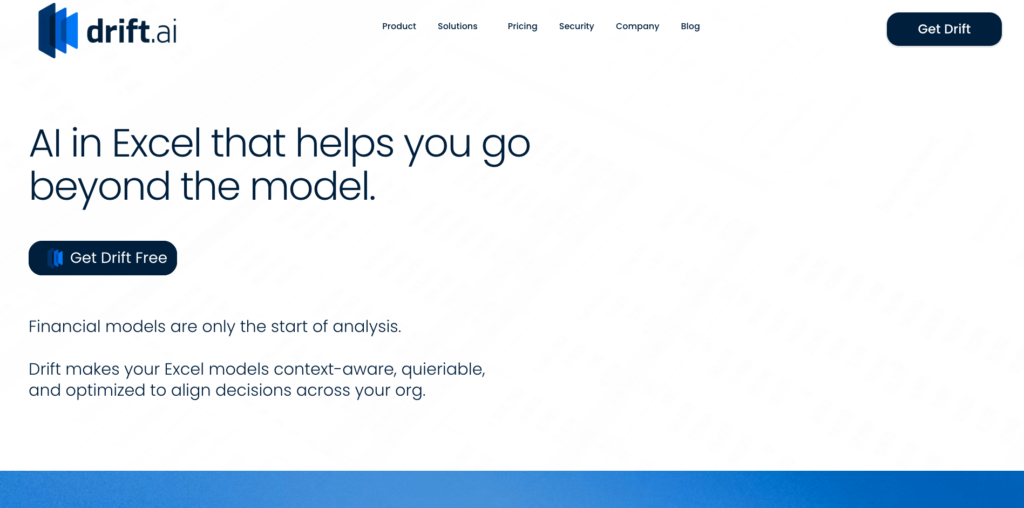
Price: Enterprise only; custom pricing bundled within the Salesloft Revenue Orchestration Platform (contact sales for a quote – no self-serve tier exists)
What it is: Drift is Salesloft’s AI chat agent for B2B websites. It deanonymizes visitors in real time using firmographic and behavioral data, qualifies them autonomously, and routes high-intent accounts directly into rep workflows – or books meetings on the spot, no human required.
Key features:
- Fastlane – identifies and instantly qualifies high-value buyers as they land, letting them skip web forms entirely and connect with a rep (or book a meeting) in seconds
- Real-time visitor deanonymization: surfaces company name, location, account history, and intent signals the moment a prospect hits your site
- Account-based routing that feeds qualified conversations directly into Salesloft Rhythm as prioritized seller actions, with full context attached
- AI-powered conversation flows that personalize messaging based on firmographic profile, prior account history, and live behavioral signals
- Pipeline and revenue attribution reporting – tracks which chat conversations generated meetings, opportunities, and closed revenue
Pros:
- Proven pipeline impact at enterprise scale; customers cite Drift as their “number one channel for high-intent leads” (Salesloft customer testimonials, drift.com)
- Deep native integration across the full Salesloft stack – Cadence, Deals, Forecast, Conversations – plus Salesforce
- AI agent operates 24/7, qualifying and booking without adding headcount
Cons:
- No transparent public pricing; requires a full sales process before you see numbers.
- Setup complexity is real – personalized conversation flows require clean CRM data and meaningful onboarding investment before the agent performs reliably.
Important: Drift is now inseparable from the broader Salesloft platform. Buying Drift means buying into Salesloft’s full revenue orchestration suite. Teams that just want a standalone conversational chatbot will likely find this overkill – and over-budget.
Best for: B2B companies with meaningful website traffic and an existing or planned Salesloft footprint, who want their site to actively generate pipeline around the clock without scaling the SDR headcount.
13. Emplifi AI Agent – Best for Social Media Analytics and Autonomous Reporting
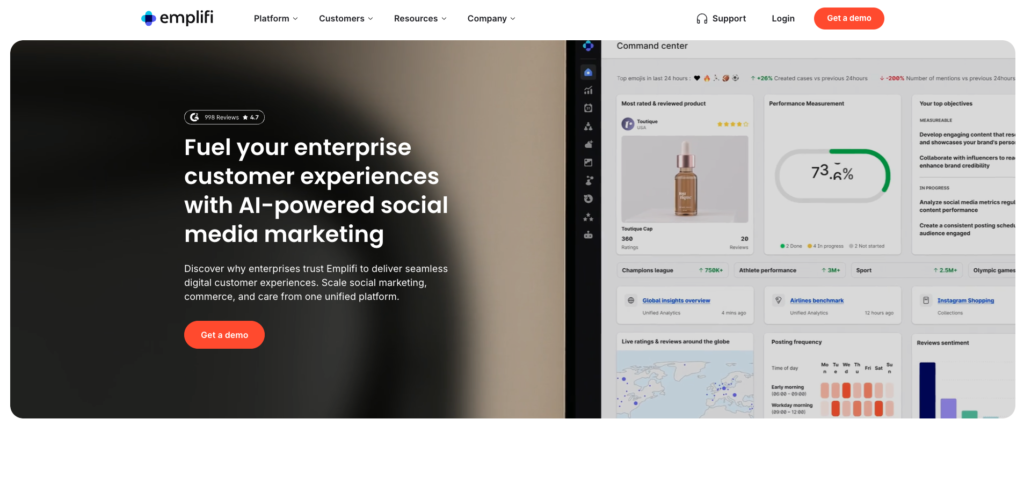
Price: Mid-market to enterprise; custom pricing only – no self-serve tiers published. Demo required for a quote.
What it is: Emplifi is a unified social customer experience platform used by more than 20,000 brands, with an AI agent layer built into its analytics suite that autonomously surfaces competitive insights, sentiment shifts, and performance narratives – without requiring a human analyst to run the numbers first.
Key features:
- Unified cross-platform analytics – consolidates paid, owned, and earned data from every major social network into a single modular dashboard, with Emplifi citing 5x faster reporting compared to manual methods
- AI narrative reports – the agent auto-generates written performance summaries, translating raw metrics into plain-language insights that are ready to share with stakeholders.
- Autonomous competitive benchmarking – continuously monitors rival brand performance and flags meaningful gaps or opportunities without manual setup per competitor.
- Social listening with sentiment analysis – Emplifi’s Listening module tracks brand mentions and audience sentiment in real time, with customers reporting a 30% improvement in engagement after acting on trend signals
- Influencer intelligence – built-in influencer discovery and performance tracking, making it one of the few analytics platforms that connects content intelligence to creator strategy in one view
Pros: Saves hours of weekly reporting; competitive intelligence runs in the background autonomously; recognized as a G2 Leader in Enterprise Social Media Suites and a 2025 MarTech Breakthrough Award winner.
Cons: This is a pure analytics and intelligence platform – it does not write, schedule, or publish content. Teams expecting a content creation layer will need a separate tool.
Important: Emplifi’s pricing is entirely custom and gated behind a sales demo. Budget at least mid-four figures monthly for an enterprise contract – this is not a tool for solo marketers or small teams.
Best for: Social media managers, brand strategists, and agency teams at mid-to-large organizations who need fast, AI-generated performance reporting and always-on competitive intelligence – and want to stop spending half their week building decks in spreadsheets.
14. MindStudio – Best No-Code Platform for Building Custom Marketing AI Agents
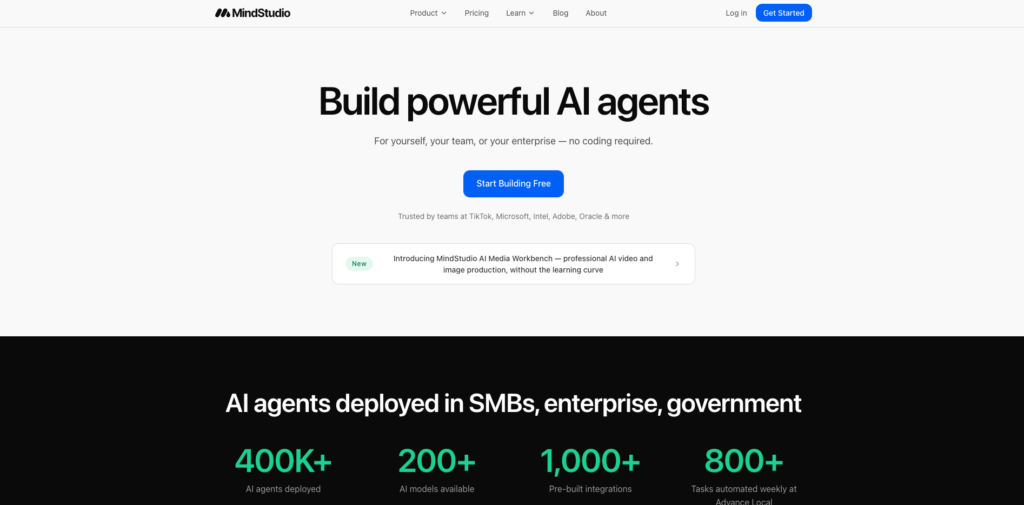
Price: Free tier available (1,000 runs/month, 1 agent, $0 + usage); Individual plan at $16/month (billed annually, unlimited agents + runs); Business plan is custom pricing (contact sales for team deployments with SSO, audit logs, and unlimited collaborators)
What it is: MindStudio is a visual, no-code agent builder that lets marketing teams design, deploy, and share purpose-built AI agents – without writing a single line of code. With 400,000+ agents already deployed across organizations, including TikTok, Microsoft, and Adobe, it’s the closest thing to a marketing ops team’s in-house AI development studio.
Key features:
- Drag-and-drop visual builder – the average agent takes 15 minutes to 1 hour to build from scratch
- Access to 200+ AI models via MindStudio’s Service Router (no individual API keys required)
- 100+ pre-built templates covering competitor research, campaign brief generation, content repurposing, and more
- 1,000+ pre-built integrations for connecting agents to existing marketing stacks
- Team deployment with granular collaborator permissions and usage controls on Business plans
Best for: Growth teams, marketing ops managers, and agencies that want proprietary AI agents tailored to their exact workflows – competitor analysis, campaign briefs, content repurposing pipelines – without waiting on engineering resources or paying per-seat enterprise software fees.
Pro Tip: MindStudio’s free tier is genuinely functional for solo marketers testing one agent. Upgrade to Individual ($16/month) the moment you need more than one agent running – the cost-per-automation economics beat most dedicated point solutions at scale.
Pros:
- Maximum workflow customization with zero engineering dependency
- Fastest time-to-deploy of any agent builder on this list
- Model-agnostic – swap GPT-4o, Claude, Gemini, or custom models under the hood
Cons: Building effective agents still requires upfront workflow-design thinking. Teams that haven’t mapped their marketing processes clearly first will build mediocre agents – the platform amplifies good process design, not bad process design.
How to Choose the Right AI Marketing Agent for Your Team
Two questions cut through every vendor demo and feature comparison: What task consumes the most team hours? And what metric is most underperforming? Your answers map directly to the agent category you should buy first.
Start With Your Biggest Marketing Bottleneck
Most teams spread themselves thin trying to fix everything at once. Don’t. Pick the single biggest drag on output or performance and start there.
- Content production bottleneck → Start with a Content Generation Agent (Jasper AI, Copy.ai Go). If your team spends more than 30% of its week writing first drafts, that’s recoverable time.
- Paid media efficiency bottleneck → Start with an Ad Optimization Agent (Albert AI, Smartly.io). If ROAS is underperforming benchmarks by 20%+ and you’re managing spend manually, autonomous bidding and creative rotation will move the needle faster than any other change.
- SEO growth bottleneck → Start with an SEO Research Agent (Surfer SEO, MarketMuse). Flat or declining organic traffic with a content backlog is the exact problem these agents were built to solve.
- Lead nurturing gap → Start with a CRM-native or conversational agent (HubSpot AI, Drift AI). If leads are entering your funnel and going cold, the problem is timing and personalization – not volume.
Pro Tip: Run this self-diagnostic before any vendor call: write down your single most time-consuming marketing task and the one KPI your team missed last quarter. If they point to the same category above, that’s your starting agent.
Building Toward a Multi-Agent Marketing Stack
Single agents produce results. Orchestrated agents produce compounding results. A real-world example: a Content Agent generates optimized drafts → an SEO Agent scores and refines them for topical authority → a Distribution Agent schedules and publishes across channels. Each handoff is automated; human review happens at defined checkpoints, not every step.
The emerging standard making this interoperability practical is MCP (Model Context Protocol), an open protocol that lets agents share context and pass structured outputs between systems without custom glue code for every connection.
Before adding a second agent, map your data flows first. Identify what data each agent needs as input, what it produces as output, and where those outputs need to land (CRM, CMS, ad platform). Teams that skip this step create disconnected automations, not a stack.
Important: Data privacy and integration requirements are the two most commonly overlooked practical considerations. Confirm that any agent you evaluate can connect to your existing CRM, ad platform, or CMS via native integration or API – and verify how it handles first-party customer data before signing a contract.
Are AI agents worth it for small marketing teams? Yes – particularly no-code platforms like MindStudio (free tier available) and Relevance AI ($0 entry plan). A solo marketer or two-person team can deploy a functional content or outreach agent in under a day without an engineering resource.
The proven playbook: start with one agent, prove ROI within 30 days, then expand. One justified win builds the internal case for the next tool faster than any business plan.
Frequently Asked Questions
What is an AI marketing agent, and how is it different from a regular AI tool?
An AI marketing agent goes beyond generating a single output – it can autonomously plan, execute, and iterate on multi-step marketing tasks with minimal human input. Unlike a standard AI tool that responds to one prompt at a time, a marketing agent can monitor campaign performance, make adjustments, and trigger follow-up actions on its own.
Which AI marketing agent is best for small businesses or startups with limited budgets?
Copy.ai Go and Taplio offer strong entry-level pricing and are well-suited for lean teams that need autonomous content and GTM support without enterprise-level costs. MindStudio is also worth considering if you want to build a custom agent tailored to your workflows rather than paying for features you won’t use.
Can AI marketing agents fully replace human marketers in 2026?
No – the strongest results in 2026 still come from teams that use AI agents to handle repetitive, data-driven tasks while humans focus on strategy, creative direction, and brand judgment. Tools like Albert AI and Smartly.io can run paid media autonomously, but they perform best when a marketer sets guardrails and reviews performance regularly.
How do AI agents handle data privacy and compliance for marketing campaigns?
Most enterprise-grade platforms covered in this article, including HubSpot AI Agent and Persado, are built with GDPR and CCPA compliance frameworks baked in, though specific data handling policies vary by vendor. Before deploying any agent that processes customer data, teams should review the platform’s data processing agreements and confirm compatibility with their own compliance requirements.
What’s the difference between a multi-agent marketing workflow and a single AI marketing agent?
A single agent handles one defined task – like optimizing email send times or generating ad copy – while a multi-agent workflow chains several specialized agents together to complete a broader marketing objective end to end. Relevance AI and MindStudio are the strongest options in this article if orchestrating multiple agents across a campaign pipeline is a core requirement.
Do AI marketing agents integrate with existing martech stacks like Salesforce or Google Ads?
Most tools ranked in this article offer native or API-based integrations with major platforms – HubSpot AI Agent connects directly to its CRM, Albert AI integrates with Google and Meta Ads, and Drift AI works within the Salesloft sales ecosystem. Integration depth varies significantly, so confirming compatibility with your specific stack before committing to a platform is strongly recommended.
How long does it take to see measurable results from an AI marketing agent?
For performance-driven agents like Seventh Sense or Surfer SEO, teams typically report measurable improvements within four to eight weeks as the system accumulates enough behavioral data to optimize effectively. Content and copy tools like Jasper or Persado can show faster output gains almost immediately, though meaningful business impact from content usually takes longer to materialize in organic channels.
Conclusion
The best AI agents for marketing in 2026 aren’t defined by feature lists – they’re defined by how quickly they eliminate your team’s biggest bottleneck. Whether that’s content velocity, paid media efficiency, SEO authority, or pipeline conversion, there’s a purpose-built agent in this list that outperforms a generalist tool every time.
The single most important takeaway: resist the urge to adopt multiple agents at once. Pick the one category where slow execution is costing you the most right now – content, SEO, or paid ads – and run a focused 30-day pilot with two or three hard KPIs attached to it.
Once that first agent is delivering measurable ROI, layer in a complementary tool and start connecting them into a coordinated workflow. Multi-agent orchestration – where your content, SEO, CRM, and analytics agents share data and trigger each other autonomously – is quickly becoming the defining marketing infrastructure advantage of 2026.
Your next step: Shortlist three tools from this guide that match your primary growth bottleneck, sign up for their free trials this week, and define your success metrics before you log in for the first time. That discipline is what separates teams that get real results from the best AI agents for marketing in 2026 from those still experimenting six months from now.