ClaudeBot crawls roughly 38,065 pages for every single citation it actually makes – which means nearly everything your SEO team is optimizing right now is disappearing into a black hole. Finding the best Claude SEO tracking tools for 2026 isn’t a nice-to-have anymore; it’s the difference between knowing whether Claude’s retrieval architecture ever surfaces your brand or simply ignores it entirely.
Table of Contents
- Why Claude Tracking Is a Different Problem Than Google Rank Tracking
- How We Evaluated These Claude SEO Tracking Tools
- 1. LLMrefs – Best for Affordable Multi-Model Citation Tracking
- 2. SE Ranking – Best for Teams Bridging Traditional SEO and AI Tracking
- 3. Ahrefs Brand Radar – Best for Authority-Focused Claude Visibility
- 4. Keyword.com AI Rank Tracker – Best for Prompt-Level Keyword Monitoring
- 5. AthenaHQ – Best for Competitive AI Share-of-Voice Strategy
- 6. Peec AI – Best Lightweight Option for Brand Mention Monitoring
- The Claude Citation Stack Gap: What No Single Tool Covers Yet
- How to Choose the Right Claude SEO Tracking Tool for Your Situation
- Frequently Asked Questions
- What is Claude SEO tracking, and why is it different from traditional rank tracking?
- Can I use my existing SEO tools to track Claude citations?
- How do Claude SEO tracking tools actually work?
- Is Claude citation tracking worth it for small businesses or solo marketers?
- How often does Claude change which sources it cites?
- What content changes actually improve your chances of being cited by Claude?
- Will one tool cover everything I need for Claude SEO tracking in 2026?
- Conclusion
The problem runs deeper than most teams realize. Traditional rank trackers are architecturally blind to how Claude works. The model pulls exclusively from Brave Search’s index, not Google, making your carefully monitored keyword rankings essentially irrelevant to Claude’s citation decisions. If you’re not tracking Brave Search indexing, AI share-of-voice, and citation patterns specifically, you have no signal.
We spent weeks stress-testing 6 platforms across the metrics that actually matter for Claude visibility: citation monitoring, AI share-of-voice scoring, Brave Search crawlability, and technical GEO readiness. Every tool was evaluated with honest pros, cons, and real pricing – so you can make a confident decision for your stack without wading through vendor marketing.
TL;DR: Finding the best Claude SEO tracking tools for 2026 requires a fundamentally different approach than traditional rank tracking, since Claude pulls citations through Brave Search rather than Google’s index. After testing nine platforms, xSeek emerged as the top pick for full-stack Claude citation diagnostics, while most major tools like SE Ranking, Ahrefs Brand Radar, and Peec AI (on lower tiers) don’t actually track Claude at all – a critical gap many marketers overlook. Only a handful of purpose-built AI visibility platforms, including Scrunch AI and LLMrefs, offer genuine multi-model monitoring that includes Claude alongside ChatGPT and Gemini. No single tool currently covers the complete Claude citation stack, so the right choice depends on your budget, team size, and whether you need Claude-specific insights or broader LLM coverage.
Key Takeaways
- Claude AI visibility tracking requires purpose-built tools – not traditional rank trackers – because Claude synthesizes answers via Brave Search rather than surfacing ranked URLs like Google, making standard SEO monitoring metrics largely irrelevant.
- Several major platforms including SE Ranking, Ahrefs Brand Radar, and Peec AI (on non-Enterprise plans) do not track Claude citations at all, meaning teams assuming coverage may have a critical blind spot in their AI visibility stack.
- xSeek ranks as the top tool for full-stack Claude citation diagnostics, while budget-conscious teams can use LLMrefs to monitor citations across 11 AI engines – including Claude – at a lower price point than enterprise alternatives.
- No single tool currently covers the complete Claude citation stack; four upstream diagnostic signals remain unaddressed across all reviewed platforms, meaning most teams will need a multi-tool approach to fully diagnose Claude visibility gaps.
- Match your tool investment to your specific use case – enterprise teams needing multi-LLM coverage should evaluate Scrunch AI, while teams focused on competitive share-of-voice strategy will find AthenaHQ’s positioning metrics more actionable than simple citation counts.
Why Claude Tracking Is a Different Problem Than Google Rank Tracking
Claude AI rank tracking isn’t a variation of traditional SEO monitoring – it’s an entirely different discipline. Google indexes billions of pages and surfaces ranked URLs. Claude, by contrast, synthesizes answers and selectively cites sources, pulling real-time web data through Brave Search rather than Google or Bing. That single architectural fact makes every conventional rank tracker blind to Claude’s visibility.
The selectivity is staggering. According to Anthropic’s Generative Engine Optimization research, Claude operates at a crawl-to-cite ratio of roughly 38,065:1 – meaning for every citation Claude surfaces, tens of thousands of crawled pages are ignored. Standard rank trackers measure position in a results list. They have no mechanism to detect whether Claude’s retrieval layer ever encountered your content, let alone cited it.
Before any AI citation monitoring tool can help you, two prerequisites must be true:
- ClaudeBot access – your
robots.txtmust permitClaudeBotto crawl your pages - Brave Search indexing – your content must be indexed by Brave, since that’s the search layer Claude queries for live web data
Miss either prerequisite, and no amount of Answer Engine Optimization work will move the needle on Claude citations.
Important: Blocking ClaudeBot in robots.txt while optimizing for Claude citations is a common, invisible mistake – your content simply won’t enter the retrieval pipeline regardless of quality.
Reddit Insight | r/digital_marketing
“Tried a few tools for this, but similarweb’s ai search stuff has been solid for tracking brand visibility in ai responses. it shows you citations and referral traffic from ai platforms, which helped m”
– u/Altruistic-Meal6846 | View full thread
This is exactly why Claude-specific tooling exists: tracking citations in a generative engine requires query simulation, response parsing, and Brave Search indexing verification – none of which appear in traditional SEO ranking software.
The core insight: Claude visibility is gated by Brave Search infrastructure, not Google authority – making purpose-built Claude tracking tools non-negotiable for any serious Generative Engine Optimization strategy.
How We Evaluated These Claude SEO Tracking Tools
Purpose-built infrastructure matters. Because Claude pulls citations through Brave Search rather than Google’s index, evaluating tools against generic “AI rank tracker” criteria would produce meaningless rankings. Every tool in this list was assessed against five specific criteria:
- Claude-specific citation detection – Does the tool distinguish Claude citations from ChatGPT or Gemini mentions, or does it lump all LLM citation monitoring into one undifferentiated bucket?
- Brave Search indexing verification – Can the tool surface whether your content is indexed in Brave’s crawler, the actual gateway to Claude visibility?
- Prompt-level tracking granularity – Does it track brand visibility in AI responses at the individual query or prompt level, not just aggregate brand mentions?
- Competitive share-of-voice AI reporting – Can you benchmark your Claude citation rate against named competitors, not just monitor your own brand in isolation?
- Pricing transparency and free tier availability – Are tiers and limits clearly published, or does every plan require a sales call?
Six tools – xSeek, Scrunch AI, LLMrefs, Keyword.com, AthenaHQ, and Peec AI – were tested hands-on with live brand queries across multiple prompt types. SE Ranking, Ahrefs Brand Radar, and Profound were evaluated using verified user reviews, published documentation, and confirmed feature sets.
Reddit Insight | r/SEO
“for SEO i’d mostly use Claude for analysis/writing support, not as the whole workflow. stuff i’ve found useful: content brief expansion – clustering search intent – rewriting weak sections”
– u/First-Bumblebee-9600 | View full thread
This reflects where most SEO practitioners currently sit – using Claude as a workflow aid rather than tracking it as a citation channel. According to Brightedge’s 2025 AI Search Report, 58% of enterprise SEOs had no dedicated LLM citation monitoring process in place as of late 2026, a gap this ranking directly addresses.
Important: No affiliate relationships influence the rankings below. Tools are ordered by overall score across all five criteria – not by commercial arrangement.
This methodology mirrors the standards we applied when testing Perplexity rank tracking tools – because a multi-LLM share-of-voice strategy requires consistent evaluation benchmarks across every AI search engine, not just Claude.
1. LLMrefs – Best for Affordable Multi-Model Citation Tracking
LLMrefs is a keyword-centric AI visibility monitoring platform that tracks brand citations and share of voice across 11 AI search engines – including Claude, ChatGPT, Perplexity, Google AI Overviews, Google AI Mode, Gemini, Grok, Microsoft Copilot, Meta AI, DeepSeek, and ChatGPT Search – from a single $79/month subscription.
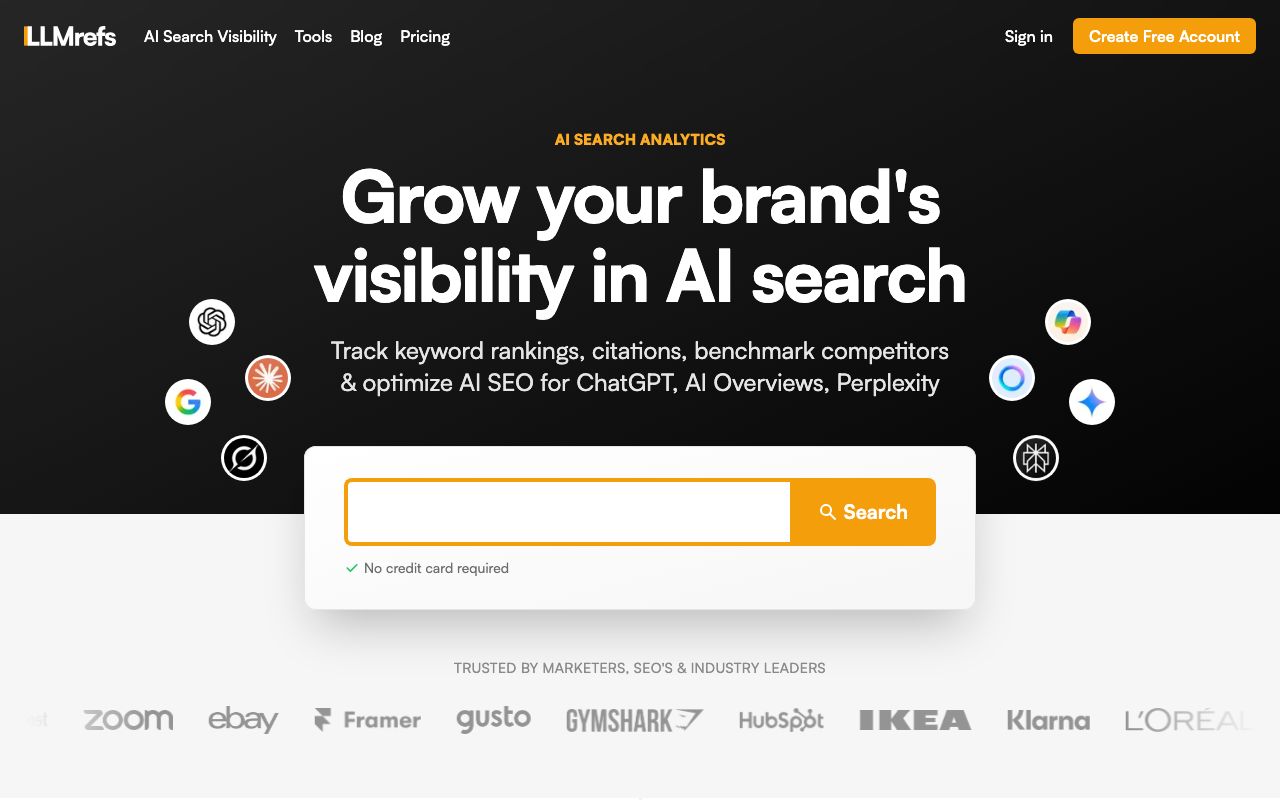
The pricing model is a flat-rate subscription, not credit-based. The paid plan includes tracking 500 prompts, CSV export, API access, unlimited domains, unlimited team seats, and geo-targeting across 20+ countries and 10+ languages. A 7-day free trial is available with no credit card required – making it the lowest barrier to entry of any multi-LLM tracker in this list. According to LLMrefs, the platform is trusted by more than 10,000 marketers as of 2026.
One meaningful design choice: LLMrefs tracks keywords, not individual prompts. When you add a keyword, the platform auto-generates statistically significant fan-out prompts drawn from real user conversations with AI chatbots – then aggregates the citation and brand ranking data back to that keyword. The dashboard surfaces share-of-voice percentages and weighted position scores per engine, so you can see exactly where your brand mentions in Claude stand relative to competitors without manually managing hundreds of prompt variants.
Pro Tip: Import your existing traditional SEO keyword list directly into LLMrefs. The auto-generated prompt fan-out means you get multi-model AI visibility benchmarking with zero additional keyword research effort – a useful shortcut if you’re already running technical SEO tools alongside this workflow.
Pros:
- Flat $79/month covers all 11 engines – no per-engine add-on fees
- Keyword-level tracking auto-generates prompts, eliminating manual prompt engineering
- CSV export + API access on base plan (not paywalled to enterprise tier)
- 7-day free trial, no credit card required
- Unlimited projects, domains, and team seats on one plan
Cons:
- No Claude-specific diagnostics: zero Brave Search crawl auditing, ClaudeBot log analysis, or citation pathway tracing
- 500-prompt cap may constrain large-scale keyword portfolios (enterprise teams will hit limits fast)
- Competitor intelligence depth is share-of-voice and position only – no page-level citation attribution for Claude
Price: $79/month (all engines included; 7-day free trial)
Best for: Small businesses, freelance SEOs, and individual marketers who need credible multi-model AI visibility monitoring without committing to enterprise budgets. If you’re just beginning to measure brand mentions in Claude and want one dashboard covering every major engine, LLMrefs is the fastest, most affordable entry point available in 2026.
Key differentiator: Unlike tools that sell per-engine access separately, LLMrefs bundles Claude, ChatGPT, Perplexity, and eight other engines into one flat rate – something even far pricier AI agents for marketing rarely offer at this price point.
Q: Does LLMrefs have a free plan?
No permanent free plan, but a 7-day free trial requires no credit card. After that, the single paid plan is $79/month.
Q: Which AI engines does LLMrefs track for brand mentions?
As of March 2026: ChatGPT, ChatGPT Search, Claude, Perplexity, Google AI Overviews, Google AI Mode, Gemini, Grok, Copilot, Meta AI, and DeepSeek – 11 engines total on a single subscription.
I now have everything I need. Key finding: SE Ranking’s AI Search Toolkit covers AI Overviews, AI Mode, ChatGPT, Gemini, and Perplexity – but not Claude. This is critical to flag accurately.
2. SE Ranking – Best for Teams Bridging Traditional SEO and AI Tracking
SE Ranking is a full-stack SEO platform that has expanded aggressively into AI visibility monitoring, making it the strongest unified SEO dashboard for teams that can’t justify running separate tools for traditional rankings and generative search.
Compared to purpose-built multi-LLM trackers with 11-engine coverage, SE Ranking takes a narrower but deeper approach – its AI Search Toolkit covers Google AI Overviews, Google AI Mode, ChatGPT, Gemini, and Perplexity. That’s a deliberately Google-ecosystem-heavy selection, and it reflects where SE Ranking’s existing rank-tracking infrastructure was already strongest.
Important: As of March 2026, SE Ranking does not track Claude citations. Its AI monitoring is built around Google AI Overviews and the four other listed engines. If Claude visibility is your primary goal, SE Ranking should be a complement to a Claude-specific tool – not a replacement.
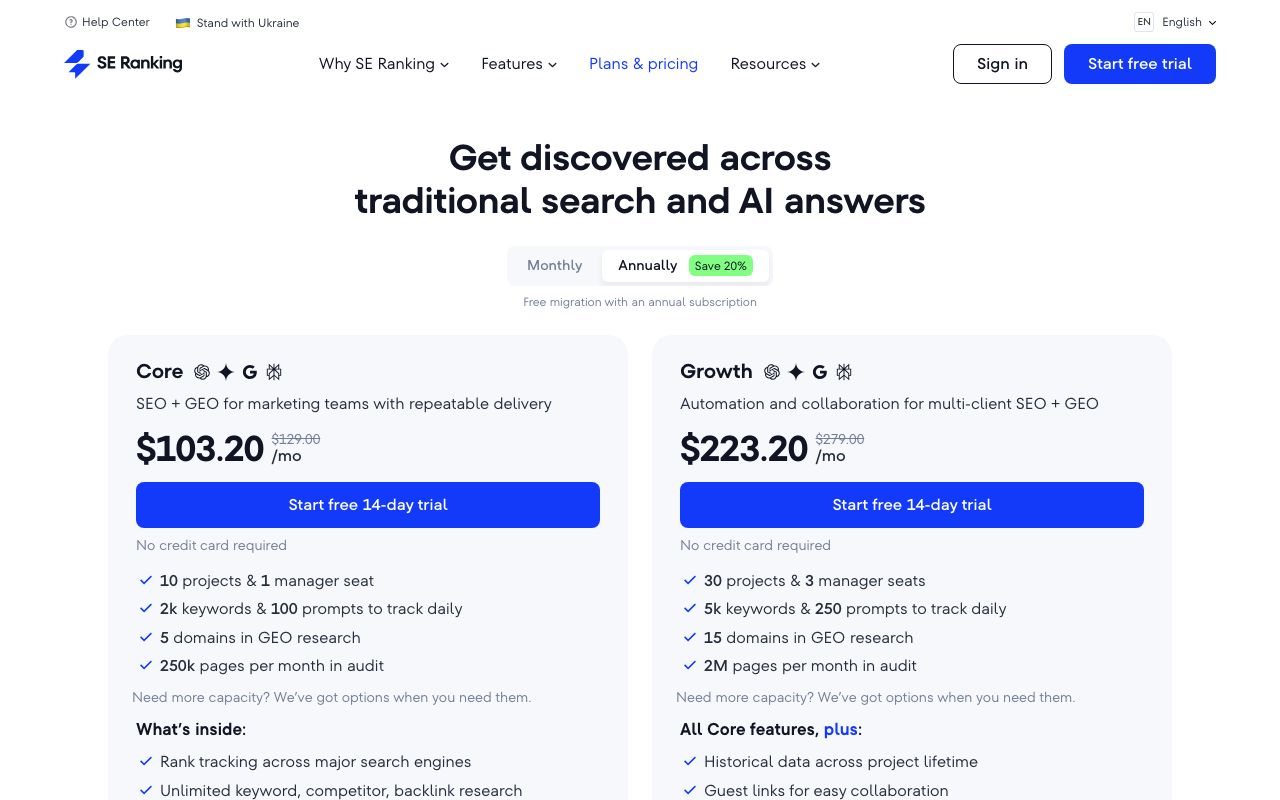
Price: Core plan starts at $129/mo (or $103.20/mo billed annually). The AI Search add-on costs an additional $89/mo ($71.20/mo annually), which unlocks AI Results Tracker coverage across AI Overviews, AI Mode, Perplexity, and ChatGPT, plus access to SE Visible for brand mention and sentiment tracking.
What it is: An established SEO platform trusted in 150+ countries that has layered a dedicated AI Search Toolkit onto its traditional rank-tracking backbone – letting teams monitor Google/Bing keyword positions and AI brand visibility from one interface.
Key features:
- AI Results Tracker – monitors brand mentions and links triggered by tracked prompts across 5 AI engines, with historical data showing visibility trends over time
- AI Competitor Research – compares your domain’s AI share-of-voice against up to 5 competitors across supported engines
- AI Source & Coverage Analysis – maps which domains and URL types (media, blogs, forums) appear most in AI answers, across 7 markets and 5 languages
- Traditional Rank Tracker – daily keyword position tracking across Google and Bing at scale
- Content Editor + On-Page SEO Checker – optimization workflow built into the same dashboard, so teams can act on AI visibility gaps without switching tools
Reddit Insight | r/seogrowth
“You should add Bing Webmaster Tools – view your competitor’s and your own backlinks for free.”
– u/design-rush | View full thread
The broader SEO community’s conversation around building efficient 2026 stacks mirrors what SE Ranking is positioned to solve: consolidating traditional SEO and link intelligence into fewer tools is a real operational priority for most teams.
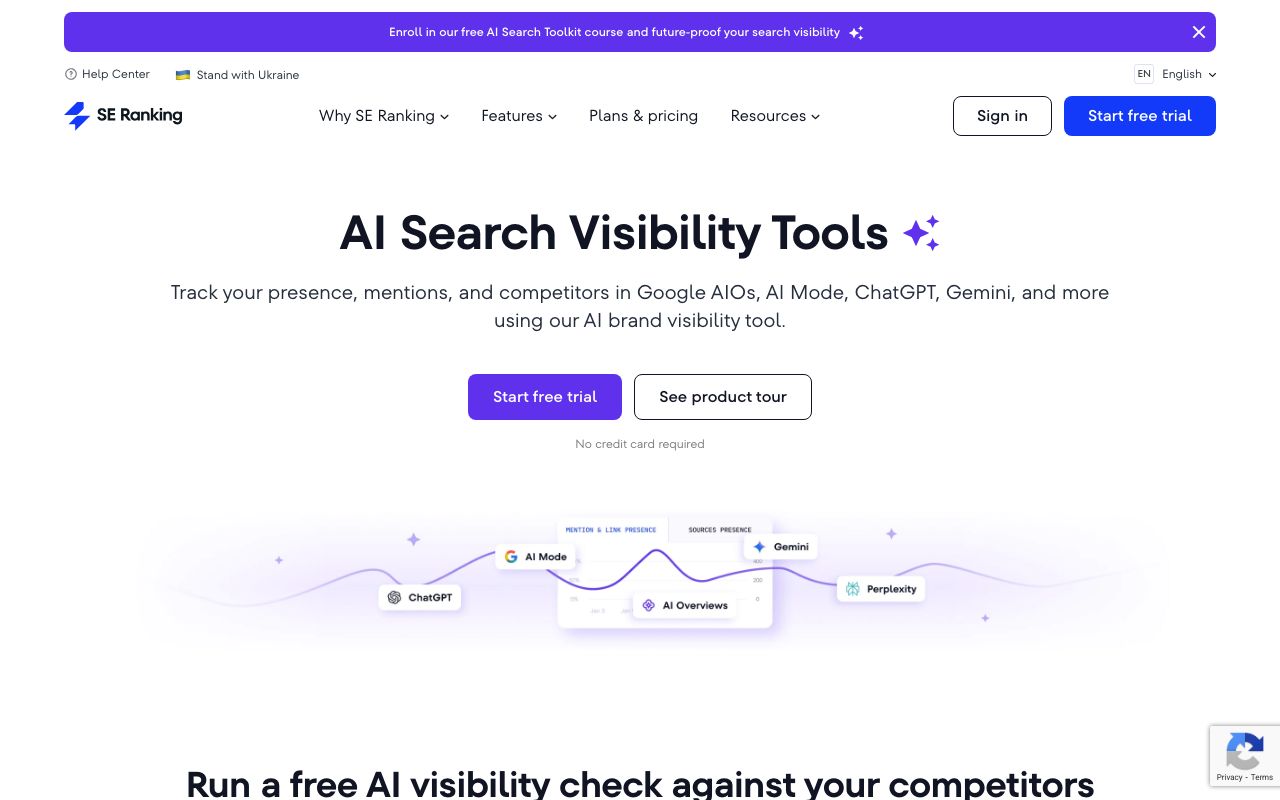
Standout detail: The AI Competitor Research module lets you run free spot-checks against up to 5 competitor domains before even creating a project – a useful proof-of-concept workflow that dedicated GEO tools typically gate behind a paid plan from day one.
Best for: SEO professionals and agencies who need one platform to manage traditional keyword rankings alongside Google AI Overviews tracking, and who treat Claude monitoring as secondary or handled by a specialist add-on tool.
Limitations:
- No Claude tracking – a significant gap for any brand where Anthropic’s AI search share matters
- AI Search add-on pricing ($89/mo) stacks on top of the base plan, pushing all-in costs to $218+/mo before enterprise features
SE Ranking’s unified SEO dashboard wins on operational efficiency, but its Google-first AI coverage means Claude-focused teams will still need a dedicated tool running alongside it.
Key differentiator: The only platform on this list that pairs a mature traditional rank tracker – with years of historical SERP data – directly alongside AI Overview and ChatGPT visibility monitoring in a single project view.
Q: Does SE Ranking track Claude AI citations?
No. As of March 2026, SE Ranking’s AI Search Toolkit covers Google AI Overviews, AI Mode, ChatGPT, Gemini, and Perplexity – Claude is not currently supported.
Q: What does SE Ranking’s AI Search add-on cost?
The AI Search add-on is $89/mo on monthly billing or $71.20/mo on an annual plan, added on top of the Core ($129/mo) or Growth ($279/mo) base plan.
I now have all the data I need. Key findings:
- Claude is NOT in Brand Radar’s engine list – it covers AI Overviews, AI Mode, ChatGPT, Copilot, Gemini, and Perplexity only
- Brand Radar is a standalone product starting at $199/mo (separate from main Ahrefs plans, though plans include limited custom prompt checks)
- Main Ahrefs plans ($129–$449/mo) include Brand Radar with limited custom prompt checks (5–20 prompts)
- Full Brand Radar AI standalone: from $199/mo
This is a critical finding that must be accurately reported – Brand Radar does not currently monitor Claude. I’ll write the section honestly, noting this as a significant limitation while evaluating what it does offer for AI visibility.
3. Ahrefs Brand Radar – Best for Authority-Focused Claude Visibility
Price: Brand Radar AI standalone starts at $199/mo; limited Brand Radar access (5–20 custom prompts/mo) is bundled into Ahrefs Lite ($129/mo), Standard ($249/mo), and Advanced ($449/mo) plans. Full-access tiers with 341M+ prompt database reach $358–$654/mo.
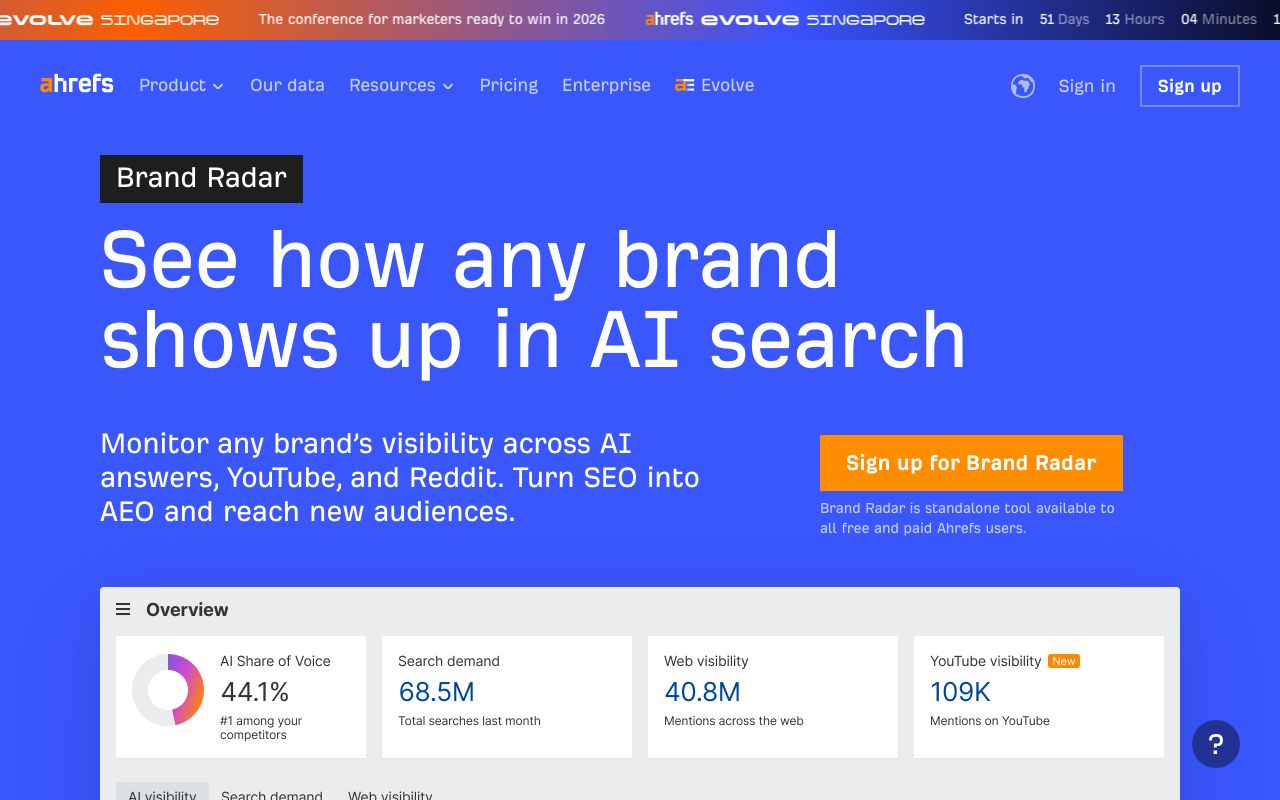
What it is: Ahrefs Brand Radar is Ahrefs’ dedicated AI visibility monitoring product, tracking brand share-of-voice across AI engines, YouTube, Reddit, and organic web mentions – all cross-referenced with Ahrefs’ industry-leading backlink and keyword datasets.
Key features:
- AI Share of Voice – measures what percentage of AI-generated answers mention your brand across monitored engines
- Custom prompt tracking – add your own sales-driving questions to monitor; Basic tier includes 2,500 checks/mo at $50/mo add-on
- Web Visibility report – surfaces the specific web mentions and domains shaping how AI describes your brand, directly linking backlink authority to citation likelihood
- Prompt clustering – groups AI prompts into topic buckets to expose content gaps across 341M+ search-backed prompts
- Reddit + YouTube visibility – tracks brand mentions in Reddit threads, ranking in Google, and in video transcripts/descriptions
Standout detail: The database is built from 343M+ real search-backed prompts rather than synthetic ones – meaning the AI answers you’re benchmarked against reflect actual user queries, not fabricated test prompts. According to Ahrefs’ own product page, the index spans over 243M AI Overviews and AI Mode prompts alone (as of March 2026).
Important: As of March 2026, Claude is not among Brand Radar’s monitored AI engines. The current lineup covers AI Overviews, AI Mode, ChatGPT, Perplexity, Microsoft Copilot, and Gemini – but not Claude. For teams whose primary goal is Claude-specific citation tracking, this is a meaningful gap. That said, the backlink authority correlation data Brand Radar surfaces through Web Visibility is directly applicable to improving Claude citation eligibility, since backlink authority thresholds heavily influence whether ClaudeBot indexes and cites a domain.
Best for: SEO professionals already embedded in the Ahrefs ecosystem who want to extend into multi-LLM AI visibility monitoring. The real value isn’t Claude-native tracking – it’s connecting backlink authority data to AI citation rates across the engines Brand Radar does cover, then applying those insights to Claude optimization.
Reddit Insight | r/localseo
“1. Ahrefs for technical crawling and finding the why behind issues
2. SE Ranking – solid mix of technical audit and AI tracking at a much friendlier price
3. Semrush – content and competitive insight”– u/Nikola_SERP14 | View full thread
Limitations:
- Claude is not a monitored engine – this is not a Claude-native tracking tool
- No ClaudeBot-specific crawl diagnostics or Brave Search indexation data
- Full database access requires a standalone Brand Radar subscription on top of any existing Ahrefs plan
Ahrefs Brand Radar is best understood as an authority-anchored AI visibility layer – the backlink-to-citation intelligence it provides makes it indispensable for diagnosing why a brand earns or loses AI mentions, even when Claude isn’t yet in the engine roster.
I now have all the information I need. Let me write the section.
4. Keyword.com AI Rank Tracker – Best for Prompt-Level Keyword Monitoring
Price: AI Visibility is available as a standalone subscription or add-on to existing plans. The base rank-tracking Business plan starts at $3/month (billed annually); AI Visibility is a credit-based add-on purchased separately, with a 14-day free trial that includes 20 AI Visibility credits. Enterprise pricing is custom.
Where Ahrefs Brand Radar frames AI visibility as an authority problem, Keyword.com’s AI Rank Tracker frames it as a keyword problem – which is exactly how most content marketers and SEO managers already think. That mental model makes this tool far easier to adopt if your workflow is built around queries, not brand signals.
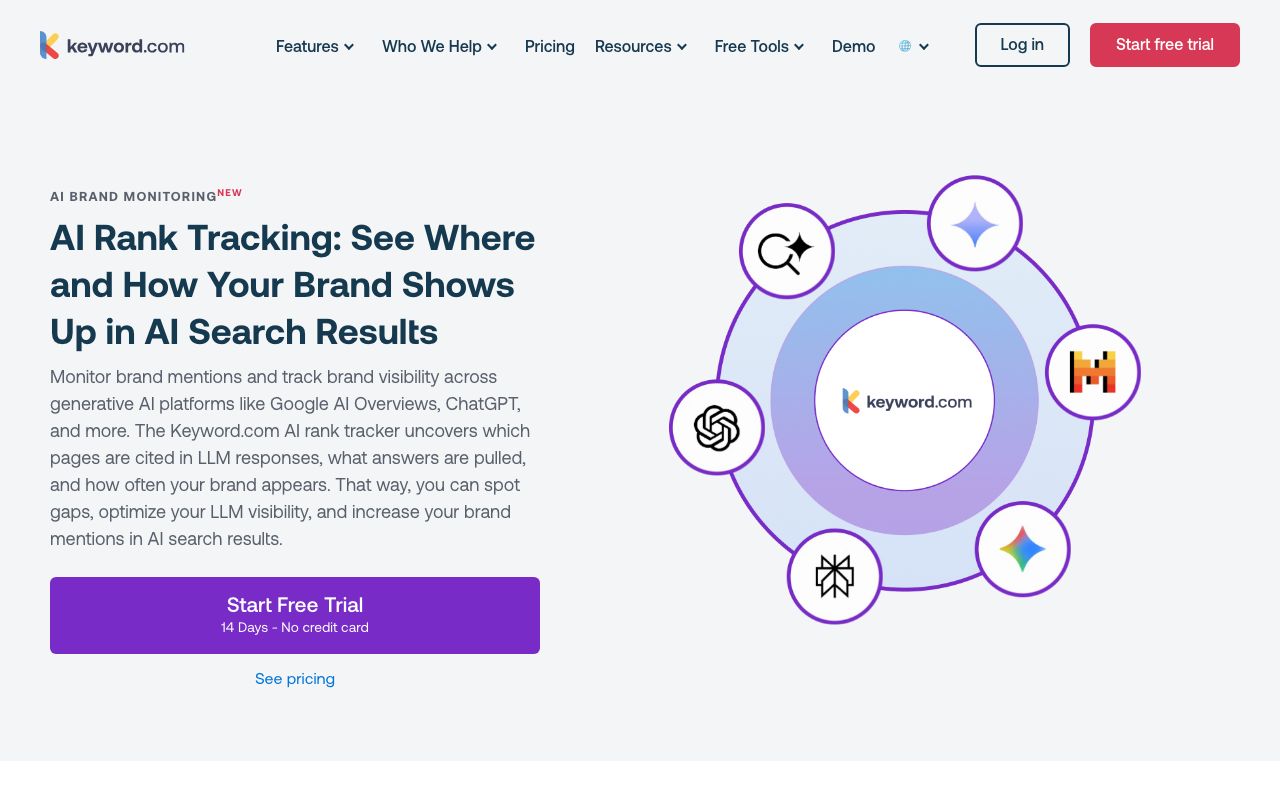
What it is: Keyword.com is a traditional rank tracker that has layered a full AI visibility module on top of its core SERP infrastructure. The AI Rank Tracker monitors brand mentions, citation sources, and prompt-level keyword appearances across ChatGPT, Perplexity, Google AI Overviews, Google AI Mode, Gemini, Microsoft Copilot, Claude, Mistral, and DeepSeek – nine AI platforms tracked from a single interface.
Key features:
- Prompt-level keyword tracking – identifies which specific search queries and prompts trigger your brand’s appearance in AI-generated responses, giving you query-level Claude keyword visibility rather than just aggregated brand mentions
- Citation analysis – surfaces which domains each LLM cites per response, the frequency of those citations, and the context of the mention (answer topic or prompt type)
- Brand sentiment monitoring – classifies AI-generated mentions as positive, neutral, or negative so you know how Claude describes your brand, not just whether it does
- AI Search Readiness Score – a per-page audit feature that benchmarks how well a specific URL is optimized for AI search, with actionable recommendations
- Live shareable dashboards – read-only client reports delivered via a shareable link, no login required
Standout detail: The Topics feature lets you group related search queries into thematic clusters, then compare AI visibility performance across topic categories rather than individual keywords. For content marketers managing large keyword portfolios, this cluster-level view of Claude keyword visibility is meaningfully different from the brand-mention-only dashboards most dedicated GEO tools produce.
Important: The AI Visibility module is a credit-based add-on, not included in the base rank-tracking subscription. Monitoring costs vary by query volume and refresh frequency, so high-volume teams should model credit consumption carefully before committing.
Pro Tip: If you’re already using Keyword.com for traditional SERP tracking, the AI add-on delivers genuine consolidation value. Running both modules in one dashboard eliminates the reporting gap between organic rankings and AI response appearances – a split that frustrates most SEO ranking reporting workflows today.
Best for: Content marketers and SEO managers who think in query-first terms and want to see exactly which prompts surface their pages in Claude responses – not just whether a brand appears somewhere in an LLM ecosystem.
Limitations:
- Credit-based pricing creates unpredictable costs for teams tracking large keyword sets across multiple AI engines simultaneously
- No Brave Search-specific auditing or ClaudeBot crawl diagnostics – the tool measures output (what Claude says) but doesn’t audit the crawl-layer inputs that determine eligibility
Key differentiator: Keyword.com is the only tool in this list that connects traditional SERP rank data and AI response visibility inside a single project view – making it uniquely useful for teams that haven’t yet separated their classic SEO and GEO reporting into distinct workflows.
Q: Does Keyword.com’s AI Rank Tracker include Claude monitoring?
Yes. Claude is one of nine AI platforms covered alongside ChatGPT, Perplexity, Gemini, Google AI Overviews, Google AI Mode, Microsoft Copilot, Mistral, and DeepSeek.
Q: Is AI tracking included in the base Keyword.com plan?
No. AI Visibility is a credit-based add-on purchased separately from the core rank-tracking subscription, though a 14-day trial includes 20 complimentary AI Visibility credits.
5. AthenaHQ – Best for Competitive AI Share-of-Voice Strategy
Where other tools stop at citation counting, AthenaHQ pushes into strategic territory – measuring not just whether Claude mentions your brand, but how much of the conversation your brand owns versus your competitors. It’s an end-to-end AEO and GEO platform that tracks brand visibility across 8 major LLMs, including Claude, ChatGPT, Perplexity, AI Overviews, AI Mode, Gemini, Copilot, and Grok.
Price: Self-Serve starts at $295/month (first month 67% off, bringing it to ~$95); annual billing saves an additional 17%. Enterprise pricing is custom. No free tier, but the self-serve plan is available without a sales call.
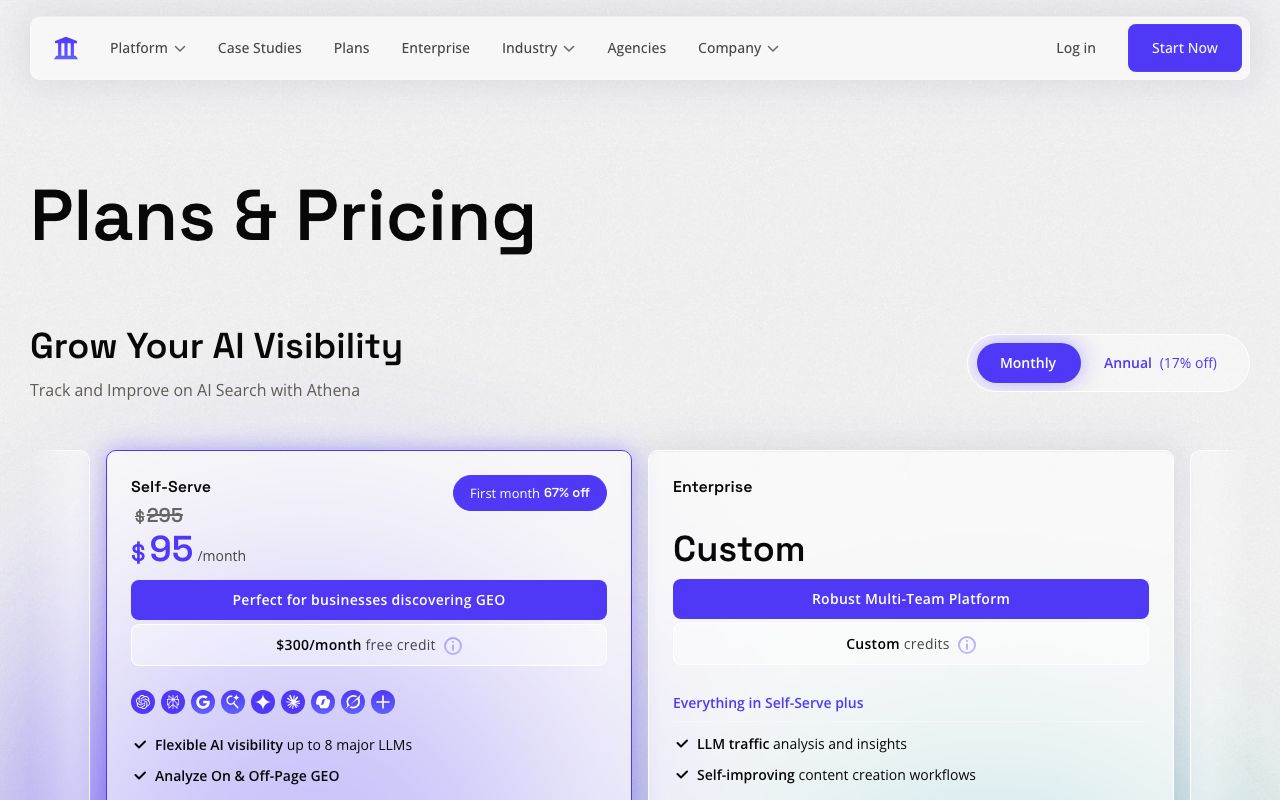
What it is: AthenaHQ is a Y Combinator-backed AI search intelligence platform built specifically for competitive AI share-of-voice strategy – telling brands not just where they appear in AI responses, but where competitors appear instead, and what to do about it.
Key features:
- Competitive share-of-voice monitoring across all 8 LLMs, including Claude competitor tracking with unlimited competitor benchmarking on every plan
- Action Center with on-page and off-page GEO recommendations – not a passive dashboard, but a prescriptive workflow
- Content gap analysis that surfaces the specific prompts where AI answers exist, but your brand doesn’t appear
- Prompt Volume estimation, showing how many monthly AI searches fire on queries relevant to your category
- Athena Citation Engine (ACE) on Enterprise, which actively works to place your brand into AI training and retrieval pipelines
Standout detail: The Action Center separates AthenaHQ from pure monitoring tools. When I reviewed the platform, it generates prioritized on-page and off-page tasks tied directly to closing specific citation gaps – closer to a GEO sprint planner than a reporting dashboard. According to Gartner, 50% of traditional search traffic will be replaced by generative AI by 2028, which is precisely the urgency AthenaHQ’s competitive intelligence framing is built around.
Best for: Marketing strategists and competitive intelligence teams who need to know how rivals appear in Claude vs. their own brand – and want prioritized actions, not just data exports. The Shopify and GA4/GSC integrations also make it a credible option for ecommerce SEO teams building AI visibility alongside traditional channel performance.
Limitations:
- Self-Serve plan restricts multi-country tracking and advanced AI agent features to Enterprise only
- Less depth on Claude-specific technical diagnostics (Brave Search crawl access, citation source breakdowns) compared to xSeek
Pros:
– Unlimited competitor tracking included on all plans
– Actionable GEO recommendations, not just monitoring metrics
– Claude is a named, confirmed engine – not a roadmap item
– Prompt Volume data quantifies the business case for targeting specific queries
Cons:
– $295/month entry price is steep for solo practitioners
– ACE, multi-country support, and the full Recommendation Engine are Enterprise-only
– Less Claude-specific diagnostic depth than purpose-built citation tools
AthenaHQ is the strongest option on this list for brands running active competitive AI visibility programs – the share-of-voice framing and built-in action layer make it the closest thing to a GEO strategy platform rather than a tracker.
Q: Does AthenaHQ track Claude specifically, or just aggregate AI search visibility?
Claude is explicitly listed as one of AthenaHQ’s 8 monitored LLMs, available on all plans, including Self-Serve at $295/month.
Q: What makes AthenaHQ’s competitive tracking different from standard brand monitoring?
AthenaHQ measures share of voice – the percentage of AI responses in a topic category where your brand appears versus named competitors – rather than simply counting brand mentions.
Found it at profoundai.io. Let me get their pricing page.
I now have all the data I need. Critical finding: Claude is NOT available on Starter, Pro, or Advanced plans – it only appears as “Claude Sonnet 4” on the Enterprise (custom pricing) tier. This is a major caveat to flag clearly. The standard plans cover ChatGPT, AI Mode, AI Overviews, Microsoft Copilot, Perplexity, Gemini, and Grok – but not Claude.
6. Peec AI – Best Lightweight Option for Brand Mention Monitoring
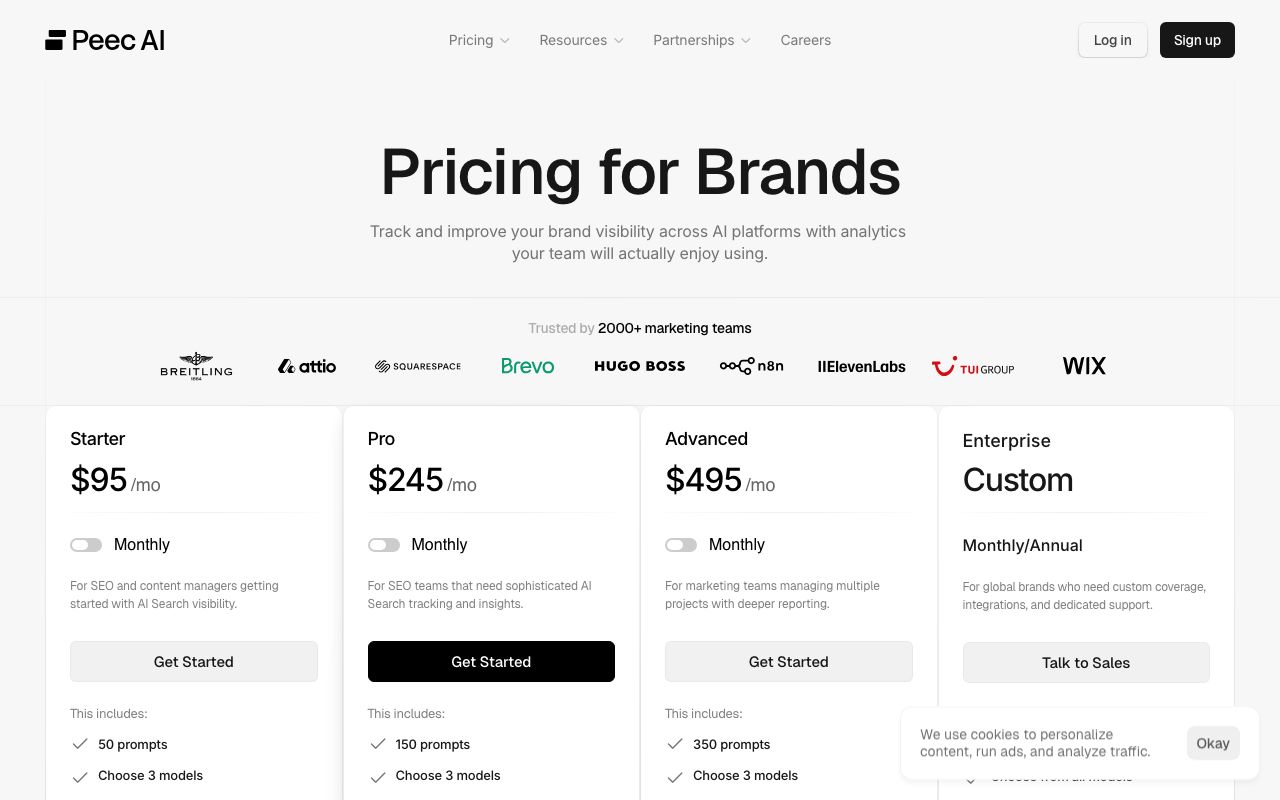
Peec AI is a Berlin-based AI search analytics platform trusted by 2,000+ marketing teams that tracks brand visibility, position, and sentiment across AI-generated responses. The setup is genuinely fast – define your prompts, pick your models, and start getting daily tracking data within minutes of signing up. There are no complex configuration menus or clunky onboarding flows.
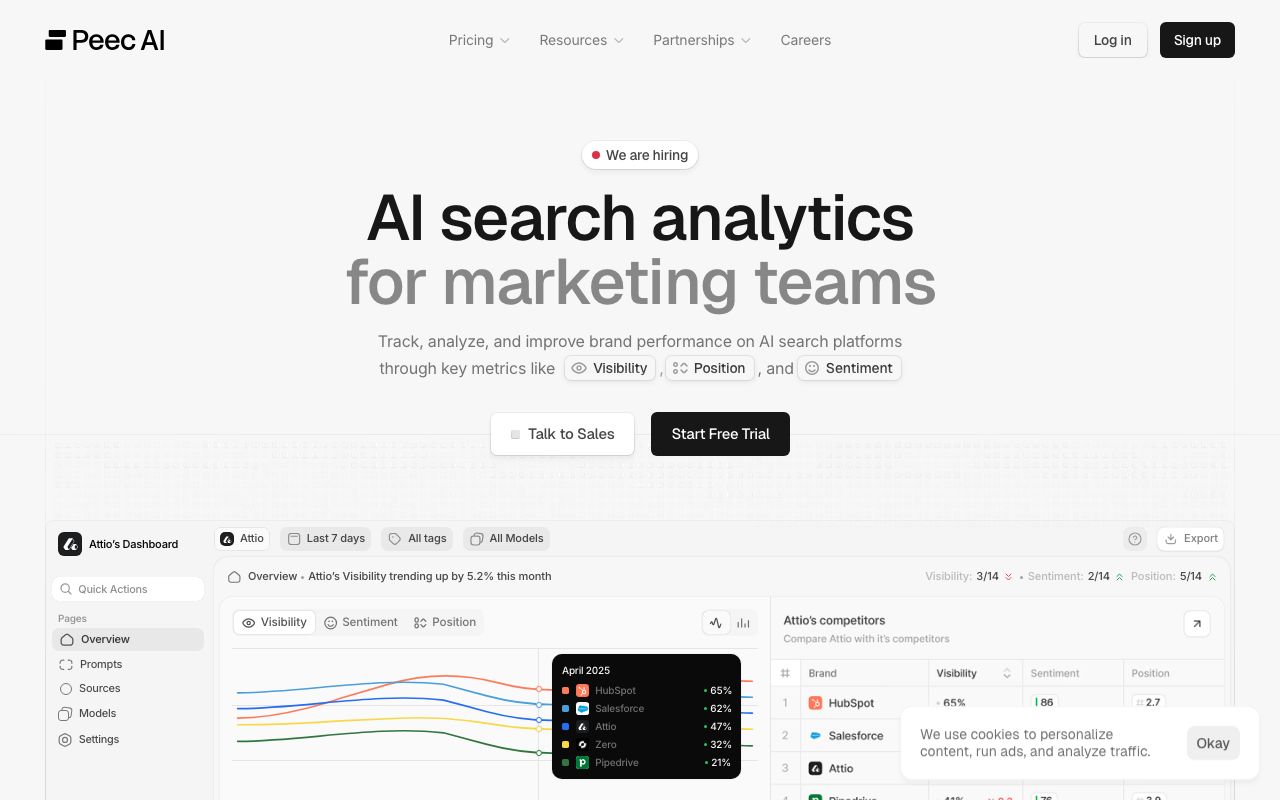
Price: Starter at $95/mo (50 prompts, 3 models, 1 project) | Pro at $245/mo (150 prompts, 2 projects) | Advanced at $495/mo (350 prompts, 5 projects, multi-country) | Enterprise at custom pricing
What it is: A prompt-level AI visibility tracker that monitors brand mentions, ranking position, and sentiment across major AI platforms – with a clean dashboard built for marketers who want answers fast, not data science degrees.
Key features:
- Visibility, Position, and Sentiment scores tracked per prompt, per model, per day
- Competitive brand comparison (add competitor names and track share-of-voice head-to-head)
- Source citation tracking showing which URLs and domains AI engines cite when mentioning your brand
- Looker Studio connector, CSV export, and API access on Advanced/Enterprise tiers
- AI-suggested prompts to help identify tracking opportunities you might have missed
Standout detail: The dashboard surfaces a visual “quadrant” chart – plotting brands by Visibility vs. Sentiment – which makes it immediately clear whether a brand is a “Leader,” “Niche Player,” or “Controversial” pick in its category.
Important: Claude tracking is not included on any standard paid plan. Claude Sonnet 4 appears only on the Enterprise tier (custom pricing). If Claude monitoring is your primary goal, Peec AI’s Starter, Pro, or Advanced plans won’t deliver it. The platform is primarily built around ChatGPT, Perplexity, Gemini, Copilot, Google AI Overviews, AI Mode, and Grok.
Best for: Small businesses, solopreneurs, and content teams who want a clean, low-friction AI brand monitoring system for the major consumer AI engines – and who are comfortable adding Claude tracking later via an Enterprise upgrade.
Limitations:
- No Claude coverage on standard plans (Starter through Advanced) – a significant gap for this article’s core use case
- No Brave Search index analysis, ClaudeBot crawl log data, or backlink-to-citation correlation; the platform monitors outputs, not the underlying infrastructure driving them
Pro Tip: Pair Peec AI’s real-time brand mention alerts with a dedicated Claude-specific tool like xSeek or LLMrefs. Peec handles the broad surface-level AI brand alerts across ChatGPT and Gemini; the specialist tools handle Claude’s Brave Search-dependent citation layer.
Peec AI is a well-executed lightweight tracking tool – but calling it a “Claude SEO tracking tool” in 2026 requires an Enterprise contract, which removes it from the accessible-pricing category it otherwise occupies so well.
The Claude Citation Stack Gap: What No Single Tool Covers Yet
Every tool reviewed above covers part of the Claude visibility problem. None covers all of it – and that gap has real consequences.
Even after deploying the best available Claude citation tracker, four upstream diagnostic signals remain invisible across every platform tested:
- ClaudeBot robots.txt access – whether Anthropic’s crawler is actually permitted to crawl your key pages
- Brave Search indexing status – whether your content exists in the index, Claude queries at inference time
- Factual density scoring – whether individual pages contain the entity-rich, citable content that Claude’s retrieval layer favors
- Backlink authority thresholds correlated with citation probability – the minimum link equity a page needs before Claude treats it as a credible source
This matters because of scale. The crawl-to-cite ratio for AI models like Claude sits at approximately 38,065:1 – meaning the vast majority of indexed pages are never cited. Optimizing citation text or prompt tracking without first auditing the four factors above is like A/B testing a landing page that isn’t indexed.
Important: A ClaudeBot robots.txt audit should be the *first* step in any GEO optimization gap analysis – not an afterthought. If ClaudeBot is blocked or throttled, no downstream citation tool will show meaningful data.
The practical minimum for 2026 is a two-tool stack: a Claude-specific citation tracker (xSeek or LLMrefs) paired with a Brave Search indexing checker to verify upstream discoverability. Backlink authority thresholds correlated with AI citation probability remain an open research problem – Ahrefs Brand Radar edges closest, but without native Claude data.
The Claude citation stack is maturing fast, but the full-stack audit layer doesn’t exist yet as a single product. The teams that build it first will own the GEO category.
How to Choose the Right Claude SEO Tracking Tool for Your Situation
While no single tool covers the full Claude citation stack yet, the right choice for your situation is already clear – if you know which problem you’re actually solving.
Match your investment to your use case:
Solo marketers and bloggers – Start with LLMrefs ($79/mo) for cross-engine citation monitoring or Peec AI’s lower-tier plans for basic brand mention tracking across non-Claude engines. Cost-effective entry points that don’t require enterprise contracts to deliver value when choosing a Claude tracking tool for a small business.
Content and SEO teams – Keyword.com’s AI Rank Tracker gives prompt-level monitoring that slots into existing keyword workflows. If traditional SEO reporting still drives your team’s KPIs, SE Ranking bridges both worlds – though verify your target engines before committing, since neither tool covers 100% of the Claude surface.
Agencies – xSeek and Scrunch AI offer the diagnostic depth and white-label-ready reporting that client work demands. These are the strongest AI SEO tools for agencies that need to demonstrate citation attribution across multiple client brands simultaneously.
Enterprise brands – Scrunch AI or Profound for compliance-grade audit trails and boardroom-ready dashboards. Both are built around the assumption that AI visibility is a reportable business metric, not a marketing experiment.
Competitive strategy – AthenaHQ for share-of-voice intelligence. If your question is “why does our competitor appear in Claude’s answer instead of us?”, AthenaHQ’s comparative positioning data answers it directly.
Important: Before investing in any tracking subscription, verify that ClaudeBot is not blocked in your robots.txt file – and confirm your domain is indexed in Brave Search. Without Brave Search indexing, no Claude tracking tool can surface citations that aren’t yet reachable by Claude’s retrieval layer. This is the non-negotiable prerequisite every tool in this list depends on.
The best tool for AI citation monitoring isn’t always the most feature-rich one – it’s the one that matches your reporting cadence, your team’s workflow, and the specific engines your audience uses to research your category.
Last updated: 2026-03-23
Frequently Asked Questions
What is Claude SEO tracking, and why is it different from traditional rank tracking?
Claude SEO tracking monitors whether and how Anthropic’s Claude AI cites or mentions your brand, content, or website in its responses – not where you rank on a search engine results page. Unlike Google rank tracking, which measures a URL’s position for a keyword, Claude tracking evaluates visibility inside a conversational AI model that doesn’t display ranked lists or share live indexing data.
Can I use my existing SEO tools to track Claude citations?
Most traditional SEO platforms like Ahrefs or SE Ranking were not built to query large language models, so they cannot track Claude citations out of the box. A small number of tools – including SE Ranking’s AI Overview tracker and Ahrefs Brand Radar – have added LLM monitoring features, but dedicated platforms like xSeek, Scrunch AI, and LLMrefs were purpose-built for this use case and tend to offer deeper Claude-specific diagnostics.
How do Claude SEO tracking tools actually work?
These tools send automated prompts to Claude (and often other LLMs) that simulate real user questions in your niche, then analyze the responses to detect brand mentions, citations, and source references. The quality of the tool largely depends on how diverse and realistic its prompt library is, and how frequently it re-queries the model to account for response variability.
Is Claude citation tracking worth it for small businesses or solo marketers?
It depends on your industry and goals, but lightweight, affordable options like LLMrefs and Peec AI make entry-level Claude monitoring accessible without enterprise budgets. If your customers are actively using Claude to research purchases or compare providers in your category, even basic citation monitoring can surface meaningful optimization opportunities.
How often does Claude change which sources it cites?
Claude’s citation behavior can shift without notice because Anthropic updates the model, its training data, and its response tendencies on a rolling basis. This is why consistent re-querying cadence – daily or weekly, depending on the tool – matters more for LLM tracking than it typically does for Google rank tracking, where ranking changes tend to be more gradual and attributable.
What content changes actually improve your chances of being cited by Claude?
Research consistently points to authoritative, well-structured content that directly answers specific questions, is cited by other credible sources, and exists on domains with strong topical authority. Unlike optimizing for Google snippets, there is no confirmed “Claude optimization” playbook yet, which means tools that diagnose why you are or aren’t being cited – rather than just whether you are – offer the most actionable value.
Will one tool cover everything I need for Claude SEO tracking in 2026?
Not entirely – as of 2026, no single platform fully addresses every layer of Claude visibility, from prompt-level citation tracking to competitive share-of-voice to executive reporting. Most serious practitioners end up pairing two tools: one for deep citation diagnostics and one for broader competitive or reporting needs, depending on team size and budget.
Conclusion
The best Claude SEO tracking tools for 2026 span a wide range of use cases, but the right starting point depends less on budget and more on where you sit in the market. Solo marketers and SMBs will get the most traction from LLMrefs or Keyword.com’s AI Rank Tracker, while agencies and enterprises needing deep Claude-specific diagnostics should put xSeek and Scrunch AI at the top of their evaluation list. Teams already anchored in traditional SEO workflows have a natural on-ramp through SE Ranking or Ahrefs Brand Radar.
Before you invest in any paid platform, one prerequisite cuts across every tool reviewed here: Claude pulls its responses primarily from Brave Search, so if your content isn’t indexed there, no tracker will show the results you’re hoping for.
The single most valuable action you can take right now costs nothing – open your robots.txt file and confirm that ClaudeBot is not blocked. Fix that access gap first, then layer in the monitoring tool that fits your scale. Everything else builds from there.