Backlinks are still one of Google’s top 3 ranking factors, yet most websites are leaving off-page SEO almost entirely to chance. If you’ve been wondering which of the 10 off-page SEO strategies that still work are worth your time in 2026, the answer might surprise you: the fundamentals haven’t changed as much as the noise suggests.
Table of Contents
- What Is Off-Page SEO (and Why It Still Matters in 2026)
- 1. High-Authority Link Building – Quality Over Quantity
- 2. Guest Blogging – Still Powerful When Done Right
- 3. Digital PR – The Backlink Strategy Most Sites Ignore
- 4. Unlinked Brand Mention Reclamation – Easy Wins You’re Missing
- 5. Community & Forum Engagement – Reddit, Quora, and LinkedIn
- 6. Local Citations and Google Business Profile Optimization
- 7. Podcast Appearances and YouTube Content – The Authority Signals Google Now Tracks
- 8. Influencer and Micro-Influencer Collaborations
- 9. Content Repurposing as a Backlink Magnet
- 10. The Off-Page SEO Tactic Nobody Talks About: Strategic Sponsorships and Community Partnerships
- Off-Page SEO Strategies Compared: Which Tactic Fits Your Site Right Now?
- Frequently Asked Questions
- What is the difference between on-page SEO and off-page SEO?
- How long does off-page SEO take to show results?
- Do social media signals directly affect Google rankings?
- Are backlinks still the most important off-page SEO factor in 2026?
- Can small businesses compete with larger sites using off-page SEO?
- Is guest blogging considered a safe SEO strategy or does Google penalize it?
- What off-page SEO strategies work best for new websites with no authority?
- Conclusion
Off-page SEO covers everything that happens outside your website to influence your rankings, think backlinks, brand mentions, and digital PR, as opposed to on-page factors like content and technical structure. While Google’s algorithm has grown more sophisticated, the core principle remains the same: authority and trust signals from external sources still heavily determine where you rank.
What has changed is how Google evaluates those signals. E-E-A-T (Experience, Expertise, Authoritativeness, and Trustworthiness) is now the lens through which every off-page tactic gets judged, meaning quality, relevance, and credibility matter more than raw volume ever did.
TL;DR: Off-page SEO strategies that still work in 2026 go far beyond basic link building, covering everything from digital PR and unlinked brand mention reclamation to podcast appearances and strategic sponsorships. Backlinks remain one of Google’s top ranking factors, making high-authority link acquisition the foundation of any serious SEO campaign. Tactics like guest blogging, community engagement on Reddit and LinkedIn, and content repurposing multiply your authority signals without requiring a massive budget. This guide breaks down 10 proven off-page SEO strategies with a comparison framework to help you prioritize the right tactics for your site’s current stage.
Key Takeaways
- Backlinks remain one of Google’s top three ranking signals, but link quality consistently outperforms quantity, so prioritize earning editorial links from high-authority, topically relevant domains over chasing volume.
- Unlinked brand mention reclamation offers the highest effort-to-reward ratio of any link acquisition tactic, making it the smartest first move for sites that already have existing brand presence online.
- Digital PR is one of the highest-ROI off-page strategies available, yet most small and mid-size sites skip it entirely, leaving a significant opportunity to earn permanent, authoritative backlinks through media coverage.
- For businesses serving a specific geographic area, optimizing local citations and a Google Business Profile represents the fastest path to ranking gains, and most local sites are currently leaving both opportunities untouched.
- Content repurposing multiplies the number of surfaces where your best ideas can earn backlinks organically and at scale, extending the value of existing assets without requiring new content creation from scratch.
- Strategic sponsorships of local events or community organizations can generate authoritative backlinks for less than $200 in some cases, making it one of the most cost-efficient and overlooked off-page tactics available.
What Is Off-Page SEO (and Why It Still Matters in 2026)
Off-page SEO refers to every optimization activity that happens outside your own website to influence search engine rankings. This includes backlinks from external domains, brand mentions (linked or unlinked), local citations, social signals, podcast appearances, online reviews, and third-party content that references your brand.
The contrast with on-page SEO is straightforward: on-page tactics like HTML tags control what’s on your pages, while off-page signals tell Google what the rest of the internet thinks about you. One builds structure; the other builds authority.
That authority gap is exactly why off-page SEO remains critical. According to Backlinko’s analysis of 11.8 million Google search results, the number of referring domains pointing to a page correlates more strongly with first-page rankings than almost any other factor.
Google’s E-E-A-T framework (Experience, Expertise, Authoritativeness, Trustworthiness) makes external signals even more consequential in 2026. You cannot self-declare authority. Google measures it through what others say about you: who links to you, who mentions you, and who cites you as a source.
Off-page work is also harder to fake at scale, which is precisely why Google’s algorithm continues to weight it heavily.
Key differentiator: On-page SEO tells Google what your site is about. Off-page SEO tells Google whether your site deserves to rank.
For tracking how your off-page efforts translate into actual ranking movement, pairing this strategy with the right SEO ranking reporting software makes the feedback loop measurable.
1. High-Authority Link Building – Quality Over Quantity
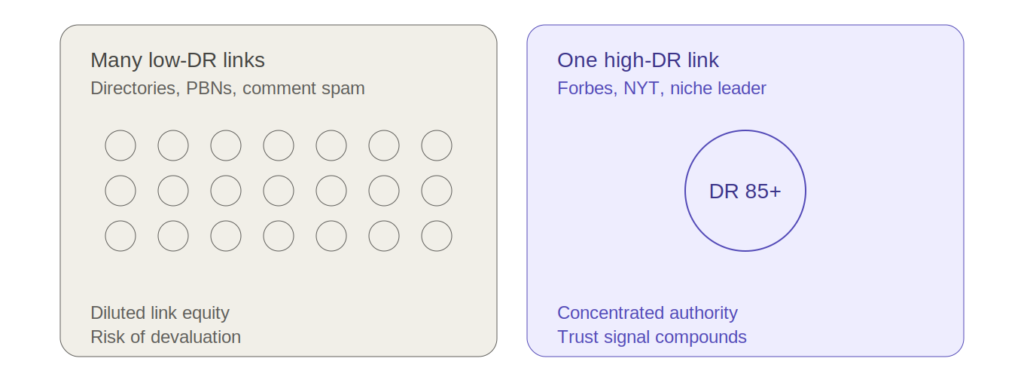
Ranking reports give you the “what.” High-authority link building gives you the “why” rankings move at all. Backlinks remain one of Google’s top three ranking signals, and the data consistently shows that link quality crushes link quantity every time.
According to Ahrefs, links from relevant pages on authoritative websites have the most direct influence on rankings, more than volume alone. A single editorial backlink from a site with a Domain Rating (DR) of 70+ can move a target keyword from page 2 to the top 5 within 4 to 6 weeks, while 50 links from DR 15 sites might deliver zero measurable lift.
The three link-building strategies that actually deliver results in 2026 are:
Broken link building. Use Ahrefs’ Site Explorer to find resource pages in your niche that link to dead URLs. Reach out to the site owner, flag the broken link, and pitch your content as a replacement. Conversion rates on this outreach run 5 to 10%, which is high by cold email standards.
Resource page outreach. Search Google for
intitle:"resources" + your niche keyword. These pages exist specifically to link out. A well-targeted pitch with a genuinely useful asset lands links from DR 60+ domains without complex negotiation.Competitor backlink gap analysis. In Ahrefs or SEMrush, run a Link Intersect (Ahrefs) or Backlink Gap (SEMrush) report. Enter 3 to 5 competitors and filter for domains linking to all of them but not to you. These sites are pre-qualified: they already link to your category and have proven editorial standards. Prioritize DR 50+ targets with real organic traffic.
For a full breakdown of the tools that make this prospecting fast, the best link-building tools in 2026 cover the full stack with tested results.
Important: Google’s SpamBrain algorithm actively detects and discounts links from Private Blog Networks (PBNs) and paid link schemes. A manual penalty for unnatural links can drop rankings by 50% or more overnight. The Google Search Essentials guidelines explicitly list link schemes as a violation. Never risk it.
One more nuance worth understanding: do-follow vs. no-follow links. Do-follow links pass PageRank; no-follow links (and the newer sponsored/UGC attributes) do not, at least not directly. But a backlink profile that’s 100% do-follow looks unnatural to Google’s algorithms. A realistic organic profile includes 20 to 30% no-follow links from news sites, forums, and directories. Aim for that natural mix.
Pro Tip: When doing competitor backlink gap analysis in Ahrefs, filter results by “Referring page traffic > 500” to instantly cut the list to domains with real audiences, not just high DR scores on paper.
High-authority link building is the highest-ROI off-page investment for most sites, but it also requires the most patience. One editorial link from a DR 80 publication beats a month of low-quality outreach, every time.
Best for: SaaS companies, B2B publishers, and ecommerce brands competing in established niches where the top 3 results all carry strong domain authority.
Key differentiator: Volume is a trap. The sites that climb fastest in competitive SERPs are building 5 to 10 exceptional links per month, not 100 mediocre ones.
2. Guest Blogging – Still Powerful When Done Right
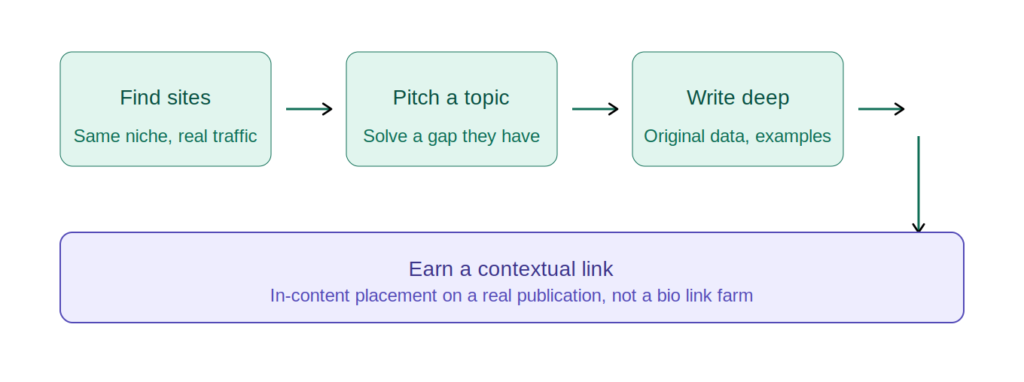
Guest blogging earns its place in any serious link outreach strategy, but only when treated as a value exchange, not a link factory. According to Ahrefs’ backlink study data, editorial backlinks from topically relevant, high-authority domains consistently move rankings faster than bulk links from generic directories or low-quality blog networks.
Google’s stance is unambiguous: mass guest posting schemes designed primarily to manipulate PageRank violate its link spam policies and can trigger manual actions. The operative word is “mass.” A single, well-placed guest post on a domain with genuine topical relevance and real traffic is worth more than 50 posts on content farms that exist purely to sell links.
Important: Google’s SpamBrain system now detects patterns of scaled guest posting, including identical author bios with keyword-rich anchor text across dozens of low-quality sites. One penalized link profile can drag an entire domain’s authority down.
The secondary benefit most people underestimate is referral traffic. A guest post on a publication your target audience actually reads drives qualified visitors who already trust the platform. That trust transfers to your brand before they even land on your site.
Here’s a best-practice process that actually works in 2026:
Identify target blogs with topical relevance first. Use tools from this link-building tools list to filter prospects by Domain Rating (50+), organic traffic (10,000+ monthly visits), and niche alignment. A post on a marketing blog won’t move the needle for a fintech SaaS tool.
Audit the publication before pitching. Check that the site publishes original editorial content, not thin filler posts. Look at their existing guest contributors – if every post is from someone with “SEO” in their bio, that’s a red flag.
Write a personalized pitch, not a template blast. Reference a specific article they published. Propose three headline ideas tailored to their audience’s existing content gaps. Editors receive dozens of generic pitches daily; specificity gets responses.
Deliver genuinely useful content. The article needs to stand alone as valuable to readers, independent of the link it contains. Avoid over-optimized anchor text. A natural contextual link within a well-structured post performs better and lasts longer than a forced exact-match backlink.
Track the referral traffic separately from the SEO value. Set up UTM parameters on your link so you can measure whether the placement actually sends engaged visitors, not just link equity.
Pro Tip: Guest posting on a site that ranks well for the same keywords you’re targeting compounds the benefit: you earn a backlink AND appear in front of an audience already searching for your topic.
Guest blogging done right is selective, relationship-driven, and measured by both the link earned and the audience reached.
3. Digital PR – The Backlink Strategy Most Sites Ignore
Ranking software tells you where you stand. Digital PR is one of the highest-ROI tactics for changing that position permanently, and most small and mid-size sites skip it entirely because it feels too “media-world” to attempt.
Digital PR for SEO is the practice of creating genuinely newsworthy content assets and pitching them to journalists, editors, and media outlets to earn editorial backlinks. These aren’t directory links or forum signatures. They’re citations from Forbes, TechCrunch, regional news sites, or industry trade publications – the kind of links that move domain authority metrics measurably and that no manual outreach campaign can easily replicate.
According to a Moz study on link equity, a single editorial backlink from a high-authority publication can carry more ranking weight than dozens of links from mid-tier blogs. The reason: Google’s algorithms weight editorial links placed by journalists (not marketers) as the strongest trust signals in search.
The mechanics are straightforward. You create an asset worth covering – original survey data, a proprietary industry report, a bold counter-narrative opinion piece, or a timely data visualization. Then you pitch it through platforms designed to connect sources with reporters.
HARO (Help a Reporter Out) sends three daily email digests to registered sources. Each digest contains journalist queries from outlets ranging from local newspapers to major national publications. A well-timed, expert response to a relevant query can land you a named media mention with a do-follow backlink, often within 48 hours of submission.
SourceBottle operates similarly but skews toward Australian, UK, and niche B2B media. It’s less competitive than HARO for many verticals, making it a strong secondary channel for earning media mentions from trade publications that carry significant topical authority.
The compounding effect is where digital PR genuinely separates itself from other off-page tactics. One piece of earned media coverage rarely stays in one place. When a major outlet publishes your data or quotes your expert commentary, syndication picks it up. Five outlets become fifteen. Fifteen earned citations become a cluster of high-authority signals pointing at your domain simultaneously.
Pro Tip: Original survey data is the single most pitchable asset in digital PR. A survey of 500 people in your industry costs roughly $200-$500 to run via tools like Pollfish, and a compelling finding can generate 20+ editorial links from a single campaign.
For teams building out a full backlink acquisition strategy alongside PR efforts, pairing these tactics with dedicated link-building tools ensures you’re tracking placements, monitoring anchor text distribution, and identifying new pitch opportunities systematically.
Key differentiator: Digital PR earns backlinks that competitors cannot replicate through outreach alone – the editorial gatekeeping that makes journalists’ links so valuable is the same barrier that protects those links from being commoditized.
4. Unlinked Brand Mention Reclamation – Easy Wins You’re Missing
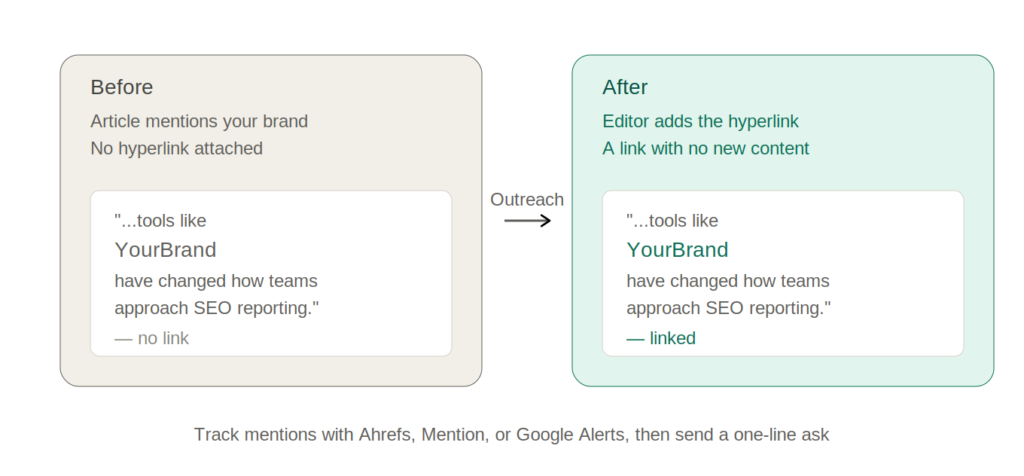
Knowing your rankings are improving is one thing. Knowing exactly which off-page actions caused it is another. Among all link acquisition tactics, unlinked brand mention reclamation delivers the highest effort-to-reward ratio because the hard work is already done: someone has already written about your brand. They just forgot to link.
An unlinked brand mention is any time a website references your brand name, product, or founder in content without hyperlinking back to your site. These are not missed opportunities sitting in the dark. They are warm leads disguised as missing anchor tags.
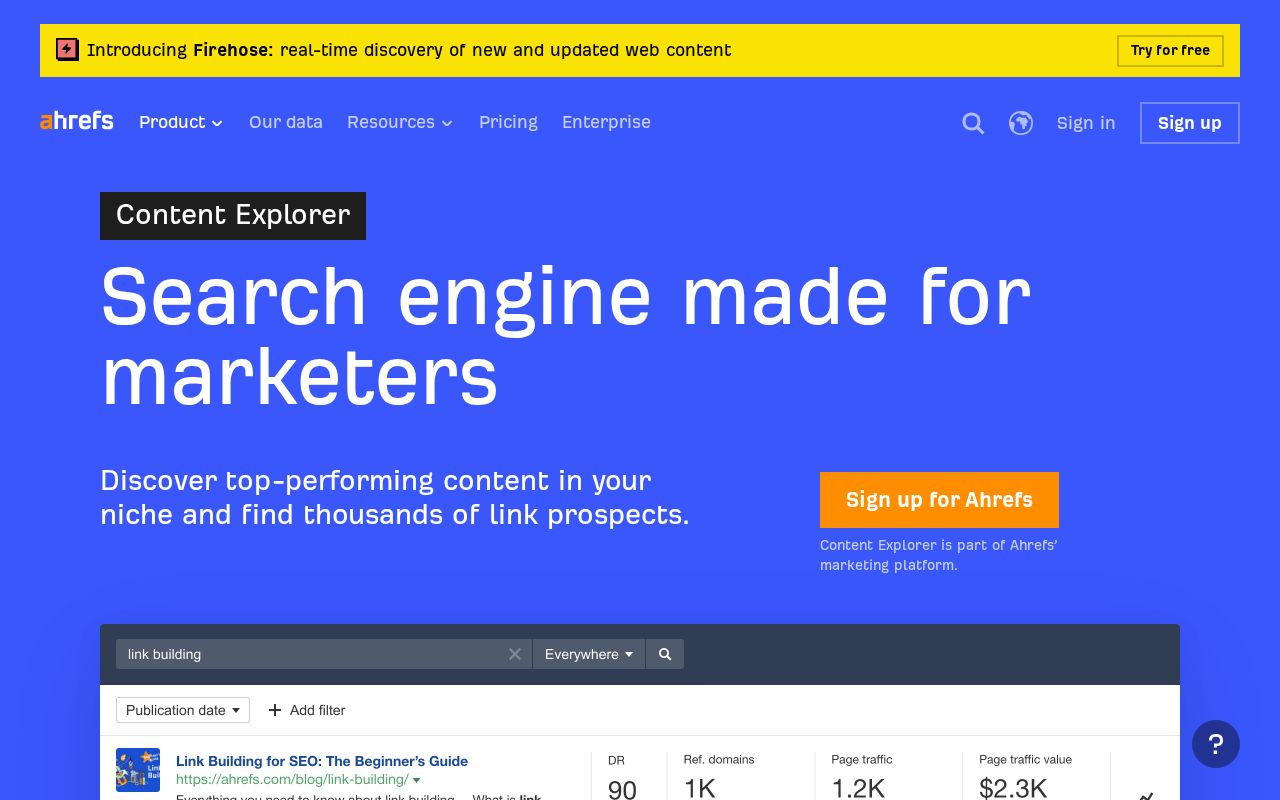
According to Ahrefs, its Content Explorer tool searches across a database of 19 billion web pages to surface brand mentions you can filter by Domain Rating, traffic, and link status. That scale means even mid-sized brands typically surface dozens of convertible opportunities in a single search session.
The process for reclaiming these mentions is straightforward:
- Set up Google Alerts for your brand name, product names, and key personnel. Free, real-time, and catches new mentions the moment they publish.
- Run a Content Explorer search in Ahrefs. Type your brand name, then filter results using the “Highlight unlinked domains” feature. This isolates pages that mention you without linking.
- Cross-check in Semrush Brand Monitoring (available on Guru and Business plans). Semrush layers sentiment analysis on top of mention data, so you can prioritize positive mentions first; those are the easiest to convert.
- Send a brief, personalized outreach email. Reference the specific article, compliment the context, and ask politely whether they’d consider adding a link to make it easier for readers to find you. Keep it under 100 words.
The conversion rate on this outreach is meaningfully higher than cold link prospecting. The author already chose to mention your brand, which signals existing awareness and credibility. You’re not pitching them to write something new. You’re asking them to add one hyperlink.
Pro Tip: When emailing, link directly to the most relevant page on your site, not just your homepage. If they mentioned a specific product, link to that product page. Relevance increases click-through for them and link equity value for you.
For a broader toolkit to find and prioritize these opportunities at scale, the best link-building tools roundup covers which platforms surface unlinked mentions most efficiently in 2026.
Best for: Any brand with existing press coverage, product reviews, or industry mentions that have accumulated over time. The older and more established your brand, the larger the backlog of convertible mentions.
Key differentiator: Unlike every other link-building method, reclamation requires zero content creation. The asset already exists. Your only job is to ask.
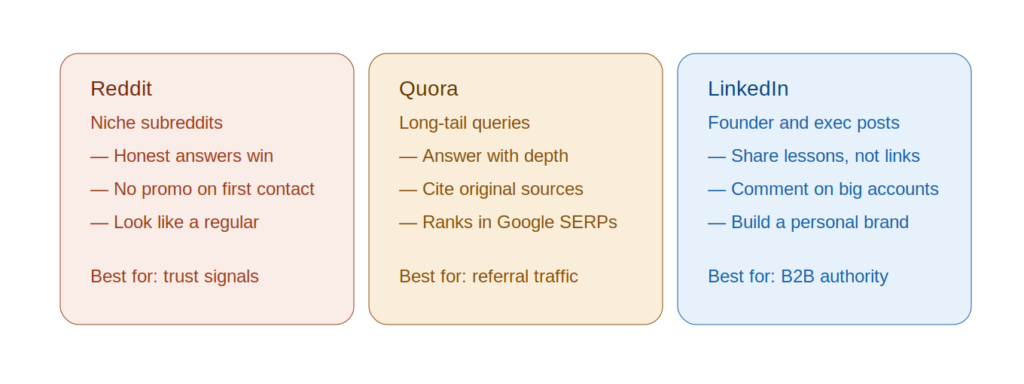
5. Community & Forum Engagement – Reddit, Quora, and LinkedIn
Reclamation converts existing brand equity into links. Community engagement builds that brand equity in the first place, and the SEO payoff is more significant than most practitioners admit.
Reddit alone drives over 1.5 billion visits per month (Semrush Traffic Analytics, 2024), and Google has a formal content licensing deal with Reddit that makes Reddit threads increasingly visible in AI Overviews and knowledge panels. Showing up consistently in relevant subreddits, Quora topics, and LinkedIn communities puts your brand where both users and Google’s crawlers are actively paying attention.
The mechanism isn’t primarily about the links themselves. Most forum contributions earn nofollow links, which carry no direct PageRank. But nofollow links still contribute to a natural, diverse link profile, and Google’s Gary Illyes confirmed in 2019 that nofollow links are used as “hints” for crawling and indexing. The real SEO value compounds through referral traffic, brand recall, and E-E-A-T signals: when a subject matter expert answers 50 questions on a topic over six months, Google’s systems recognize that author and brand as topically authoritative.
Important: Google’s spam algorithms are specifically trained to detect forum link drops. A five-year-old Quora account with 200 generic answers and links back to the same domain in every response is a spam signal, not a credibility signal. Genuine participation means answering questions you’d answer even if you couldn’t include a link.
Here’s how to build meaningful community presence across each platform:
- Reddit: Identify 3-5 subreddits where your target audience asks questions (r/SEO, r/entrepreneur, r/ecommerce, etc.). Contribute for weeks before ever mentioning your own content. When you do share a link, it should solve the exact problem being asked about.
- Quora: Focus on questions with high monthly views (visible in Quora’s topic stats). A single well-written answer on a question with 50,000+ monthly views generates compounding referral traffic for years.
- LinkedIn: Long-form posts and comment contributions in LinkedIn Groups signal professional authority. This feeds directly into E-E-A-T, particularly for YMYL industries like finance, legal, and health.
- Stack Overflow: For technical brands and developer tools, a well-sourced answer with a relevant link is one of the highest-trust placements available. Stack Overflow pages rank extremely well on their own.
- Niche industry forums: Vertical-specific communities (e.g., Warrior Forum for marketers, Houzz for home improvement brands) often have higher conversion intent than general platforms.
If you’re thinking about how forum authority connects to broader generative engine optimization strategies, the overlap is direct: AI models trained on Reddit and Quora data are more likely to cite brands that appear authoritative within those platforms.
Pro Tip: Use Ahrefs Content Explorer to find forum threads where competitors are mentioned but you’re absent. These are ready-made opportunities to add a credible, competing perspective.
Community engagement is slow to start and impossible to fake at scale, which is exactly why it builds the kind of brand trust that paid links never can.
6. Local Citations and Google Business Profile Optimization
If brand mentions are the easiest link wins, local citations are the easiest ranking wins for any business that serves a specific geographic area. And most local sites are leaving both on the table simultaneously.
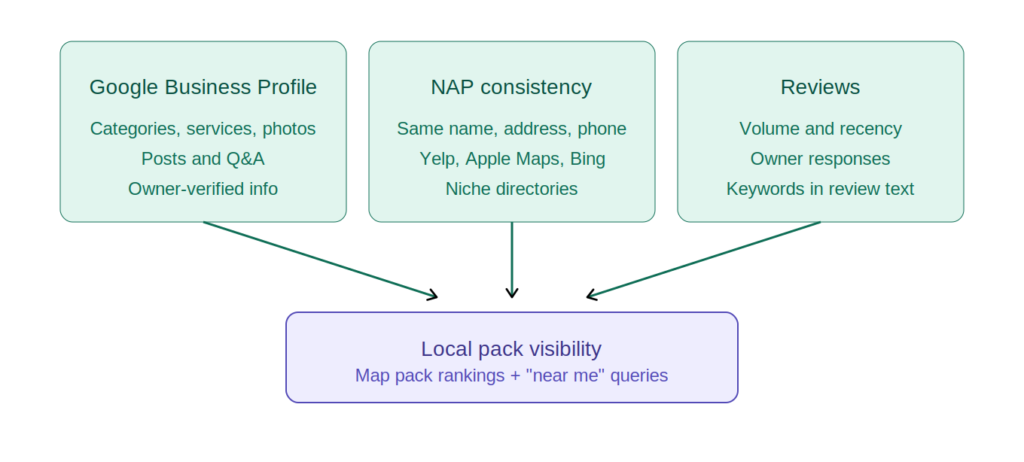
A local citation is any online mention of your business’s Name, Address, and Phone number (NAP). These appear on directories like Yelp, Apple Maps, TripAdvisor, and industry-specific platforms like Healthgrades or Houzz. Search engines treat consistent NAP data across the web as a trust signal: the more platforms confirm the same details, the more confident Google is that your business is legitimate and operating at that location.
Citations fall into two categories:
- Structured citations: Formal directory listings with dedicated fields for name, address, phone, website, and hours (think Yelp, Apple Maps, Bing Places)
- Unstructured citations: Casual mentions of your NAP in blog posts, news articles, or community forums, without a formal listing structure
According to BrightLocal’s Local Consumer Review Survey, 98% of consumers used the internet to find information about local businesses in 2023. That audience lands on your listings whether you’ve optimized them or not.
Important: NAP inconsistency is a silent ranking killer. If your Yelp listing says “Suite 100” and your Google Business Profile says “Ste. 100,” Google treats these as potential mismatches. Audit every listing to enforce character-for-character consistency.
Google Business Profile (GBP) is the single most impactful local off-page asset you control. A fully completed and actively managed profile directly influences local pack rankings, the three-business box that appears at the top of location-based searches. GBP factors that matter most for local pack placement include:
- Business category (primary and secondary)
- Complete and keyword-informed business description
- Updated hours, including holiday hours
- Regular photo uploads (Google’s own data shows profiles with photos receive 42% more direction requests)
- Q&A section actively managed by the business
- Review responses within 24 to 48 hours of posting
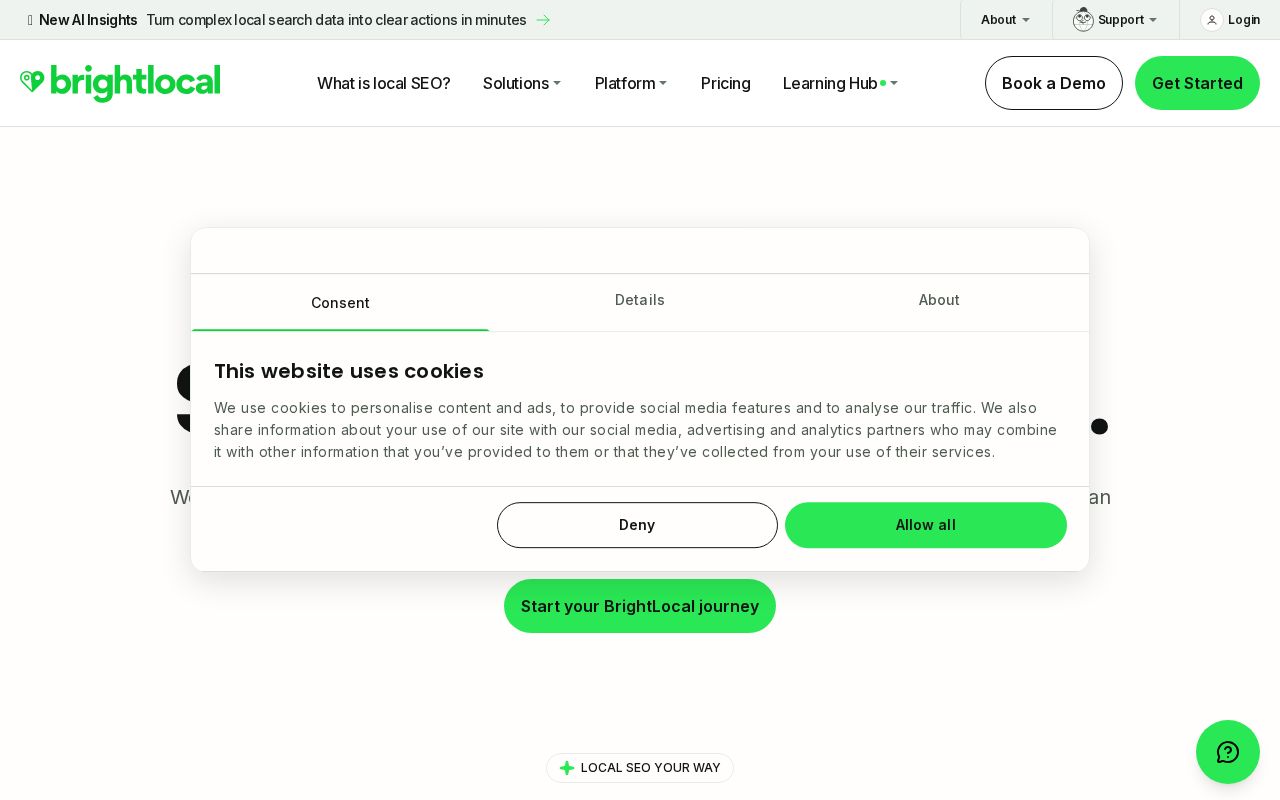
For citation auditing at scale, BrightLocal scans 300+ directories, flags NAP inconsistencies, identifies duplicate listings, and tracks citation growth over time. Its Citation Tracker dashboard shows each directory’s accuracy status in a single view, making it practical for both single-location businesses and agencies managing dozens of clients.
Pro Tip: Prioritize the “data aggregators” first: Data Axle, Neustar Localeze, and Foursquare feed dozens of downstream directories automatically. One corrected listing at the aggregator level can fix 20+ citations passively.
For agencies managing local SEO at scale, pairing citation management with a capable white-label SEO platform lets you report on citation health and ranking movement inside a single branded dashboard.
Key differentiator: Unlike backlink building, citation optimization has a definitive “done” state. Once your NAP is consistent across all major directories and your GBP is fully built out, you’ve created a durable local authority foundation that compounds over time with reviews and engagement alone.
7. Podcast Appearances and YouTube Content – The Authority Signals Google Now Tracks
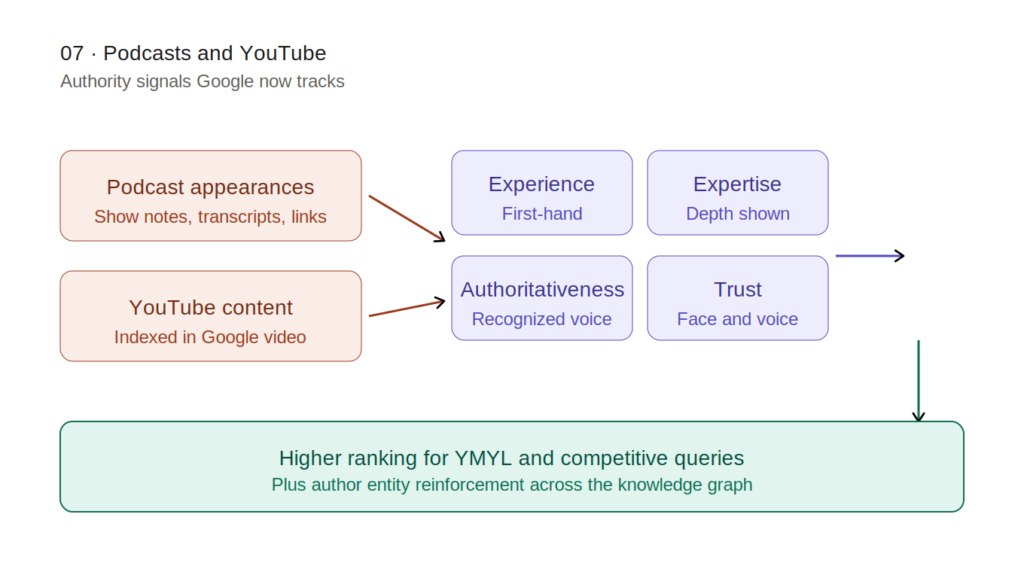
Reclamation works because your brand already exists in the conversation. Podcast appearances and video content take that logic one step further: they build your presence in conversations that are actively indexed, cited, and treated as authority signals by Google’s entity-recognition systems.
Podcast appearances are one of the most underrated off-page SEO tactics in 2026. Every episode you appear on typically generates a dedicated show notes page with a backlink to your site. Beyond the link itself, appearing alongside established hosts associates your name and brand with authoritative entities – a direct E-E-A-T signal that Google’s systems register when evaluating your expertise in a topic area. According to Edison Research’s Infinite Dial 2024 report, 47% of Americans listened to a podcast in the past month, meaning the audiences are real and measurable, not just SEO footnotes.
The podcast SEO value compounds over time:
- Show notes backlinks from established podcast domains often carry meaningful authority, especially on platforms like Buzzsprout-hosted shows, Substack, or dedicated podcast websites
- Transcript pages on podcast sites add keyword-rich, indexable content that associates your brand with specific topics
- YouTube republication of podcast episodes creates a second indexed asset on the most trusted non-Google domain in existence (which is, of course, owned by Google)
- Entity association from appearing with respected voices in your niche reinforces your topical authority faster than most content-based tactics.
YouTube off-page SEO deserves its own emphasis. Video descriptions with links back to your site function as referral signals. Long-form YouTube content that earns comments, shares, and embeds generates behavioral signals that Google weighs heavily. YouTube Shorts, meanwhile, can surface in Google’s main search results directly, creating brand impressions that strengthen entity recognition even when no direct click occurs.
Pro Tip: When you upload a YouTube video, treat the description like a landing page. Include your target keyword in the first 150 characters, link to a relevant page on your site, and add timestamps – all three improve both YouTube and Google indexing of that asset.
LinkedIn Articles and posts round out this category. A LinkedIn article ranks independently in Google Search and associates your personal brand with specific topics, which strengthens the entity graph around your business domain. This matters especially if you’re working to optimize for generative engine results, where entity associations drive citation frequency in AI-generated answers.
Key differentiator: Unlike most link-building tactics, podcast appearances and YouTube content produce authority signals across multiple channels simultaneously: backlinks, entity association, branded search volume, and indexable media assets.
Frequently Asked Questions
Do podcast show notes links actually help SEO? Yes. Show notes pages are indexed by Google, and a followed link from a domain with real audience traffic carries ranking value, particularly when the podcast is topically relevant to your niche.
Does YouTube content count as off-page SEO? Because YouTube is a separate domain from your site, any link or brand mention there functions as an off-page signal. Google also treats YouTube channel authority and video engagement metrics as trust indicators for associated brands.
8. Influencer and Micro-Influencer Collaborations
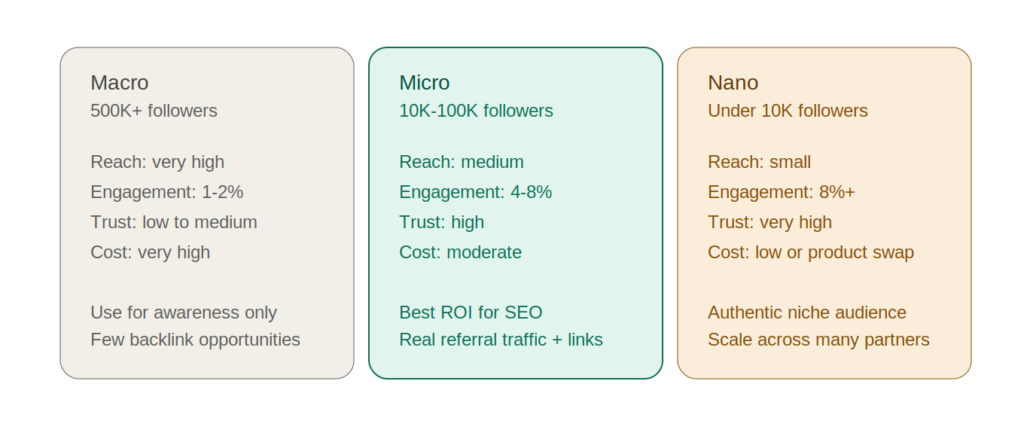
Reclamation works because someone else already created the asset. Influencer collaborations flip that model: you pay or partner to create the asset, and the ROI depends almost entirely on who you choose to create it with.
Here is where most brands get this wrong. They chase follower counts instead of relevance. Micro-influencers with 10,000 to 100,000 followers in a specific niche consistently outperform macro-influencers on the metrics that matter for SEO. According to Influencer Marketing Hub’s 2024 Benchmark Report, micro-influencers generate engagement rates of 3.86% on average compared to just 1.21% for mega-influencers. Higher engagement signals a tighter, more trusting audience – which directly correlates with authentic content that earns editorial links and genuine brand mentions.
The SEO value here is not just the link in a bio. It is the cumulative brand signal. When a fitness blogger on YouTube reviews your supplement brand, a parenting creator on Instagram tags your product in a Reel, and a B2B professional on a LinkedIn newsletter cites your tool, Google’s systems register those co-occurrence signals across domains. That pattern of brand mentions across authoritative, topically adjacent properties reinforces domain authority over time, even when the links themselves carry nofollow attributes.
Collaboration formats that move the needle for influencer marketing SEO:
- Product reviews on YouTube: Long-form video reviews generate indexed content, backlinks in video descriptions, and timestamps that keep audiences engaged. YouTube SEO is its own discipline, but a review from a 50,000-subscriber channel in your niche often outranks paid placements from a 2-million-subscriber generalist.
- Co-created blog content: Partnering on a written article where the influencer contributes genuine expertise earns a followed backlink from their domain, plus social amplification. This is the format most likely to earn secondary links from their own audience.
- Sponsored Instagram and Facebook posts with brand tags: Even without a direct link, tagged mentions on Facebook and Instagram create crawlable brand associations and drive branded search volume, which is itself a domain authority signal that AI-powered search engines increasingly weigh.
- Newsletter features: Niche email newsletters with engaged readerships often have companion websites. A mention earns both an authoritative backlink and direct referral traffic.
Important: Google’s guidelines require disclosure for sponsored content. Posts with followed links must be clearly labeled as paid partnerships. Undisclosed sponsored links risk manual penalties, and the brand, not just the influencer, can be penalized.
Pro Tip: Before outreach, audit a micro-influencer’s existing brand partnerships using a tool like Ahrefs’ Content Explorer filtered by their domain. If they already cover competitors, a collaboration places your brand directly in front of a pre-qualified audience – and the comparison content often earns the most links of any format.
For teams scaling this outreach efficiently, pairing influencer campaigns with AI-powered marketing tools cuts prospecting time significantly and helps identify which micro-influencers already generate brand-adjacent content organically.
The brands that treat micro-influencer collaborations as a brand signal accumulation strategy, not a one-off traffic play, are the ones that see domain authority compound year over year.
9. Content Repurposing as a Backlink Magnet
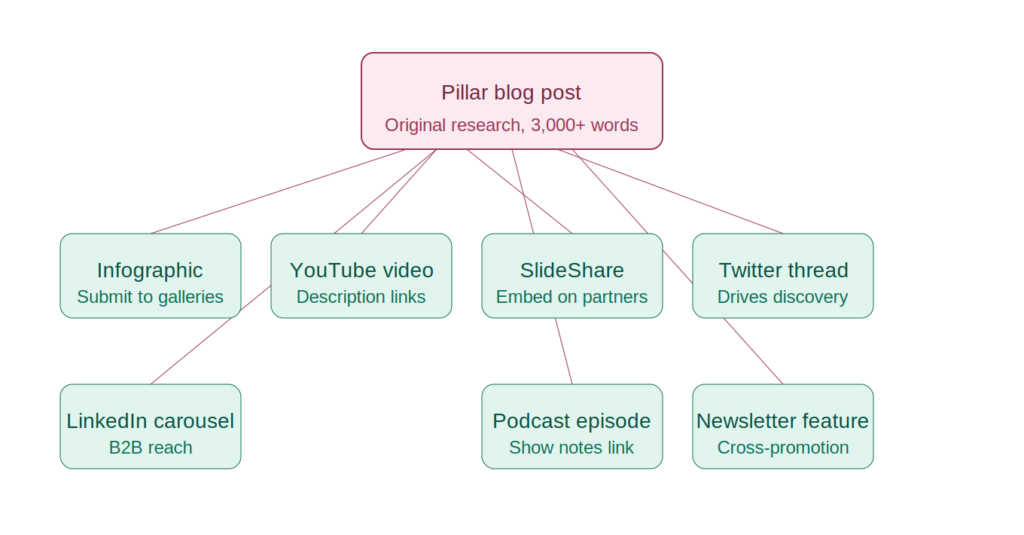
Brand signal accumulation through influencers works because trusted third parties vouch for your content. Content repurposing works because you multiply the number of surfaces where your best ideas can earn those vouchers organically, at scale, without starting from scratch every time.
A single high-performing blog post contains enough raw material to become six distinct linkable assets: an infographic, a YouTube explainer, a SlideShare slide deck, a Pinterest data visualization, a short-form video, and a standalone research summary. Each format lives on a different platform, reaches a different audience, and creates a new entry point for inbound links.
According to Semrush’s State of Content Marketing report, content with original research and data earns 3x more backlinks on average than purely editorial content (2023). That multiplier compounds dramatically when you repurpose that research into visual formats that other publishers can embed with attribution.
Here is how to execute this as a deliberate backlink acquisition system:
- Identify your highest-traffic post that contains original data, a unique framework, or a stat-heavy argument. These are your best repurposing candidates.
- Convert the core insight into an infographic. Infographics earn natural embeds across niche blogs, and embed codes include a dofollow attribution link back to your domain. Distribute via Pinterest and outreach directly to sites that have linked to similar visuals.
- Upload the slide version to SlideShare. SlideShare SEO remains underused in 2026. Decks indexed there appear in Google Image Search and attract links from educators, newsletter writers, and bloggers who cite visual references.
- Publish a video version on YouTube that references the original post. Video descriptions with source links generate direct referral traffic and create an additional off-page brand mention tied to your URL.
- Package raw data into a standalone report. Even a one-page PDF with original findings becomes a citable asset that journalists and researchers link to, especially if you pitch it alongside a digital PR angle.
Pro Tip: When creating infographics for backlink acquisition, always include a pre-written embed code beneath the graphic on your site. Publishers who want to share it will use the path of least resistance, and that code ensures the attribution link points exactly where you need it.
The formats that consistently attract the most organic links are data visualizations and original research reports. If your content repurposing strategy is built around those two asset types, you can pair it with tools covered in our best AI SEO tools roundup to automate ideation and accelerate production at scale.
Key differentiator: Every other link-building tactic requires you to create something new. Content repurposing squeezes three to five additional backlink opportunities from work you have already done.
10. The Off-Page SEO Tactic Nobody Talks About: Strategic Sponsorships and Community Partnerships
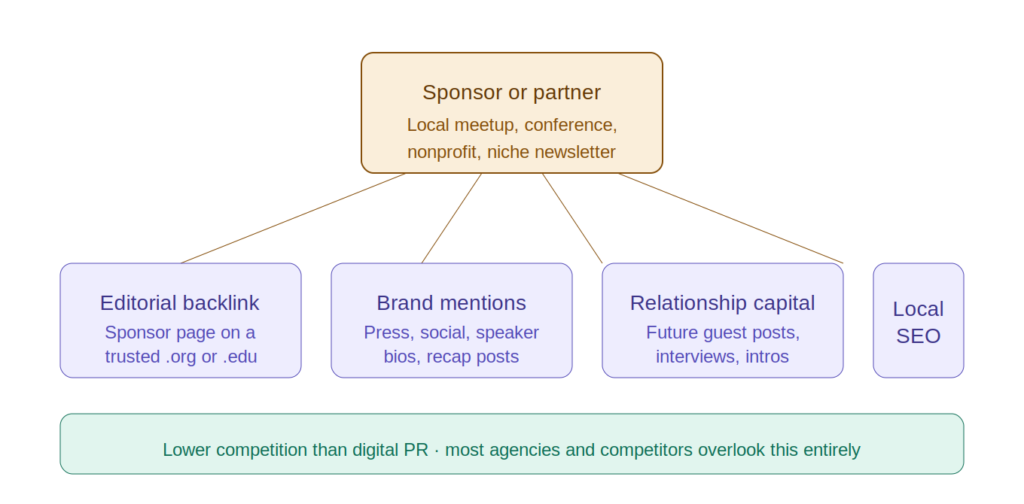
Compound authority from influencer partnerships is powerful. But there’s an even simpler method that requires no content calendar, no follower count, and sometimes less than $200: sponsoring a local event, university club, or nonprofit organization in exchange for a backlink from their website.
Most SEO guides never mention it. Almost every organization that accepts sponsors publishes a sponsors page, and those pages sit on .org, .edu, and established local domains with trust signals that pure outreach campaigns rarely achieve.
According to Moz’s Domain Authority research, links from .edu and .gov domains carry disproportionate trust weight in Google’s algorithm because these domains are structurally harder to manipulate and carry decades of accumulated authority. A single link from a university’s student club page can outperform dozens of links from mid-tier blogs.
Here’s how to execute this as a repeatable white-hat link-building system:
Identify targets. Search Google for
"sponsors" site:.eduor"our sponsors" [your city] site:.org. Filter for pages where the sponsors list already includes a linked logo or URL. This confirms the site will actually publish a link, not just a name.Qualify the domain. Check the domain’s authority using any AI-powered SEO platform before reaching out. Target DR/DA 30+ for maximum impact, though smaller local .org links still contribute genuine trust signals.
Make the offer. Email the event organizer, department coordinator, or nonprofit director with a flat sponsorship offer. For local 5K races, university hackathons, or regional industry meetups, $100 to $500 typically secures a sponsor credit with a follow-up link. Larger conferences start around $500 to $2,000, but their domain authority and audience size often justify the spend.
Confirm the link placement. Before paying, ask for a sample sponsors page or confirm the URL where your link will appear. Specify that you want a text link or logo link pointing to your homepage or a specific landing page.
Scale systematically. One sponsorship per month over 12 months builds a portfolio of 12 high-trust, contextually diverse links from real organizations. That’s the kind of link profile that looks completely natural because it is completely natural.
Pro Tip: University department sponsorships are the most underused source of university backlinks. Reach out to computer science, marketing, or business school clubs that run annual events. Many have sponsor packages starting at $100 and publish a dedicated sponsors page on the university’s primary .edu domain.
Real-world examples make the math obvious. Sponsor a city parks department 5K run: you get a backlink from a .org domain tied to municipal infrastructure. Sponsor a university entrepreneurship club’s pitch competition: you earn a .edu backlink alongside Fortune 500 logos. Neither requires a PR agency or a six-figure budget.
Best for: Local businesses, regional service providers, and niche B2B brands that want authoritative community partnership SEO signals without the unpredictability of media outreach.
Key differentiator: Sponsorship backlinks are the only link type where you pay for the relationship first, and the link follows as a natural byproduct, making them entirely compliant with Google’s link spam policies when the sponsorship is genuine.
Strategic sponsorships turn marketing budget into one of the cleanest, most durable link acquisition channels available, especially for sites that have already exhausted their immediate outreach network.
Off-Page SEO Strategies Compared: Which Tactic Fits Your Site Right Now?
Choosing between 10 tactics without a decision framework is how SEO budgets get wasted. This off-page SEO comparison maps every strategy against the factors that actually matter for prioritization.
| Strategy | Difficulty | Time to Results | Cost | Best For | Primary Benefit |
|---|---|---|---|---|---|
| 1. High-Authority Link Building | High | Months | $$$ | All | Links + Authority |
| 2. Guest Blogging | Medium | Months | $ | All | Links + Traffic |
| 3. Digital PR | High | Months | $$$ | National/Ecommerce | Authority + Links |
| 4. Unlinked Mention Reclamation | Low | Weeks | Free | All | Links |
| 5. Community & Forum Engagement | Low | Months | Free | All | Brand + Traffic |
| 6. Local Citations & GBP | Low | Weeks | Free/$ | Local | Authority + Rankings |
| 7. Podcast & YouTube | Medium | Months | $ | All | Authority + Brand |
| 8. Influencer Collaborations | Medium | Weeks | $$ | Ecommerce/National | Brand + Traffic |
| 9. Content Repurposing | Low | Months | Free | All | Links + Traffic |
| 10. Strategic Sponsorships | Low | Weeks | $ | Local/National | Links |
According to Ahrefs’ 2024 link building survey, 65% of SEOs say link building is the hardest part of their job, which makes sequencing your efforts correctly even more valuable than the tactics themselves.
New sites should stack the three lowest-effort, highest-signal tactics first: unlinked mention reclamation (Strategy 4), local citations or GBP (Strategy 6), and content repurposing (Strategy 9). These build foundational authority without requiring an existing audience or outreach budget.
Established sites with Domain Rating above 40 should shift toward digital PR (Strategy 3), guest blogging (Strategy 2), and strategic sponsorships (Strategy 10) for compounding link equity. If you’re running an e-commerce property, pairing this approach with a well-optimized technical foundation, covered in the best technical SEO tools guide, ensures off-page gains actually convert to rankings.
Pro Tip: Run through this table as an off-page SEO checklist quarterly. As your domain authority grows, the “High Difficulty” tactics become proportionally more achievable, and your link building ROI improves with each tier you unlock.
Last updated: 2026-05-01
Frequently Asked Questions
What is the difference between on-page SEO and off-page SEO?
On-page SEO refers to optimizations you make directly on your website, such as content, title tags, and internal links. Off-page SEO covers everything that happens outside your site, including backlinks, brand mentions, social signals, and third-party content. Both work together, but off-page SEO is largely about building trust and authority in the eyes of search engines and real users.
How long does off-page SEO take to show results?
Most off-page SEO efforts take anywhere from three to six months before you see measurable improvements in rankings or traffic. Tactics like unlinked brand mention reclamation can produce faster results, while link-building campaigns from high-authority sites may take longer to gain traction. Consistency matters more than speed, so treat off-page SEO as an ongoing process rather than a one-time project.
Do social media signals directly affect Google rankings?
Google has officially stated that social media signals are not a direct ranking factor. However, social media activity can indirectly support SEO by increasing content visibility, driving referral traffic, and attracting backlinks from people who discover your content through those platforms. Think of social media as a distribution channel that amplifies your off-page efforts rather than a ranking lever on its own.
Are backlinks still the most important off-page SEO factor in 2026?
Backlinks remain one of the strongest off-page ranking signals, but quality now outweighs quantity by a significant margin. A single link from a highly relevant, authoritative site can carry more weight than dozens of links from low-quality sources. Google has also gotten better at evaluating brand authority through signals beyond links, so a well-rounded off-page strategy will outperform a link-only approach.
Can small businesses compete with larger sites using off-page SEO?
Yes, and off-page SEO is actually one of the areas where small businesses can punch above their weight. Tactics like local citation building, Google Business Profile optimization, community engagement, and micro-influencer partnerships are accessible and cost-effective for smaller budgets. Focusing on a specific niche or local audience allows small sites to build genuine authority without competing head-to-head with enterprise-level domains.
Is guest blogging considered a safe SEO strategy, or does Google penalize it?
Guest blogging is safe when done with a focus on relevance, quality, and genuine value for the reader. Google penalizes manipulative guest posting schemes that exist purely to pass links through low-quality or unrelated sites. Publishing well-researched articles on reputable sites within your industry is not only safe but remains one of the more effective ways to build authority and referral traffic.
What off-page SEO strategies work best for new websites with no authority?
New websites typically see the fastest early gains from unlinked brand mention reclamation, community and forum engagement, and local citations if they serve a geographic area. These tactics do not require existing authority to execute and can help establish an initial footprint of trust signals. Pairing these with one or two strong guest posts on relevant sites gives new domains a solid off-page foundation to build from.
Conclusion
Off-page SEO in 2026 rewards one thing above all else: genuine authority earned across the wider web. Every strategy covered in the 10 off-page SEO strategies that (still) work comes back to the same core principle, whether you are building high-quality backlinks, appearing on podcasts, or reclaiming unlinked brand mentions. Google is not looking for volume. It is looking for trust signals that real people and real publications are vouching for your site.
The two ideas worth holding onto are these: quality consistently beats quantity, and diversification protects you when any single channel shifts.
Here is your concrete next step. Open Google Search Console today and pull your current backlink profile. Identify where your authority stands right now, then choose two or three strategies from this list that match your site’s current level. From there, map out a focused 90-day execution plan and commit to it.
Consistency over the next three months will move the needle more than chasing every tactic at once.