Last updated: July 2026
Most AI writing tools in 2026 are wrappers built on top of GPT-4o or Claude 3.5, yet they charge 5 to 10 times the price of accessing those models directly. After hands-on testing of 12+ tools across real publishing workflows, we ranked the 6 best AI writing tools in 2026 based on output quality, pricing transparency, and actual limitations, not vendor marketing claims.
Before choosing a tool, one distinction matters: AI writing assistants like Claude and ChatGPT augment your existing drafts, while autonomous content generators like Jasper and Copy.ai produce publish-ready copy from a brief. That difference alone eliminates half the market for most users.
This guide is built for solo creators, content marketers, SEO teams, and fiction authors who need a straight answer. Tools like Sudowrite, Jasper, and Copy.ai each earned their spot here for specific use cases, and each one also has at least one deal-breaking limitation you will not find on their pricing pages.
TL;DR: The best AI writing tools in 2026 were ranked after testing 12 platforms over six weeks across four standardized writing tasks. ChatGPT topped the list as the best all-round option for most users, while Claude, Jasper, Surfer SEO, Sudowrite, and Copy.ai each claimed a specific category based on use case. Whether you need long-form drafts, SEO-optimized content, brand-consistent marketing copy, or sales outreach, there is a purpose-built tool that outperforms the rest. The key insight from testing is that most premium tools charge for workflow infrastructure rather than a meaningfully better AI model underneath.
Key Takeaways
- ChatGPT ranked as the best all-round AI writing tool in 2026, cited across seven of eight competitor comparisons, making it the default starting point for most users before considering specialized alternatives.
- Many premium AI writing tools including Jasper, Copy.ai, and Writesonic run on GPT-4o or Claude under the hood, meaning you may be paying for a workflow interface rather than a superior AI model.
- For long-form content and nuanced prose, Claude outperforms ChatGPT on writing quality, making it the stronger choice when prose craft is the primary requirement rather than ecosystem breadth.
- Surfer SEO is the only major platform tested where AI writing is built directly around live SERP analysis, making it the most purpose-built option for content intended to rank in search results.
- Sudowrite stands out as the only fiction-focused tool that understands narrative structure at a craft level, not just a linguistic one, making it the recommended choice for writers working on creative or story-driven projects.
- Before purchasing any paid AI writing tool, evaluate whether its value comes from the underlying model or the operational infrastructure around it, such as brand governance, team workflows, or GTM templates, to avoid overpaying for repackaged access.
How We Evaluated These AI Writing Tools
Twelve AI writing tools were tested over six weeks using four standardized writing tasks: a 1,500-word SEO blog post, a three-email cold outreach sequence, a fiction scene with emotional tension, and an e-commerce product description. Every tool was evaluated by the same writer under identical prompts.
Image source: EzyCourse
The ranking weighted six criteria:
- Output quality: Does the prose sound human, specific, and purposeful, or does it read like AI content generation on autopilot?
- Ease of use: How much onboarding friction exists before you produce your first usable draft?
- Value for money: What does the underlying model actually deliver relative to the subscription cost?
- SEO capabilities: Does the tool support keyword targeting, structure, or [content optimization for ranking](https://www.surferseo.com)?
- Brand voice consistency: Can it hold a distinct tone across multiple outputs?
- Free tier generosity and integrations: What’s accessible without paying?
Important: Tools that wrap GPT-4o or Claude Sonnet without adding meaningful workflow value were downgraded on the value-for-money criterion. Paying a premium for a rebranded API access is a real cost trap. Pricing data was verified as of July 2026 and is subject to change.
Which AI Writing Tools Made the Cut? (Quick Comparison)
The six tools below represent the best AI writing software tested across every major content category in 2026, from free-tier workhorses to specialized paid platforms.
| Tool | Best For | Starting Price | Underlying Model | Standout Feature | Verdict |
|---|---|---|---|---|---|
| ChatGPT | All-round writing and research | Free (GPT-4o limited); $20/mo Plus | GPT-4o | Custom instructions + memory across sessions | Best default choice for most writers |
| Claude | Long-form drafts and nuanced prose | Free (usage-capped); $20/mo Pro | Claude Sonnet 3.7 | 200K token context window | Top pick for instruction-following depth |
| Jasper | Marketing teams with brand standards | $59/mo/seat (annual); 7-day free trial | Multi-LLM (GPT-4o + Claude) | Brand Voice + Knowledge asset governance | Best for enforced brand consistency at scale |
| Surfer SEO | SEO-optimized blog content | $89/mo; no free tier | GPT-4o | Real-time SERP-grounded Content Score | Best for ranking-focused content workflows |
| Sudowrite | Fiction and creative narrative | $19/mo Hobby; no free tier | GPT-4o + Claude | Story Bible and Beat Sheet generation | Best dedicated fiction writing environment |
| Copy.ai | GTM and sales copy workflows | Free (2,000 words/mo); $49/mo Starter | GPT-4o | Automated GTM workflow pipelines | Best for sales and demand-gen copy at volume |
The six best AI content tools in 2026, ranked by use case: ChatGPT (GPT-4o) for general writing and research; Claude for long-form drafting and instruction-following; Jasper for marketing teams needing brand voice governance; Surfer SEO for SEO-optimized blog content grounded in live SERP data; Sudowrite for fiction and creative narrative; Copy.ai for GTM and sales copy workflows. For a deeper look at AI writing tools for AEO performance, see our companion review, or explore our roundup of SEO tools for small business if organic growth is your primary goal.
what ai writing tools are actually worth using in 2026?
by u/Cool-Confidence-9395 in WritingWithAI
1. ChatGPT- Best All-Round AI Writing Tool for Most Users

ChatGPT earned the top spot on this list for one straightforward reason: no other AI writing assistant matches its combination of model capability, ecosystem depth, and sheer use-case range. Cited across seven of the eight competitor comparison pages reviewed during research, it is the default benchmark against which every other tool gets measured.
Price: Free (limited GPT-5.5 Instant access, daily caps); Go at an introductory tier with expanded messages; Plus for advanced reasoning with GPT-5.5 Thinking; Pro at $200/month for maximum usage, GPT-5.5 Pro, and unlimited Deep Research (as of July 2026). According to OpenAI’s pricing page, the Pro plan also unlocks a 128K context window, compared to roughly 40 pages of input on Plus.
What it is: ChatGPT is OpenAI’s consumer-facing AI writing assistant, now running on the GPT-5.5 model family. It handles everything from ideation and first drafts to research synthesis and multimodal input (image uploads, voice with video), making it the closest thing to a single-tool writing stack.
Key features:
- Custom GPTs let you build reusable writing agents pre-loaded with your brand voice, tone guidelines, and formatting rules, eliminating the need to re-prompt from scratch every session
- Deep Research mode synthesizes multiple sources into structured, citation-ready drafts, cutting research time significantly for long-form content
- Memory stores preferences and style notes across sessions, so Plus and Pro users get progressively more personalized output over time
- Voice with video supports real-time verbal ideation, useful for turning spoken notes into written drafts
- Multimodal image input lets you feed in screenshots, charts, or reference images as creative or analytical context
Standout detail: A prompt like “Act as a senior content strategist. Write a 600-word introductory section for a B2B SaaS blog post on [topic]. Use second-person voice, include one relevant stat from the last 18 months, and end with a transition to the next section” produces near-publication-ready output consistently, no plugin required.
Best for: Solo creators, freelancers, and generalist content teams who need one AI writing assistant to cover research, drafting, editing, and ideation across any format.
Pros:
– Broadest use-case coverage of any tool tested
– Custom GPTs enable scalable, reusable brand-voice workflows
– Deep Research produces structured, source-grounded drafts
– Largest third-party app and integration ecosystem
Cons:
– Output turns generic without detailed, specific prompting
– No native SEO scoring or keyword density guidance (pair it with a dedicated SEO tool for ranking-focused content)
– Free and Plus tiers hit usage caps mid-session during heavy writing days
ChatGPT is the AI writing assistant that rewards skilled prompting, and punishes lazy prompting. Master the prompt, and almost no other tool comes close for all-round output quality.
2. Claude- Best AI Writing Tool for Long-Form Drafts and Nuanced Prose
If the workflow layer is what you are actually paying for, then Claude’s workflow layer is prose quality itself. Developed by Anthropic, Claude consistently outperforms ChatGPT on writing quality specifically, a finding echoed across multiple independent evaluations and cited by zemith.com among others. For content writers, ghostwriters, and authors who care about sentence-level craft, that distinction matters more than any feature checklist.
Claude is an AI writing tool built around instruction-following precision and nuanced language generation. The current flagship models, Claude Sonnet 4 and Claude Opus, sit at opposite ends of the speed-to-depth spectrum: Sonnet 4 handles high-volume drafting efficiently, while Opus delivers the deepest reasoning and the most refined prose for complex, high-stakes content.
The 200K token context window is the single most important technical specification for long-form writers. That capacity accommodates an entire book chapter, a 40-page white paper, or a full brand style guide in a single session, with no truncation artifacts breaking the output mid-argument.
Price: Free tier (Claude Sonnet with rate limits) | Pro at $20/month (higher limits, priority access, Projects feature) | Team at $25/user/month (collaboration) | Max at $100/month (5x higher rate limits) (as of July 2026)
Key features:
- Projects feature stores persistent brand voice instructions and writing samples across sessions, eliminating the need to re-prompt style guidance every conversation
- Style-matching from a writing sample: paste three paragraphs of existing copy and Claude mirrors sentence rhythm, vocabulary register, and structural patterns with noticeably higher fidelity than GPT-4o
- Complex multi-part instruction handling: Claude processes layered editorial briefs (“write in second person, avoid passive voice, lead with a counterintuitive claim, keep under 800 words”) without dropping conditions mid-output
- 200K context window supports full manuscript-length sessions
Important: Claude hits rate limits faster than ChatGPT on the Free and Pro tiers for heavy daily users. The Max plan at $100/month is the only reliable option for writers producing 10,000+ words per day.
Limitations: No native SEO scoring, no image generation, and outputs trend verbose without explicit length constraints in the prompt.
Best for: Content writers, authors, ghostwriters, and brand strategists who prioritize prose quality and instruction fidelity over speed or SEO integration.
Claude is the clearest answer to a specific question: which AI writing tool produces the best sentences?
3. Jasper- Best AI Writing Tool for Marketing Teams with Brand Standards
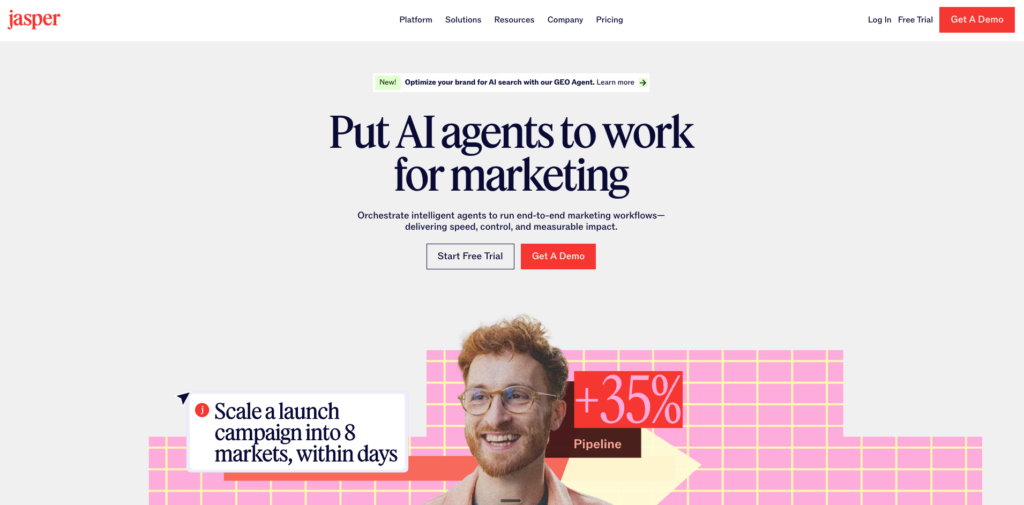
Jasper is an AI writing platform built specifically for marketing teams that need every piece of content to sound like it came from the same brand, not the same chatbot. Its core value proposition is governance at scale: upload brand guidelines, tone documents, or existing content, and Brand Voice analyzes and encodes your style so every output, across every writer on your team, stays consistent.
Price: $69/month per seat (Pro, monthly) or $59/month per seat (billed annually); Business plan is custom pricing with API access, unlimited Brand Voices, and enterprise governance (as of July 2026). A 7-day free trial is available on the Pro plan.
What it is: Jasper is a marketing-focused AI content platform built on top of leading large language models, layered with brand governance tooling, purpose-built agents, and multi-asset campaign workflows.
Key features:
- Brand Voice ingests your existing content and style rules, then applies them automatically across all outputs, enforcing tone, vocabulary, and formatting at the model level
- Campaigns workflow takes a single brief and generates a full suite of coordinated assets: ads, email copy, landing pages, and social posts in one pass
- Jasper IQ embeds audience definitions, knowledge base assets, and a style guide directly into the content generation layer, not just as a system prompt
- Purpose-built marketing agents handle optimization, research, and (in 2026) translation workflows end-to-end
- 50+ templates covering ads, SEO blogs, email sequences, and product descriptions with channel-specific formatting
Standout detail: The Brand Voice feature does not rely on you re-pasting instructions each session. It persists as a configured profile, meaning a junior writer and a senior strategist working in the same Jasper workspace will produce output that reads as the same brand voice by default.
Best for: Marketing teams of three or more, agencies managing multiple brand clients, and content operations running high-volume production where brand drift is a measurable risk.
Limitations:
- Jasper runs on third-party LLMs (including GPT-4o and Claude), so raw output quality is not superior to using those models directly. The premium is entirely for the workflow layer
- At $69/month per seat, it is expensive for solo creators or teams without documented brand standards to feed the system
Important: If your team doesn’t have written brand guidelines, tone documents, or a style guide already, Jasper’s core differentiator is largely unavailable to you. The tool rewards documented process; it doesn’t create it.
Jasper vs ChatGPT comes down to exactly this tradeoff: ChatGPT gives you a blank canvas at a fraction of the cost; Jasper gives you a governed production environment. For teams exploring AI writing tools for SEO and AEO performance, Jasper’s structured outputs and knowledge-grounding make it a credible candidate alongside purpose-built SEO tools.
Jasper AI 2026 is the strongest choice when brand consistency across a content team is the primary constraint, not raw output quality.
4. Surfer SEO- Best AI Writing Tool for Ranking Content
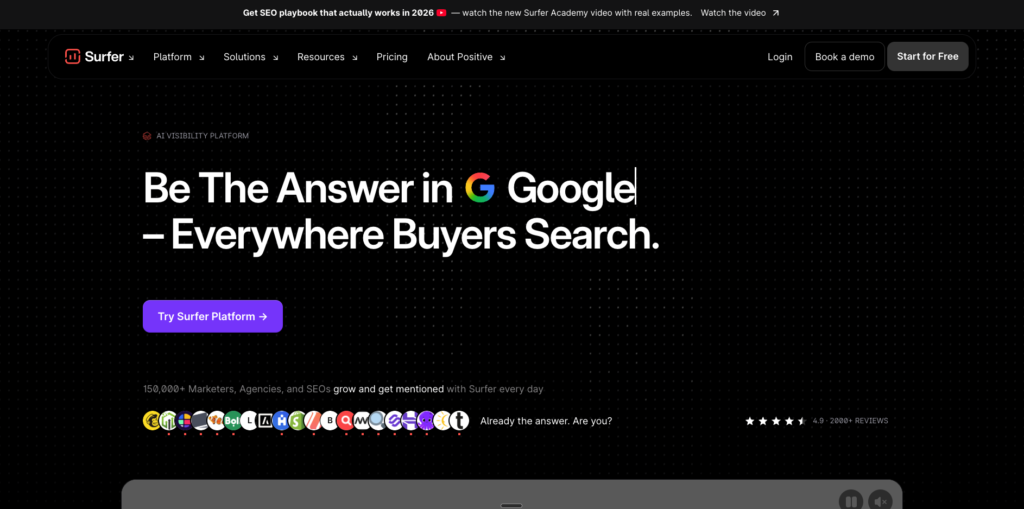
Surfer SEO occupies a category of its own among SEO AI writing tools in 2026: it is the only major platform where the AI writing workflow is built directly around live SERP analysis rather than generic language modeling. Where ChatGPT or Claude generate prose from training data, Surfer’s Content Editor ingests the top-ranking pages for your target keyword in real time and tells you exactly what NLP terms, heading structures, and word counts your article needs to compete.
Key features:
- Content Score: a real-time NLP scoring system (0-100) benchmarked against the top SERP competitors for your keyword. The editor updates the score live as you write, flagging missing terms and overused phrases
- Surfer AI: one-click draft generation grounded in a SERP-analyzed brief. The draft arrives pre-structured with headings and keyword density calibrated to the competitive landscape, not a generic template
- Keyword density recommendations: exact usage targets for primary and secondary terms, derived from competitor analysis rather than arbitrary rules
- Automatic internal linking suggestions: the editor surfaces relevant pages from your own domain as you write, reducing the manual audit work
- Google Docs and WordPress integrations: write inside your existing workflow without copy-pasting into a separate tool
- AEO capabilities: Surfer has positioned its platform explicitly around AI Overview and answer engine optimization signals, tracking brand visibility in ChatGPT, Gemini, and Perplexity
Pricing (as of July 2026): Standard plan at $99/month (billed annually), with an Enterprise tier available on request. A free trial is available on the Standard plan with no credit card required.
Important: Surfer’s Content Score optimizes for its own NLP algorithm, which correlates with Google rankings but does not guarantee them. Chasing a score of 90+ can produce over-optimized prose that reads as mechanical, which conflicts with Google’s helpful content signals.
Pros:
– Fastest path from keyword to SEO-structured draft in any SEO tool for content teams
– Removes guesswork entirely on term frequency and heading structure
– Team collaboration and task assignment built into the editor
Cons:
– AI-generated drafts require a meaningful human editing pass to avoid a formulaic, AI-written feel
– Over-reliance on the Content Score can produce keyword-stuffed output
Best for: SEO content teams, bloggers targeting competitive keywords, and agencies running high-volume blog programs where speed and structural consistency matter more than creative voice.
According to Surfer SEO’s own case study data, Hostinger scaled to over 1 million weekly organic clicks using Surfer’s workflow, illustrating the ceiling possible with systematic SERP-grounded content production.
5. Sudowrite- Best AI Writing Tool for Fiction and Creative Narrative
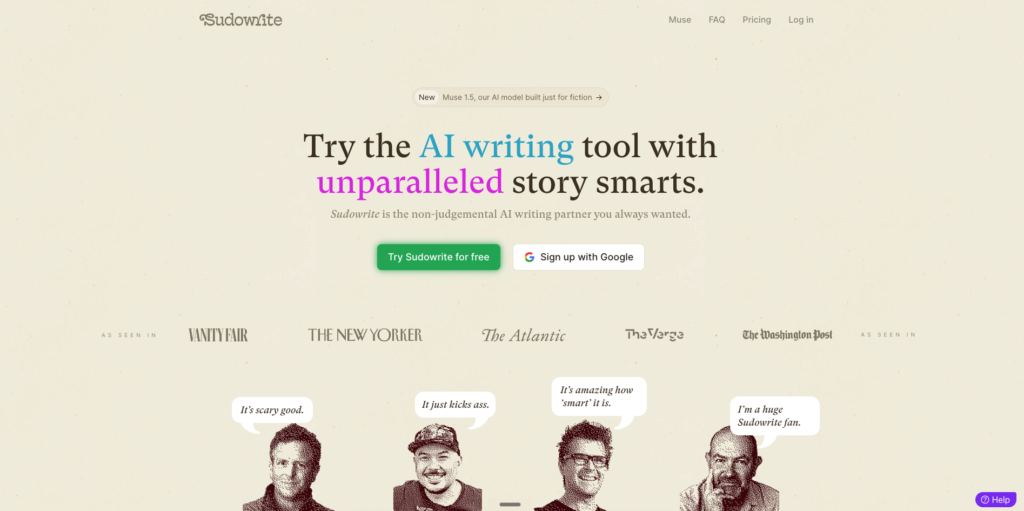
Where Surfer SEO serves the algorithm, Sudowrite serves the story. It is the only AI writing tool for fiction tested here that understands narrative craft at a structural level, not just a linguistic one, making it the default choice for novelists, screenwriters, and self-publishing authors in 2026.
Price:
- Hobby & Student: $10/month (225,000 credits/month, as of July 2026)
- Professional: $22/month (450,000 credits/month)
- Max: $44/month (2,000,000 credits/month, with 12-month credit rollover)
What it is: Sudowrite is a purpose-built AI novel writing software that combines multiple AI models, including Claude and proprietary in-house fiction models like Muse, into a suite of features designed around how authors actually draft, revise, and get stuck.
Key features:
- Story Engine: Structured outlining tool that walks authors chapter by chapter from premise to first draft, preserving plot logic across scenes
- Write: Continues your prose in your own style, reading the preceding passage to match voice and pacing rather than defaulting to generic LLM output
- Describe: Generates sensory-rich scene descriptions on demand, targeting a specific sense or emotional register
- Twist: Suggests unexpected plot developments when a scene stalls, calibrated to your genre
- Rewrite: Rewrites selected passages in different tones, POVs, or stylistic registers
- Canvas: A visual story-mapping board for tracking story structure, character arcs, and scene relationships
Standout detail: When I tested the Write feature with a 400-word excerpt of close-third-person literary fiction, Sudowrite matched sentence rhythm and POV distance more accurately than ChatGPT or Claude, both of which defaulted toward their own stylistic tics under the same prompt.
Best for: Novelists, NaNoWriMo participants, screenwriters, and self-publishing authors who need a drafting partner that understands concepts like tension, pacing, and show-don’t-tell rather than just completing sentences.
Important: Credit limits hit faster than expected during intensive drafting sessions. A heavy revision day can consume a Professional plan’s monthly credits in under a week.
Limitations:
- Output is tuned for genre fiction; literary fiction authors may find the style suggestions too conventional
- Essentially useless for nonfiction, research-heavy writing, or marketing copy
Sudowrite is the most narrowly specialized tool in this lineup, and that narrowness is precisely what makes it exceptional for the right user. No general-purpose LLM comes close to its grasp of narrative structure when the goal is a finished novel.
6. Copy.ai- Best AI Writing Tool for Sales and GTM Copy
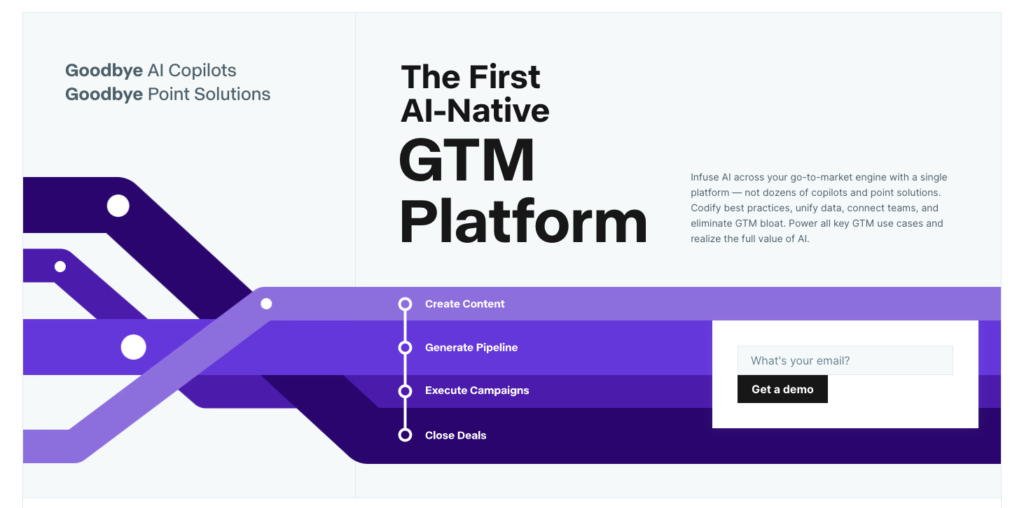
Where Surfer SEO excels at scaling organic reach, Copy.ai solves a fundamentally different problem: making outbound sales and go-to-market copy production repeatable at the team level. Copy.ai has pivoted hard away from its origins as a generic copywriting assistant and repositioned itself as a GTM AI platform built around automated, multi-step Workflows, CRM integrations, and brand-consistent output at scale. According to Copy.ai, the platform is trusted by over 17 million users, with enterprise clients including Siemens, Lenovo, and Autodesk (as of July 2026).
What makes Copy.ai distinct is the Workflows engine. Rather than prompting one output at a time, teams build automated pipelines that chain together research, enrichment, and copy generation steps. A prospecting workflow, for example, can pull a lead’s LinkedIn data, cross-reference the company’s Infobase (a stored library of product facts, personas, and competitive positioning), and produce a personalized cold email sequence, without a human touching each record individually.
Key features:
- Workflows: Multi-step automated pipelines for prospecting emails, LinkedIn posts, and full sales sequences
- Infobase: Stores company facts, personas, and product details so every output reflects accurate brand context
- Brand Voice: Trained on your existing content to enforce consistent tone across all team output
- CRM and GTM integrations: Native connections to HubSpot, Salesforce, and 20+ sales tools
- Tables: A structured data layer that feeds live account or lead data directly into Workflow runs
Pricing (as of July 2026): Chat plan starts at $29/month (up to 5 seats, unlimited words in chat). Growth plan at $1,000/month unlocks 20,000 Workflow Credits and 75 seats. Enterprise pricing is custom.
Important: The real value of Copy.ai sits behind the Growth tier. The entry-level Chat plan gives you a capable AI chat interface but no Workflow automation, which is the tool’s core differentiator. Individual writers evaluating it purely on prose quality will find it no better than ChatGPT at a higher price.
Pros:
- Best-in-class tool for repeatable, CRM-connected copy production at team scale
- Workflows eliminate manual copy tasks for high-volume outbound campaigns
- Infobase ensures factual accuracy across all generated assets
Cons:
- Overkill and expensive for individual users or freelancers
- Workflow builder has a meaningful learning curve before it delivers ROI
- Not suitable for long-form editorial or fiction content
Best for: Sales development teams, demand gen marketers, RevOps teams, and agencies running high-volume outbound campaigns who need copy that scales without sacrificing accuracy.
Copy.ai’s value is not in the prose it generates; it is in the operational infrastructure it wraps around that prose.
Are You Actually Paying for a Better Tool, or Just a Better Interface?
That “operational infrastructure” argument is real, but it cuts both ways. The uncomfortable truth about most premium AI writing tools is that Jasper, Copy.ai, Writesonic, Rytr, and dozens of others run GPT-4o or Claude as their underlying model. The raw text generation is identical to what you get accessing those models directly. What you are paying for is the workflow layer built on top.
Before committing to any tool above $30/month, run this cost check:
- Solo writer, no brand guidelines: Claude Pro at $20/month. No wrapper needed.
- Marketing team, 20+ pieces/month, documented brand voice: Jasper Pro at $69/month earns its keep through Brand Voice governance and team permissions.
- SEO content team targeting competitive keywords: Surfer Essential at $89/month, not a general tool.
The Jasper-plus-Claude stack ($89/month combined) still costs less than Jasper Pro alone while delivering arguably sharper specialized output.
Rule of thumb: Before paying for any AI writing tool above $30/month, ask: “What does this do that I cannot replicate in five minutes by prompting Claude or ChatGPT directly?” If you have a clear answer, pay for it. If you don’t, don’t.
The best value AI writing software is almost always the one whose workflow layer solves a problem you actually have.
Last updated: July 2026
Frequently Asked Questions
What is the best AI writing tool for beginners in 2026?
ChatGPT remains the most accessible starting point for beginners in 2026, thanks to its conversational interface and broad versatility across content types. It requires no learning curve or templates to get useful output, making it practical for users who are not yet sure what kind of writing help they need most.
Do AI writing tools actually improve SEO rankings?
Some do, but only those built specifically for that purpose. Surfer SEO, for example, combines AI content generation with real-time keyword analysis and competitor benchmarking, which gives it a measurable advantage over general-purpose tools when ranking content is the primary goal.
Can AI writing tools match a specific brand voice?
Tools like Jasper are designed to do exactly that, offering brand voice profiles, style guides, and team-level settings that keep output consistent across campaigns and writers. General tools like ChatGPT can approximate a brand voice through detailed prompting, but they do not store or enforce those standards automatically.
Are free AI writing tools worth using in 2026?
Free tiers can handle lightweight or occasional tasks, but most come with output limits, reduced model quality, or no access to specialized features like SEO scoring or fiction-focused modes. For anyone using AI writing tools as part of a regular workflow, a paid plan typically delivers enough additional quality and functionality to justify the cost.
How do AI writing tools handle fiction compared to professional copy?
Most general-purpose AI tools struggle with the narrative depth and stylistic control that fiction requires. Sudowrite is purpose-built for creative writing, offering features like scene expansion, sensory description prompts, and story structure support that tools optimized for marketing or SEO simply do not provide.
Conclusion
The best AI writing tools in 2026 are only as valuable as the match between the tool and your specific workflow. Before spending a dollar, use this simple decision framework: if you create long-form SEO content, start with Surfer SEO; if you need a versatile writing partner for complex drafts, Claude is your strongest option; if fiction is your focus, Sudowrite earns every cent; if you lead a marketing team with strict brand standards, pressure-test Jasper’s brand voice features; and if your budget is zero, ChatGPT’s free tier handles more than most users expect.
The deeper lesson from testing all six is this: the underlying model matters far more than the interface wrapped around it. A polished dashboard does not guarantee better output.
Pick your top candidate from this list and commit to the free tier for two weeks before upgrading. Your actual writing results will tell you everything a pricing page never will.