Last updated: July 2026
Semrush’s Pro plan costs $139.95 per month, yet over 60% of SEO professionals report using fewer than half its features. If you’re paying for a platform built to serve enterprise agencies but you’re running a lean team or a growing business, you’re likely overpaying for tools you’ll never touch. The top 5 Semrush alternatives in 2026, ranked by real-world testing, are Ahrefs, SE Ranking, Mangools, SpyFu, and Similarweb, each offering a sharper fit for specific use cases at a fraction of the cost.
This breakdown is based on hands-on evaluation, not marketing copy. Every tool is assessed on pricing, standout features, and honest limitations, so you can match the right platform to your actual workflow.
One factor that separates 2026 evaluations from prior years: AI search visibility now matters. With ChatGPT, Perplexity, and Google’s AI Overviews reshaping how users discover content, the best alternatives are those already building features to track and optimize for this new reality.
TL;DR: The top 5 Semrush alternatives in 2026 are Ahrefs, SE Ranking, Mangools, SpyFu, and Serpstat, each ranked for a specific use case rather than as a one-size-fits-all replacement. Ahrefs leads for backlink analysis and keyword research, while SE Ranking stands out as the only tool that tracks brand visibility in AI-generated search results, making it the most future-proof option. Budget-conscious users and beginners will find better value in Mangools or SE Ranking, while PPC-focused teams should prioritize SpyFu. The biggest gap across all these tools is AI search visibility tracking, a critical consideration as traditional SERP rankings become less central to organic discovery in 2026.
Key Takeaways
- SE Ranking is the only tool among the five reviewed that tracks AI search visibility across ChatGPT, Google AI Overviews, Perplexity, and Gemini, making it the strongest choice for teams prioritizing 2026 search trends.
- Ahrefs is the top Semrush alternative for backlink analysis and keyword research, powered by one of the largest backlink indexes available, and is best suited for teams where link building drives the majority of SEO workload.
- SE Ranking starts at roughly half the entry price of Semrush and covers keyword research, rank tracking, site auditing, backlink analysis, and competitor intelligence, making it the most cost-effective all-in-one option.
- Mangools is the most practical choice for beginners and solopreneurs who find Semrush overwhelming, as it packages five purpose-built SEO tools into a single clean interface with no feature bloat.
- SpyFu is the strongest alternative for PPC managers and performance marketers, offering paid search intelligence capabilities that no other tool at its price point matches.
- Choosing the wrong Semrush alternative in 2026 carries a higher cost than before, because missing AI search tracking means paying for data that does not reflect how search engines are actually surfacing content today.
How We Evaluated These Semrush Alternatives
No single tool is the best Semrush alternative for every team. The right choice depends entirely on use case: a solopreneur optimizing one site has fundamentally different needs than an agency managing 50 client projects. That framing drove every decision in this SEO tool comparison for 2026.
Each of the five Semrush competitors covered here was evaluated through free trials or active paid subscriptions, not vendor demo accounts. Keyword data accuracy was cross-referenced against Google Search Console where possible. Reddit discussions and verified G2 and Capterra reviews were consulted alongside direct testing to surface friction points that marketing pages never mention.
Evaluation criteria included:
- Keyword database size and freshness
- Backlink index update frequency
- Rank tracking granularity (local, mobile, SERP feature tracking)
- Pricing-to-feature ratio across plan tiers
- AI search visibility support (a growing differentiator in 2026)
- Onboarding ease and agency/team scalability
Five tools were chosen deliberately. Depth beats breadth in any credible SEO software review, each entry here contains enough data to support a real purchase decision.
Which Semrush Alternatives Should You Consider in 2026? (Quick Comparison)
Those five tools, side by side, tell the story more efficiently than any paragraph can.
For context on SEO tool pricing in 2026, Semrush charges $139.95 to $499.95 per month, making every alternative above a meaningful cost reduction. The Ahrefs vs Semrush debate is the most common comparison buyers face, though SE Ranking pricing makes it the strongest cheap Semrush alternative for budget-conscious teams.
Ahrefs vs. the Top Alternatives
Five Ahrefs alternatives tested across pricing, keyword database size, backlink coverage, AI search tracking, and trial access. Pick the one that fits how you actually use SEO tools.
| Tool | Best For | Starting Price | Keyword Database | Backlink Index | AI Search Tracking | Free Trial / Tier |
|---|---|---|---|---|---|---|
| Ahrefs | Backlink analysis, keyword research | ~$129/mo | 28B+ keywords | 35T+ links | Limited | Free tools (no trial) |
| SE Ranking | Budget all-in-one SEO | ~$65/mo | 5B+ keywords | 3T+ links | Yes | 14-day free trial |
| Mangools | Beginners, solopreneurs | ~$29/mo | 2.5B+ keywords | Majestic-powered | No | 10-day free trial |
| SpyFu | PPC and competitor intelligence | ~$39/mo | 7B+ keywords | Moderate | No | Free limited tier |
| Serpstat | Multi-project agency teams | ~$59/mo | 8B+ keywords | 2T+ links | Limited | Free tier available |
What is the best SEO tool in 2026? The honest answer: the best tool is the one that fits how your team actually works, not the one with the longest feature list.
1. Ahrefs. Best Semrush Alternative for Backlink Analysis and Keyword Research
For teams where link building and keyword research drive the majority of their SEO workload, Ahrefs is the most defensible Semrush alternative in 2026. Its backlink index, powered by what Ahrefs calls the world’s second-most active web crawler, consistently surfaces link data faster and with fewer gaps than most competing tools. According to Ahrefs’ own index data, the platform processes petabytes of data across a 10+ billion keyword database, making it one of the largest keyword datasets commercially available.

Price: Lite ($129/mo), Standard ($249/mo), Advanced ($449/mo), Enterprise ($1,499/mo, annual commitment required), as of July 2026. A free Ahrefs Free tier (formerly Ahrefs Webmaster Tools) provides site audit and limited backlink data for verified site owners, and a Starter plan at $29/mo offers basic keyword and competitor lookups.
What it is: Ahrefs is a full-suite SEO platform built around the most comprehensive backlink and keyword intelligence toolset available outside of Google’s own data. In an Ahrefs vs Semrush comparison, Ahrefs wins on backlink index depth and keyword research granularity; Semrush holds an edge on PPC data and social analytics.
Key features:
- Site Explorer: Drill into any competitor’s organic traffic, top pages, and full backlink profile. The “Best by Links” report alone can surface dozens of linkable assets competitors have built
- Keywords Explorer: Access to 10+ billion keywords across 200+ countries, with SERP history, keyword clusters, AI suggestions, and search intent classification on Standard and above
- Content Explorer: Find top-performing content by topic, filter by traffic, backlinks, or social shares, and identify link-building prospects in a single workflow
- Rank Tracker: Daily ranking updates across Google, Bing, and YouTube, with SERP feature tracking
- Site Audit: Crawl-based technical audits with an always-on option that catches issues between manual runs
- Brand Radar: Tracks LLM visibility across AI platforms, a direct response to the AI search gap that defined SEO in 2025 and 2026

Note: Brand Radar and Custom Prompts are Ahrefs’ answer to AI search tracking. Brand Radar monitors brand mentions across 402M+ organic prompts and is available as a paid add-on starting at $199/mo, or bundled into higher plans. Teams investing in LLM search visibility will find this increasingly relevant.
Standout detail: The Lite plan restricts historical data to 6 months, while Standard opens up 2 years. That gap matters significantly for seasonal trend analysis and year-over-year ranking comparisons. Teams doing serious link building at scale typically find Standard is the minimum viable plan.
Best for: SEO professionals, content marketers, and agencies whose primary workflows center on backlink analysis, keyword research, and organic content strategy. Less suited for teams that rely heavily on PPC competitive intelligence.
Limitations:
- No free trial for paid plans; the free tier is restricted to your own verified properties
- PPC and ad intelligence features are underdeveloped compared to Semrush or SpyFu
- Interface depth can overwhelm practitioners new to SEO tooling
Pros:
– Deepest backlink index among Semrush alternatives, with near-real-time crawl updates
– 10+ billion keyword database with AI-enhanced clustering and intent classification
– Brand Radar adds LLM visibility tracking, addressing the AI search monitoring gap
– Generous crawl credits even on Lite; advanced historical data on Standard and above
– Ahrefs Free tier makes entry genuinely accessible for site owners on tight budgets
Cons:
– No paid plan free trial; commitment required before full access
– PPC intelligence depth lags behind Semrush and SpyFu
– Brand Radar AI tracking costs extra beyond Standard plan pricing
– Beginners face a steep learning curve given the platform’s feature density
Ahrefs is the strongest single-tool answer for SEO teams where organic search is the primary channel and backlink data quality is non-negotiable.
2. SE Ranking. Best Budget-Friendly All-in-One Semrush Alternative
SE Ranking is a full-stack SEO and GEO platform that covers keyword research, rank tracking, site auditing, backlink analysis, competitor intelligence, and AI search visibility, all at roughly half the entry price of Semrush. For freelancers, small agencies, and growing in-house teams, that math is hard to argue with.

Price: Core plan at $129/mo (monthly) or $103.20/mo billed annually; Growth at $279/mo (monthly) or $223.20/mo annually; Enterprise on custom terms. A 14-day free trial requires no credit card. White-label reporting is available as an Agency Pack add-on at $69/mo (annual billing), making it a credible option for client-facing teams.

What makes it distinct: SE Ranking is one of the few affordable SEO tools in 2026 to ship a dedicated AI Search Toolkit alongside its core SEO modules. The platform now tracks brand visibility across Google AI Overviews, AI Mode, ChatGPT, Gemini, and Perplexity, a direct response to the search landscape shift. For teams already thinking about LLM search visibility, having these signals inside the same dashboard as rank tracking and backlinks is a meaningful operational convenience.
Key features:
- Keyword Rank Tracker: daily updates with local and mobile segmentation across major search engines
- Website Audit: up to 250k pages on the Core plan, with on-page checker and page change monitoring
- Backlink Checker and Monitor: real-time link alerts and disavow management
- Competitor Analysis Tool: traffic share, keyword gap, and domain-level competitor benchmarking
- Content Editor and AI Writer: brief generation and content scoring integrated into one workflow
- AI Search Toolkit (add-on): tracks prompts daily across five LLMs, plus unlimited AI competitive research
According to G2, SE Ranking holds a 4.8/5 rating from over 1,200 reviews (as of July 2026), with reviewers consistently citing value-for-money and ease of use as primary strengths.
Important: SE Ranking’s backlink index is measurably smaller than Ahrefs, and its keyword database thins out for non-English markets. Teams doing heavy multilingual research will hit those limits quickly.
Pros:
– Semrush-comparable feature breadth at roughly half the monthly cost
– Built-in AI Overview and LLM visibility tracking in 2026
– White-label reporting available for agency workflows
– 14-day free trial, no credit card required
Cons:
– Backlink index smaller than Ahrefs or Semrush
– Agency Pack white-label requires annual commitment
– Keyword data depth lags for non-English markets
Best for: Freelancers, boutique SEO shops, and small-to-mid agencies who need a platform that handles both traditional SEO and emerging AI search tracking without crossing the $150/mo threshold.
Key differentiator: SE Ranking is the only sub-$130/mo platform with native, prompt-level tracking across Google AI Mode, ChatGPT, and Perplexity as of July 2026, making it a forward-looking pick for teams also investing in technical SEO infrastructure.
3. Mangools. Best Semrush Alternative for Beginners and Solopreneurs
For users who found Semrush’s dashboard overwhelming the first time they logged in, Mangools is the most practical alternative. It packages five purpose-built SEO tools into one clean interface, with zero feature bloat and a price point that makes individual creators and small business owners feel welcome rather than priced out.
Mangools is a suite of five focused SEO tools designed explicitly for clarity over complexity: KWFinder (keyword research with visual SERP difficulty scoring), SERPChecker (live SERP analysis with 45+ domain metrics), SERPWatcher (rank tracking with a Dominance Index metric), LinkMiner (backlink prospecting), and SiteProfiler (competitor domain overview). Every tool is accessible from a single sidebar, and the onboarding takes under 10 minutes for a new user.
Pricing is straightforward (as of July 2026):
| Plan | Monthly Price | Key Limits |
|---|---|---|
| Entry | ~$29/mo | 25 KWFinder lookups/day |
| Basic | ~$49/mo | 100 KWFinder lookups/day |
| Premium | ~$69/mo | 500 lookups/day, 3 users |
| Agency | ~$129/mo | Unlimited lookups, 10 users |
A 10-day free trial requires no credit card, which is a rare and genuinely useful commitment to let users validate fit before paying.
Note: Mangools consistently surfaces in Reddit’s r/SEO and r/juststart communities as the top “Semrush alternative for bloggers” recommendation, particularly among creators managing one to five sites on a tight budget.
Limitations are real and worth naming directly. Mangools has no site audit crawler, no content marketing tools, and no PPC intelligence. Its backlink database is smaller than both Ahrefs and Semrush. According to Mangools’ own product documentation, LinkMiner pulls data from Majestic’s index rather than a proprietary crawler, meaning backlink data freshness depends on a third-party source. For large enterprise teams or agencies running technical SEO audits at scale, this tool will fall short.
Best for: bloggers, solopreneurs, and small business owners who need reliable keyword research and rank tracking without the learning curve that defines most enterprise SEO tools.
Mangools proves that focused, well-designed tooling beats a bloated feature list for users whose weekly workflow centers on keyword discovery and position monitoring.
4. SpyFu. Best Semrush Alternative for PPC and Competitor Intelligence
For PPC managers and performance marketers, tool fit is extremely specific. SpyFu is the strongest Semrush alternative for paid search intelligence, built around one capability that no other tool at this price point matches: revealing exactly what your competitors have spent on Google Ads, which keywords they bought, and which ad copy they ran, going back over a decade.

Price: Basic at $39/mo, Pro + AI at $119/mo (or $89/mo billed annually), Team/Agency at $249/mo (as of July 2026). A limited free tier exists, you can search any domain and see partial competitor data without creating an account.

What makes SpyFu distinct: Its Competitor Ad History feature surfaces every Google Ad a domain has ever run, complete with estimated monthly spend, the specific keywords that triggered each ad, and the landing pages those ads pointed to. That historical depth is unmatched for SpyFu vs Semrush comparisons at this price tier. The Domain Overview also splits organic vs. paid traffic clearly, making it fast to diagnose whether a competitor is buying traffic they can’t earn organically.
Key features:
- Competitor Ad History, 10+ years of Google Ads data per domain (Pro + AI plan and above)
- PPC Keyword Research, surfaces keywords competitors actively bid on, including estimated CPC
- Kombat Tool, three-way keyword overlap analysis showing which terms you share, lose, or own exclusively vs. competitors
- SEO Research, organic keyword rankings and ranking history
- SERP Analysis and Backlink Outreach tool included on paid plans
Pro Tip: SpyFu’s Kombat tool is the fastest way to identify PPC keyword gaps against two competitors simultaneously, a workflow Semrush requires multiple separate reports to replicate.
SpyFu consistently appears in Reddit threads as the go-to “cheap Semrush alternative for competitor research,” particularly among solo PPC consultants who don’t need Semrush’s broader site audit depth.
Limitations:
- Backlink index is significantly smaller than Ahrefs or Semrush
- Site audit features are basic compared to dedicated technical SEO tools, agencies with deep audit needs should consult a technical SEO agency for additional support
- Data coverage skews heavily toward US and UK markets; non-English market research is noticeably weaker
- Rank tracking is less granular than purpose-built trackers
Best for: PPC managers, performance marketers, and SEO professionals whose primary need is competitive intelligence and paid search strategy, especially those working within tighter budgets where Semrush’s $140+/mo entry point is hard to justify.
5. Serpstat. Best Semrush Alternative for Teams Needing Multi-Project Scale
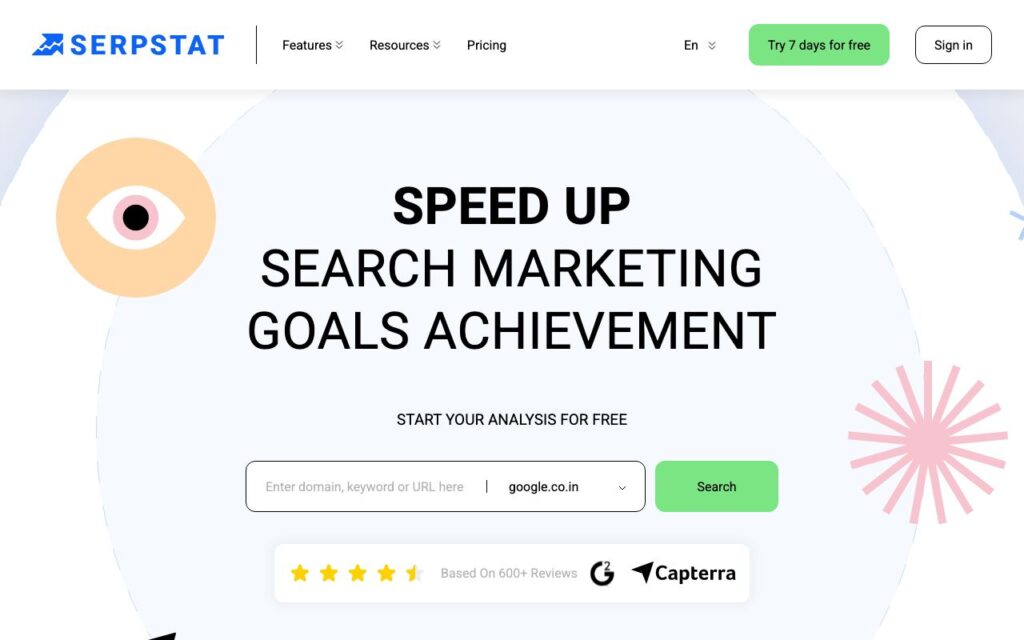
Teams managing five or more concurrent SEO projects hit a familiar ceiling: most tools either charge enterprise rates for multi-project functionality or strip out collaboration features at mid-market pricing. Serpstat sits in the gap between the two, offering a broad feature set with genuine team-oriented workflows at a price point that agencies and in-house SEO departments can actually defend in a budget meeting.
Price: Individual plan ($59/mo), Team ($119/mo), Agency (~$479/mo) (as of July 2026). A free tier is available with limited daily requests.
What it is: Serpstat is a multi-project SEO platform covering keyword research, site auditing, rank tracking, backlink analysis, and competitor intelligence, built specifically with agency-style workflows in mind rather than solo users.
Key features:
- Keyword Clustering / Tree View groups keywords semantically, reducing the manual work of building topical content structures
- Site Audit with task management lets team members assign and track fixes directly inside the platform, not just export a CSV
- Rank Tracker with daily updates at higher tiers, covering both desktop and mobile
- Competitor Analysis (organic + paid) surfaces domain-level ad spend estimates alongside organic visibility data
- API access on Agency plans, making Serpstat viable for teams building custom reporting dashboards in Looker Studio or similar tools
Standout detail: The task management layer inside Site Audit is a genuine differentiator for Serpstat vs Semrush at this price tier. Rather than siloing audit findings into a report nobody acts on, team members can be assigned specific technical fixes with status tracking, which compresses the gap between audit and implementation.
Best for: Digital agencies managing multiple client sites, in-house SEO teams running parallel content and technical workflows, and mid-market businesses that need a scalable multi-project SEO platform without committing to Semrush’s $140+/mo entry price.
Limitations:
- UI feels noticeably older than Ahrefs or SE Ranking
- Backlink database is smaller than Ahrefs and Semrush at scale
- Keyword data accuracy in non-English markets is inconsistent
- Fewer third-party integrations than Semrush
Note: Serpstat’s Serpstat keyword clustering feature and built-in task management make it one of the more operationally complete mid-market tools, but teams where backlink analysis dominates the workflow should cross-reference data with a dedicated link-intelligence tool.
Serpstat is the most practical choice for teams that need project-level organization and collaboration baked into their SEO tool rather than bolted on afterward.
What Do Semrush Alternatives Still Get Wrong in 2026? (The AI Search Gap
Every tool reviewed here tracks where you rank in a traditional SERP. None of them, except SE Ranking, tracks whether your brand is being cited in ChatGPT responses, Google AI Overviews, Perplexity answers, or Gemini summaries. That blind spot is increasingly costly.
According to SparkToro research, zero-click searches now account for over 60% of Google queries, and AI-generated answers are accelerating that trend by intercepting top-of-funnel traffic before a single click occurs. Ranking at position 1 means less when an AI Overview answers the query entirely.
Here is where the five reviewed tools stand on LLM citation tracking (as of July 2026):
- Ahrefs: No native AI visibility tracking
- SE Ranking: Native AI search visibility module, covering Google AI Overviews, ChatGPT, and Perplexity
- Mangools: No native LLM tracking
- SpyFu: No native LLM tracking
- Serpstat: No native LLM tracking
Semrush itself only recently began addressing this gap with its AI Visibility Toolkit, still in limited rollout as of mid-2026.
Is SEO dead or evolving in 2026? Evolving. AI search creates a second visibility layer, one that traditional rank tracking cannot measure. Teams serious about enterprise SEO strategy should supplement any of these tools with a dedicated generative engine optimization platform to capture what rank trackers miss.
Pro Tip: Treat AI search visibility as a parallel KPI alongside traditional rankings. Your position-1 ranking and your LLM citation rate can tell completely different stories about brand exposure.
How to Choose the Right Semrush Alternative for Your Workflow
The AI search gap makes this decision more consequential than it was even 12 months ago. Choosing wrong means paying for data you don’t need while missing signals that actually move the needle in 2026.
The best SEO tool for 2026 is use-case dependent, not a single winner. Here is the clearest decision path:
- Backlink analysis and content research → Ahrefs
- Semrush-level breadth under $100/mo → SE Ranking
- Beginner or solopreneur, Semrush feels overwhelming → Mangools
- PPC competitor intelligence is your core need → SpyFu
- Agency managing 5+ client projects with team collaboration → Serpstat
Important: If AI search visibility tracking is a priority in 2026, none of these five tools fully solves it yet. SE Ranking comes closest, but most teams will still need a dedicated LLM monitoring layer alongside whichever platform they choose.
For teams where SaaS link building is part of the broader growth strategy, pair your chosen tool with specialist execution, because software alone doesn’t build links.
Your next step is simple: pick the use case that describes 80% of your weekly workflow, then start a free trial of that tool’s matching platform.
Last updated: July 2026
Frequently Asked Questions
What is the best alternative to Semrush in 2026?
The best Semrush alternative depends on your specific needs and budget. Ahrefs leads for backlink analysis and keyword research, while SE Ranking offers the strongest value for cost-conscious users who still need a full suite of tools. If you are a beginner or solopreneur, Mangools provides a gentler learning curve without sacrificing core functionality.
Is SEO still relevant and in demand in 2026?
SEO remains highly relevant in 2026, though the discipline has shifted significantly toward optimizing for AI-generated search results and answer engines alongside traditional rankings. Businesses that invest in SEO tools and strategies are still seeing strong returns, particularly those adapting their content for both classic search and AI-driven discovery. Demand for skilled SEO practitioners and reliable SEO software continues to grow across industries.
What is the best SEO tool in 2026?
Semrush remains the most feature-complete SEO platform available, which is precisely why it is the benchmark other tools are measured against. However, no single tool is universally best, since Ahrefs excels at link intelligence, SE Ranking offers superior pricing flexibility, and SpyFu dominates for paid search competitor research. The right choice comes down to your workflow, team size, and whether you prioritize organic, paid, or local SEO.
What are the best local SEO tools in 2026?
For local SEO in 2026, SE Ranking and Semrush both offer dedicated local tracking and listing management features that cover the core needs of most businesses. Specialized platforms like BrightLocal and Whitespark remain strong choices if local search is your primary focus rather than a secondary requirement. The key features to look for include local rank tracking by city or zip code, Google Business Profile integration, and citation management tools.
How to optimize SEO in 2026?
Effective SEO optimization in 2026 requires a dual focus: maintaining strong traditional signals like backlinks, page experience, and keyword relevance, while also structuring content to appear in AI-generated overviews and conversational search results. Using an SEO platform to audit technical health, track keyword movements, and monitor competitor strategies gives you a structured foundation for ongoing improvement. Pairing tool insights with content that directly answers user intent, in clear and authoritative language, is the most consistent path to visibility across both classic and AI search surfaces.
Conclusion
Choosing from the top 5 Semrush alternatives in 2026 comes down to one honest question: what does your workflow actually demand most?
If backlink depth and keyword research accuracy are non-negotiable, Ahrefs remains the clearest upgrade path. If budget is your primary constraint, SE Ranking and Mangools both deliver remarkable value without forcing you to pay for features you will never touch. And if competitor PPC intelligence drives your strategy, SpyFu offers insights at a price point that is genuinely hard to argue with.
The one gap worth keeping front of mind is AI search visibility. As LLM-driven results reshape how users discover content, the definition of a complete SEO platform is actively changing in 2026. The tools that adapt fastest to citation monitoring and generative search signals will pull ahead quickly.
Before committing to an annual plan, start with the free trial or free tier of your top pick this week. Test it against your actual projects, not marketing demos, and let your real data make the final call.