Google’s AI Overviews now appear in over 50% of all search queries, compressing organic clicks faster than any algorithm update in the past decade. Yet pages built around deep semantic entity coverage consistently hold their positions, making the best semantic SEO tools to outrank competitors in 2026 no longer optional. They are the core infrastructure of any serious search strategy.
Table of Contents
- What Makes a Semantic SEO Tool Worth Using in 2026?
- Quick Comparison: Top Semantic SEO Tools at a Glance
- 1. Semrush – Best All-in-One Semantic SEO Suite
- 2. Ahrefs – Best for Entity-Based Competitor Gap Analysis
- 3. Surfer SEO – Best for Real-Time Semantic Content Scoring
- 4. Frase – Best for Search Intent Mapping and AI Content Briefs
- 5. Clearscope – Best for Editorial-Grade Topical Authority
- 6. Google Search Console – Best Free Semantic Baseline Tool
- 7. Moz Pro – Best for Domain Authority and Semantic Link Context
- 8. Screaming Frog + Schema Markup Tools – Best for Technical Semantic SEO Auditing
- How Schema Markup Strengthens Semantic Entity Signals
- Which Semantic SEO Tools Actually Help You Rank in AI Search – Not Just Google?
- How to Choose the Right Semantic SEO Tool Stack for Your Goals
- Frequently Asked Questions
- What is semantic SEO and how is it different from traditional keyword SEO?
- Do I need multiple semantic SEO tools or can one tool handle everything?
- Are semantic SEO tools worth the cost for small businesses or solo creators?
- How do semantic SEO tools help content rank in AI-powered search results like Google SGE?
- What is entity-based SEO and which tools support it best?
- Can I use free tools for semantic SEO or do I need a paid subscription?
- How long does it take to see results after optimizing content with semantic SEO tools?
- Conclusion
Semantic SEO tools go beyond keyword matching to map entities, topics, and contextual relationships across your content, signaling true topical authority to both traditional crawlers and LLM-powered search engines like ChatGPT, Perplexity, and Gemini.
2026 is a pivotal year because these AI-driven search surfaces reward comprehensive topic coverage over keyword density, rendering traditional rank trackers insufficient on their own. The eight tools reviewed here were evaluated across five criteria: entity coverage, topical mapping depth, content optimization accuracy, integration flexibility, and pricing transparency.
TL;DR: The best semantic SEO tools to outrank competitors in 2026 combine named entity recognition, topic cluster mapping, and AI search visibility tracking to go far beyond traditional keyword targeting. Semrush leads as the top all-in-one platform, while tools like Surfer SEO and Frase excel at real-time content scoring and search intent mapping respectively. Google Search Console remains the best free baseline option, delivering the raw signals that paid tools are built on top of. Rather than buying every tool available, the article recommends diagnosing your specific bottleneck first, since a focused two-tool stack used consistently will outperform a bloated suite of underused platforms.
Key Takeaways
- The best semantic SEO tools in 2026 combine named entity recognition, topic cluster mapping, and AI search visibility tracking, going far beyond traditional keyword research to analyze contextual relevance across your entire content graph.
- For most teams, a focused 2-tool stack used consistently will outperform a 10-tool subscription graveyard, so diagnose your primary bottleneck first before purchasing any platform.
- Google Search Console is the only free tool that provides direct, source-level semantic intent data at $0, making it the essential baseline before investing in paid tools like Frase ($49/mo) or Clearscope.
- Ranking in AI-powered answer engines like ChatGPT or Perplexity requires a different strategy than traditional Google SEO, and structured data alone is not sufficient to become a citable source in those environments.
- Surfer SEO scores your content against top-ranking pages in real time using NLP, making it the fastest option for closing semantic gaps before publishing, while Clearscope serves editorial teams at enterprise brands like Adobe, Shopify, and Deloitte that need higher grading precision.
- Technical semantic SEO, including schema markup validation via Screaming Frog, is the layer most content strategies ignore entirely, yet it directly supports how search engines and AI tools interpret and trust your site’s entity signals.
What Makes a Semantic SEO Tool Worth Using in 2026?
The best semantic SEO tools in 2026 combine named entity recognition, topic cluster mapping, and AI search visibility tracking. Unlike traditional keyword tools, they analyze contextual relevance across your entire content graph, helping you close entity gaps that prevent Google and LLMs from citing your pages.
LSI keyword clustering alone is no longer sufficient. According to Google’s Search Quality Evaluator Guidelines, search quality now rewards demonstrated topical authority over keyword density. The tools worth your budget in 2026 deliver on five criteria:
- Entity and NLP-based analysis that maps real-world concepts, not just surface keywords
- Topic cluster and content gap detection across your full domain
- AI search visibility tracking for ChatGPT, Perplexity, and Gemini citations (a non-negotiable in 2026)
- Structured data support to surface schema markup opportunities that AI crawlers prioritize
- Pricing transparency, including free tiers for solo creators vs. agency-grade plans
Google Search Console remains the essential free baseline every stack must include, regardless of what paid tools sit above it. Agencies need white-label reporting and multi-site management; e-commerce teams need product entity mapping; solo creators need affordable NLP content analysis without enterprise overhead. The eight tools below were selected against every one of these criteria.
Quick Comparison: Top Semantic SEO Tools at a Glance
Every tool below was evaluated against the same criteria: NLP/entity features, pricing transparency, free access, and AI search tracking. Use this semantic SEO tools comparison 2026 table to identify the right fit before reading the full reviews.
| Tool | Best For | Semantic/NLP Features | Starting Price | Free Tier | AI Search Tracking |
|---|---|---|---|---|---|
| Semrush | All-in-one semantic suite | Topic clusters, entity gap, keyword intent | $117.33/mo (annual) | 7-day trial | Yes |
| Ahrefs | Entity-based competitor gap | Content gap, NLP keyword clustering | $129/mo | Limited free tools | No |
| Surfer SEO | Real-time content scoring | NLP term analysis, topical coverage score | $89/mo | No | No |
| Frase | Search intent mapping | SERP intent clustering, AI brief builder | $45/mo | 5-day trial ($1) | No |
| Clearscope | Editorial topical authority | Google NLP API grading, term frequency | $189/mo | No | No |
| Google Search Console | Free semantic baseline | Query grouping, entity impression data | Free | Yes (freemium) | Partial |
| Moz Pro | Domain authority + link context | Keyword intent, topic authority scores | $99/mo | 30-day trial | No |
| Screaming Frog + Schema Tools | Technical semantic auditing | Schema validation, entity markup audits | £259/yr + free tier | Yes (500 URL limit) | No |
Pro Tip: For AI search visibility beyond Google, Semrush is the only tool in this list with dedicated LLM tracking built into its core platform. All others require third-party add-ons.
The cheapest SEO tool entry point here is Google Search Console at $0, while Clearscope sits at the premium end. See individual reviews below for hands-on detail.
1. Semrush – Best All-in-One Semantic SEO Suite
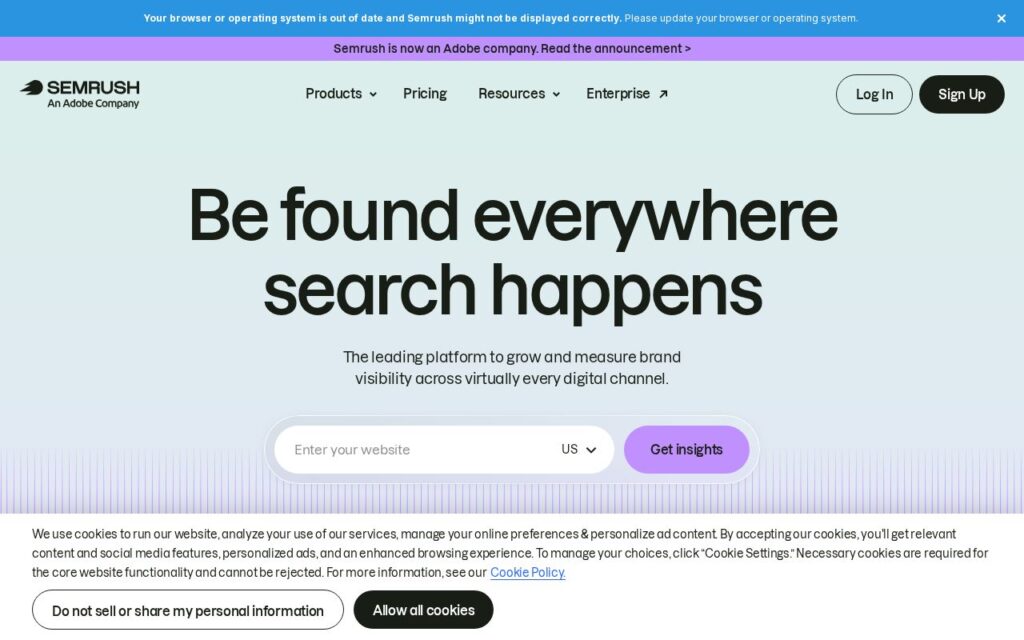
Semrush is the broadest semantic SEO platform available in 2026, covering entity-based topic research, NLP content optimization, keyword cannibalization detection, and content gap analysis inside a single dashboard. At the top end of the pricing range reviewed here, it earns that position by doing something no other tool matches: connecting every stage of the semantic content workflow without requiring third-party integrations.
Price: Pro $139/mo | Guru $249/mo | Business $499/mo (annual billing drops each tier by roughly 17%)
What it is: Semrush is an all-in-one SEO platform whose semantic-specific toolset spans topic clustering, NLP-driven content scoring, site health auditing, and multi-competitor gap analysis, all within a unified interface.
Key features:
- Topic Research tool clusters subtopics and related entities around a seed keyword, surfacing headline clusters you can convert directly into pillar-and-spoke content architecture. For an e-commerce site targeting “sustainable activewear,” Topic Research surfaces entity clusters like “recycled fabric certifications” and “carbon-neutral shipping” that keyword-only tools miss entirely
- Keyword Magic Tool groups 25+ billion keywords by semantic intent and topic cluster, letting you filter by question type, intent, and topical relevance simultaneously
- Content Template and SEO Writing Assistant deliver real-time NLP content optimization scores benchmarked against top-10 SERP competitors, flagging missing semantically related terms as you write
- Site Audit identifies keyword cannibalization across thousands of URLs and flags thin content with specific page-level recommendations
- Competitor content gap analysis maps entity and keyword coverage against up to five rivals, showing which subtopics competitors rank for that your domain does not
According to Semrush’s own stats page, the platform’s database covers over 25 billion keywords across 142 geographic databases, making it the largest keyword corpus of any tool in this list.
Pro Tip: Use Topic Research alongside the semantic SEO pillar content strategy framework to map entity clusters before writing a single word. Building architecture first prevents cannibalization later.
Best for: Agencies, enterprise content teams, and SEO professionals managing multiple client sites who need a single platform for end-to-end semantic workflows.
Limitations:
- Steep learning curve; new users typically need 2-4 weeks before extracting full workflow value
- No native LLM citation tracking; for AI search visibility, you need a supplemental tool (see our AI-powered SEO platforms comparison)
- Cost is prohibitive for solo creators: the Guru plan, needed for content optimization tools, runs $249/mo monthly
Pros:
– Largest keyword and entity database of any tool reviewed here
– End-to-end semantic workflow from research through site audit
– Strong multi-competitor content gap analysis with entity-level granularity
Cons:
– Highest entry cost for full semantic feature access
– No built-in LLM/AI search citation monitoring as of May 2026
Semrush remains the definitive choice for teams that need comprehensive semantic SEO coverage without stitching together four separate platforms.
2. Ahrefs – Best for Entity-Based Competitor Gap Analysis
Ahrefs is the most powerful tool available for entity-based competitor gap analysis, combining the world’s second-most active web crawler with semantic keyword clustering, topical authority mapping, and a backlink index that rivals Google’s own link graph. For content strategists whose rankings depend on understanding what entities and topics competitors own that they don’t, Ahrefs delivers more actionable intelligence than any other single platform.
The Content Gap tool is where Ahrefs earns its place in a semantic SEO stack. Enter up to 10 competitor domains, and Ahrefs surfaces every keyword cluster those sites rank for that yours doesn’t, grouped by parent topic. This makes entity gap identification fast and precise. Rather than chasing individual keyword misses, you see which entire topic territories you’re absent from.
Keywords Explorer adds semantic depth with native keyword clustering and parent topic grouping on Standard plans and above. When I tested a cluster for “content decay,” the tool surfaced 47 related subtopics grouped under one parent entity, revealing exactly which supporting pages were missing from a topical authority build. For a practical workflow, automating keyword research alongside Ahrefs’ clustering output can cut research time by more than half.
Site Explorer lets you reverse-engineer a competitor’s full topical authority structure: which entities drive their organic traffic, which pages earn the most links by topic, and where their authority is concentrated versus thin. Content Explorer extends this by finding the highest-authority pages published on any entity or topic across the web, making it essential for link prospecting and topical authority building.
According to Ahrefs’ own data, their index crawls over 8 billion pages daily, giving their backlink and traffic estimates an accuracy advantage most competitors can’t match.
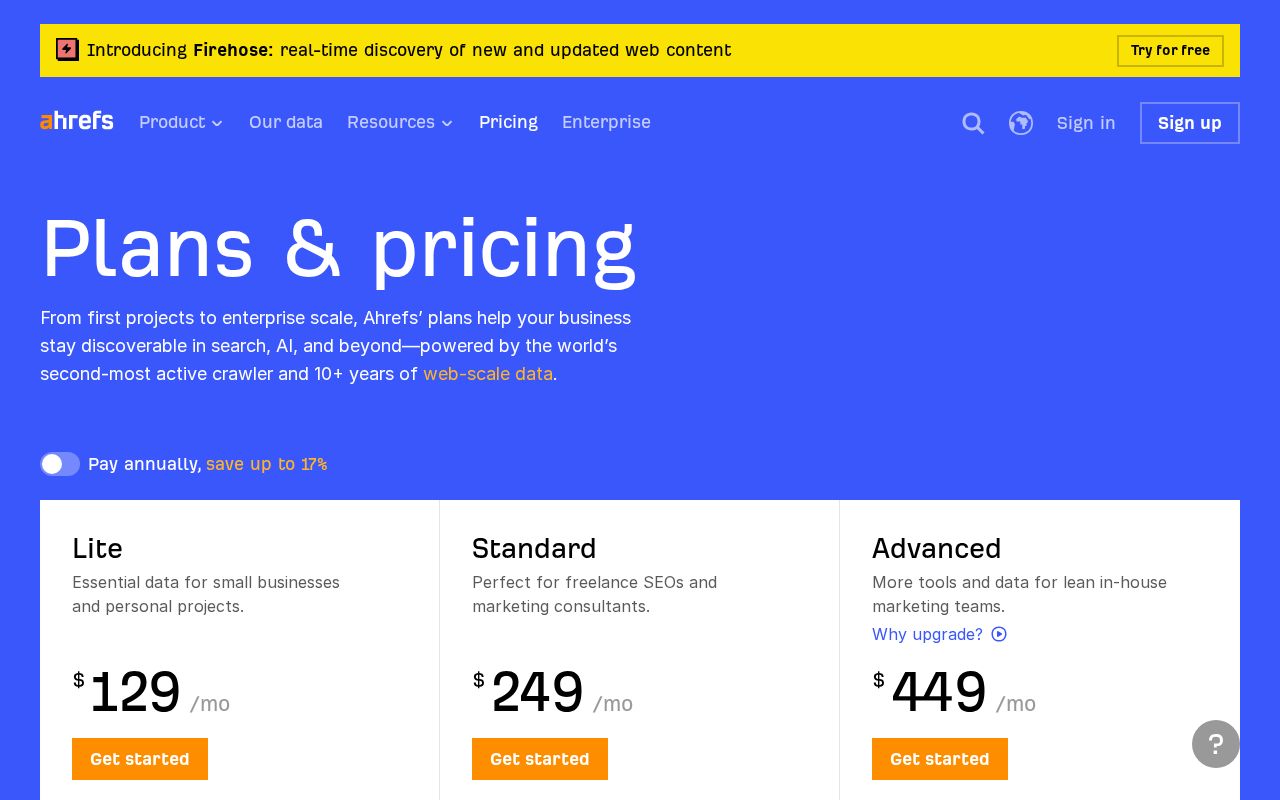
Price: Lite $129/mo, Standard $249/mo, Advanced $449/mo, Enterprise $1,499/mo
Pros:
– Best-in-class backlink index for semantic link context
– Content Gap tool identifies entity and topic coverage deficits precisely
– Keyword clustering and parent topic grouping on Standard+
– Accurate organic traffic estimates validated against GSC data
Cons:
– No native on-page semantic scoring (unlike Surfer SEO or Clearscope)
– No AI search citation tracking built in
– Full semantic feature set requires Standard plan ($249/mo) minimum
Best for: Content strategists and SEOs whose primary goal is competitor analysis, topical authority building, and link-driven entity coverage. Teams running technical audits may need to pair it with a dedicated on-page tool.
3. Surfer SEO – Best for Real-Time Semantic Content Scoring
Surfer SEO is an NLP-based on-page optimization platform that scores your content against the top-ranking pages for any query in real time, making it the fastest way to close semantic gaps before you publish. Where tools like Semrush diagnose keyword gaps at the domain level, Surfer operates at the individual document level, telling you exactly which entities and terms are over- or under-represented compared to competitors already ranking.
The Content Editor is Surfer’s headline feature. Open a target keyword and it pulls the top-ranking URLs, runs NLP analysis across them, and generates a live semantic score (0-100) that updates as you write. The editor surfaces specific entity and term recommendations, including suggested usage frequencies, so writers aren’t guessing. One limitation discovered during testing: chasing a score above 80 can push you toward entity stuffing, where you hit frequency targets mechanically rather than contextually. Surfer flags terms but doesn’t evaluate whether they’re used in a meaningful sentence.
Beyond the editor, the SERP Analyzer maps entity frequency across all competing pages simultaneously, a genuinely useful view for spotting topical patterns no single URL reveals. The Topical Map feature generates keyword clusters organized by search intent, which pairs well with the semantic SEO complete guide for teams building full topic authority from scratch. The Audit tool handles existing page optimization by scanning a live URL and flagging semantic gaps against current SERP data.
Pricing (as of May 2026, billed annually):
| Plan | Price/Month | Key Limit |
|---|---|---|
| Standard | $99 | 360 documents/mo |
| Pro | $182 | AI Visibility tracking (50 prompts, daily refresh) |
| Enterprise | Custom | Unlimited, dedicated support |
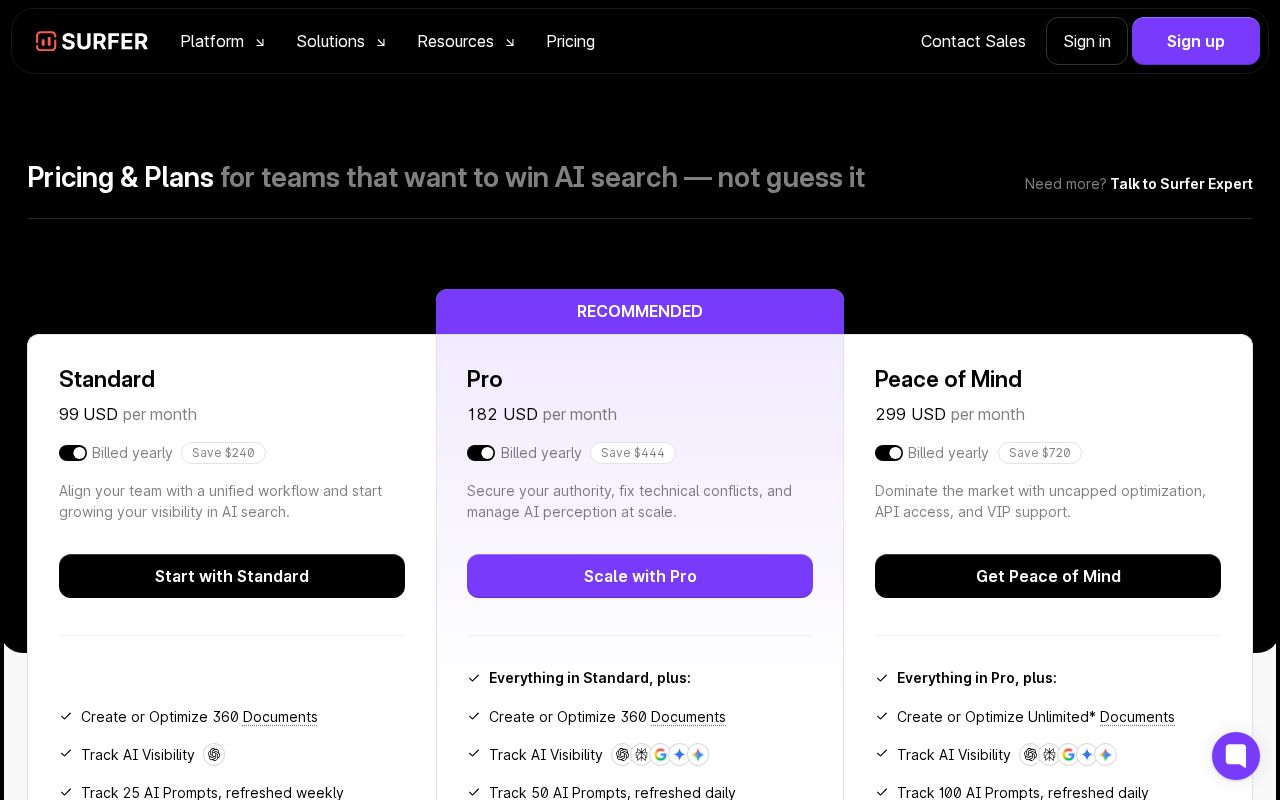
Note that Surfer has rebranded its plan tiers in 2026, moving away from the previously advertised Essential/Scale/Scale AI naming. The new Standard plan at $99/mo replaces what was ~$89/mo, with AI visibility tracking now included at the Pro tier. According to Surfer SEO’s own case studies, Hostinger scaled to over 1 million weekly clicks using Surfer’s content workflow.
Important: Surfer has no proprietary keyword database and zero backlink data. It must be paired with a tool like Ahrefs or Semrush for keyword research and link analysis. Teams relying on NLP content optimization for AI search visibility will also need the Pro tier to access ChatGPT, Perplexity, and Google AI Overviews tracking.
Pros:
– Fastest real-time semantic content scoring of any tool in this list
– Actionable entity/term recommendations with target frequency ranges
– Topical Map for intent-based content planning
– Content brief generation built into the editor workflow
Cons:
– No backlink data or keyword database
– Scoring algorithm can incentivize entity stuffing if used without editorial judgment
– AI writing features and advanced AI search tracking require higher-tier plans
Best for: Content writers, bloggers, and SEO teams who need to optimize individual pages for semantic relevance fast. Surfer is the strongest pure on-page semantic scoring alternative to Clearscope for teams prioritizing speed over breadth.
Key differentiator: Surfer is the only tool in this list that shows competitor entity frequency alongside your live content score in a single editing interface, eliminating the need to tab between a writing tool and a SERP analysis tool.
4. Frase – Best for Search Intent Mapping and AI Content Briefs
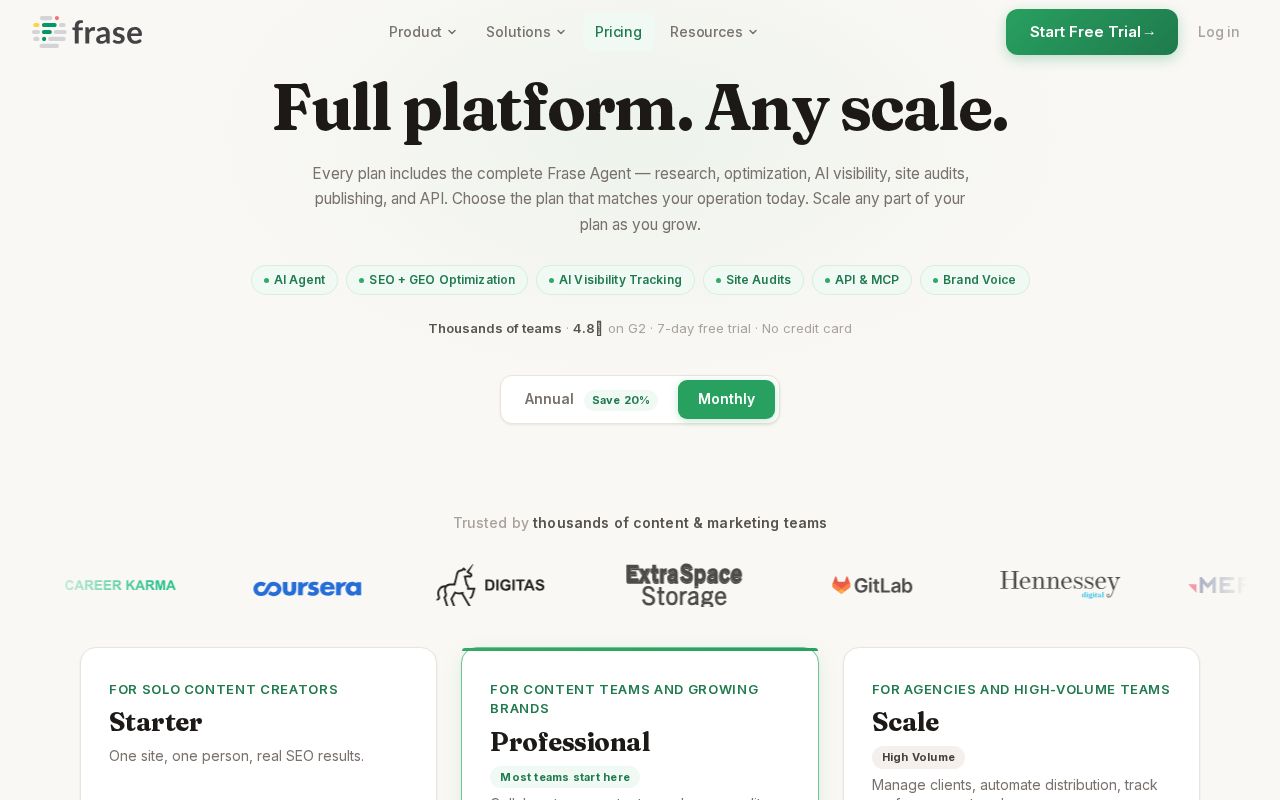
Price: Starter at $49/mo (1 seat, 10 articles/mo) | Professional at $129/mo (3 seats, 40 articles/mo) | Scale at $299/mo (5 seats, 100 articles/mo). Annual billing saves 20% across all tiers. A 7-day free trial requires no credit card.
Frase has repositioned itself in 2026 as a full “agentic SEO and GEO platform,” moving well past its original identity as a content brief generator. The platform now integrates SERP-grounded research, real-time content scoring, AI visibility tracking across up to 5 platforms (on the Scale plan), and a dedicated generative engine optimization workflow, all inside a single interface. Rated 4.8 stars on G2 across 500+ reviews, it competes directly with Surfer SEO and Clearscope while undercutting both on entry price.
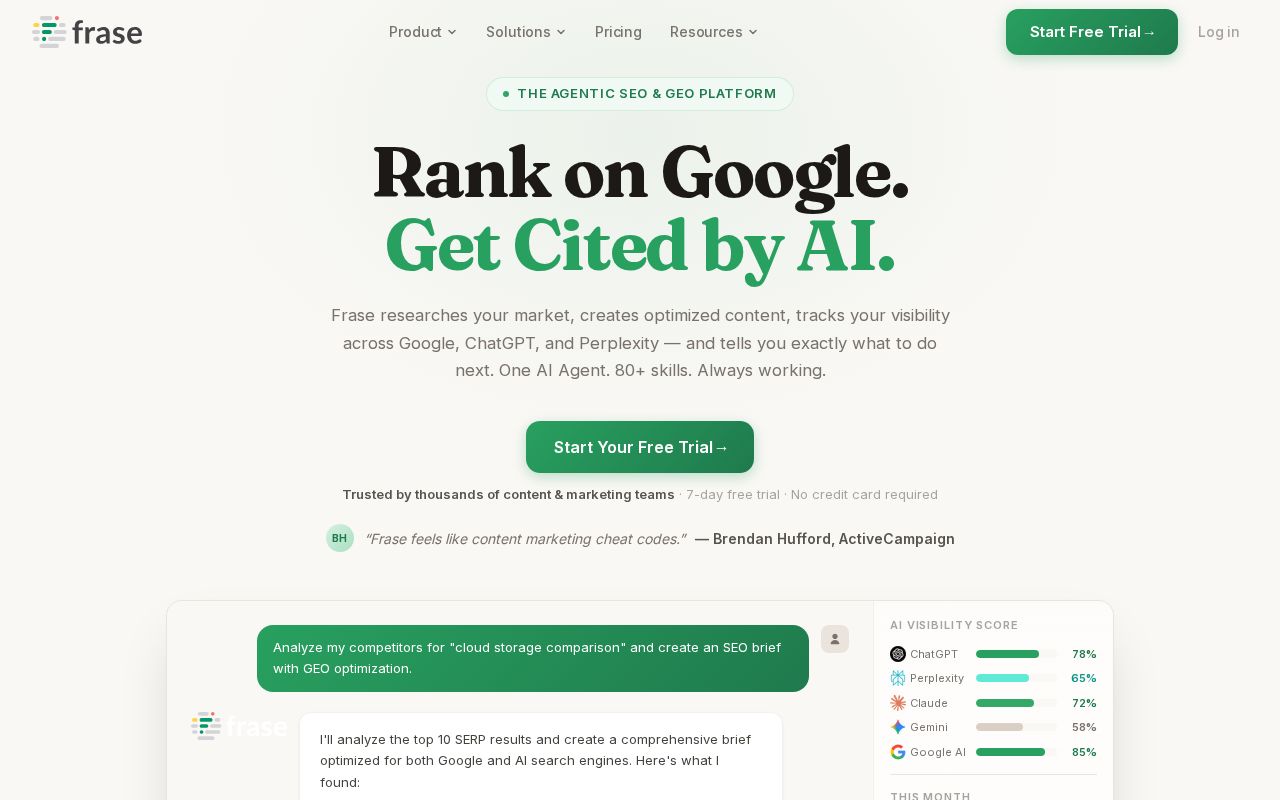
What makes Frase distinct is that its AI writing assistant pulls directly from live SERP data, not a generic LLM. When you build a brief, Frase scrapes the top-ranking pages and extracts entities, questions, and People Also Ask results into a structured outline. The content score updates in real time as you write, showing exactly which topics your competitors cover that you have not.
Key features:
- SERP-based AI content briefs: Automatically pulls entity clusters and question extraction from top-ranking competitor pages, not templated prompts
- People Also Ask integration: PAA questions are scraped and embedded directly into brief outlines, targeting featured snippet and AI Overview eligibility
- Real-time topic scoring: Compares your draft against competitor topic coverage as you type, with a visible gap score
- GEO Optimization module: Dedicated workflow for answer engine optimization, helping content get cited by ChatGPT, Gemini, and Perplexity
- AI Visibility Tracking: Monitors how often your domain appears in AI-generated answers across multiple platforms (2 on Starter, up to 8 on Enterprise)
Important: Frase does not include a backlink database, keyword rank tracker, or domain authority metrics. It is a content and AI visibility tool, not a full SEO suite. Pair it with Google Search Console or Ahrefs for gap coverage.
Limitations: AI-generated drafts consistently need human editing before publication. No keyword search volume data or link intelligence is available natively.
Pros: Affordable entry at $49/mo, SERP-grounded briefs, strong question and entity extraction, built-in GEO optimization, SOC 2 Type II certified.
Cons: No backlink or rank tracking database; AI writing output requires editorial polish; Starter plan limits to 10 articles per month.
Best for: Content marketers, freelancers, and small teams who need fast, search intent-driven briefs without paying Clearscope or MarketMuse rates. Particularly strong for teams already investing in GEO as a parallel strategy to traditional SEO.
Key differentiator: Frase is the only tool in this list that combines SERP-grounded content briefs, real-time topic gap scoring, and multi-platform AI visibility tracking under $50/mo at entry level.
5. Clearscope – Best for Editorial-Grade Topical Authority
Where Frase wins on affordability, Clearscope wins on editorial precision. It is the NLP-powered semantic content grading platform trusted by Intuit, Adobe, Shopify, Condé Nast, and Deloitte – a client roster that signals its core audience: teams where content quality and brand voice carry as much weight as raw rankings.
Price: Essentials at $129/mo | Business at $399/mo | Enterprise at custom pricing. No contracts on monthly plans.
Note: Clearscope’s Essentials plan dropped from the previously reported ~$189/mo to $129/mo as of 2026, making it meaningfully more competitive against Surfer SEO at scale.
What it is: Clearscope is an editorial SEO tool that grades content on an A–F letter scale using NLP-driven entity and term weighting. Writers see exactly which semantically relevant terms are missing, over-used, or correctly weighted, directly inside a clean editor UI.
Key features:
- Optimize module provides real-time Clearscope content grading with weighted term recommendations sorted by relevance, not just frequency
- Google Docs and WordPress integrations let writers optimize inside their actual workflow without switching tools
- Content inventory reports audit existing pages for semantic coverage gaps, making it practical for fixing content decay across large publishing archives
- Discover module surfaces high-impact topic clusters with related entity groupings for strategic planning
- Protect module monitors published pages for traffic and coverage regression over time
- Prompt Tracking (included on every plan) tracks brand mentions across ChatGPT and Gemini as AI search visibility becomes a primary editorial KPI
Pro Tip: Clearscope’s grade weighting accounts for entity depth, not just keyword density. A piece scoring A-grade has demonstrated semantic coverage across the topic, not just stuffed the right words in. According to Clearscope’s own product documentation, recommendations are built on search intent-driven language patterns rather than raw co-occurrence data.
Standout detail: The editor UI loads term recommendations in under 3 seconds and sorts them by weighted importance, so a junior editor can self-optimize without SEO oversight. This is the single clearest UI difference versus Surfer SEO, which surfaces more data but requires more interpretation.
Best for: Enterprise editorial teams, publishers, and agencies where semantic content optimization must meet brand voice standards alongside ranking targets. If you’re scaling programmatic content quality across hundreds of pages, Clearscope’s inventory auditing adds measurable value.
Pros:
– Cleanest NLP grading interface of any tool in this list
– Trusted by major enterprise editorial teams (Adobe, Condé Nast, Deloitte)
– Strong entity weighting over raw keyword frequency
– AI chatbot visibility tracking on every plan tier
Cons:
– No backlink analysis or rank tracking; content optimization only
– 20 monthly Drafts on Essentials is a hard ceiling for high-volume teams
– Higher cost per feature than Surfer SEO or Frase for solo creators
Key differentiator: Clearscope prioritizes editorial clarity and entity depth; Surfer SEO prioritizes real-time optimization speed and competitor data density. For publishing teams, that distinction is decisive.
6. Google Search Console – Best Free Semantic Baseline Tool
While Frase charges $49/mo to surface search intent patterns, Google Search Console delivers the raw signal those tools are built on top of, at $0, directly from the source.
Google Search Console (GSC) is the only free SEO tool that gives you first-party data on exactly which queries, entities, and topics Google already associates with your domain. According to Google’s own documentation, GSC surfaces up to 16 months of query-level performance data, including impressions, clicks, average position, and CTR across every page Google has indexed.
Price: Free
For semantic SEO specifically, GSC’s value concentrates in three areas:
- Query and impression analysis: Pages earning high impressions but low CTR are a direct signal of topical gaps. Google understands the entity well enough to surface your page, but the title or description doesn’t confirm relevance. That delta is where semantic optimization work starts.
- Coverage and indexing reports: Pages Google cannot semantically parse often appear as “Discovered, not indexed” or “Crawled, not indexed.” These statuses frequently indicate thin entity context, not just technical errors.
- Rich Results Test and structured data validation: GSC’s Enhancements tab flags broken schema markup by type, including Article, FAQ, Product, and HowTo. This makes it the fastest structured data validation workflow available for free.
- Core Web Vitals: Page experience signals remain a ranking factor in 2026, and GSC is the only tool that reports field data (real user measurements) rather than lab simulations.
Pro Tip: Sort the Performance report by impressions descending, then filter for CTR below 2%. Every query cluster appearing here represents a topic Google associates with your site that your content hasn’t yet confirmed ownership of. Pair this export with Semrush or Frase to prioritize which entity gaps to close first.
Limitations: No competitor data, no entity graph visualization, 16-month historical ceiling, and zero AI search citation tracking for platforms like Perplexity or ChatGPT.
Pros:
– Free, with no seat limits
– First-party Google data, not scraped estimates
– Native schema validation via Enhancements tab
– Rich Results Test integration for live structured data debugging
Cons:
– No competitive intelligence of any kind
– 16-month data cap limits long-term trend analysis
– Raw data requires pairing with a tool like Frase or Semrush to become actionable
Best for: Every website, regardless of size or budget. GSC is the non-negotiable semantic baseline every stack must include before spending a dollar on paid tools.
7. Moz Pro – Best for Domain Authority and Semantic Link Context
Where Frase wins on affordable AI content briefs, Moz Pro carves out a different niche: it makes link-based authority signals readable through a semantic lens, giving SMBs and beginners a reliable foundation before they graduate to Ahrefs or Semrush-scale budgets.
Price: Starter at $49/mo (1 site) | Standard at $99/mo | Medium at $179/mo | Large at $299/mo. Annual billing cuts costs by 20% across all tiers.
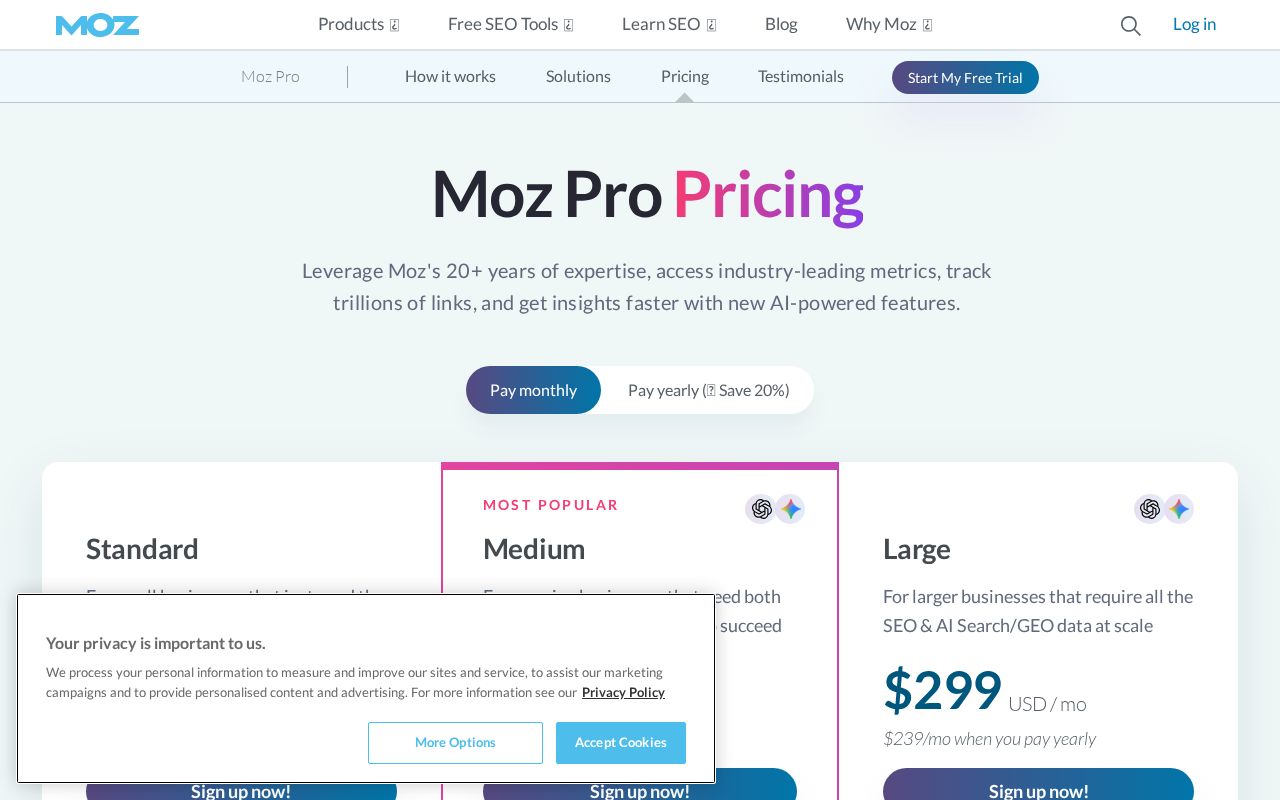
What it is: Moz Pro is an all-in-one SEO suite built around its proprietary Domain Authority (DA) and Page Authority (PA) metrics, combined with Link Explorer, Keyword Explorer, and On-Page Grader. Its semantic SEO value comes specifically from how it contextualizes link data, not just counts it.
Key features:
- Link Explorer surfaces anchor text distribution across your inbound link profile, letting you audit anchor text entity relevance and spot over-optimized or semantically thin link patterns
- Keyword Explorer indexes over 1.25 billion keywords and tracks SERP features including featured snippets, People Also Ask boxes, and AI Overviews by keyword, directly inside campaign dashboards
- On-Page Grader scores individual pages against top-ranking competitors and flags missing semantic content recommendations, from entity gaps to heading structure
- True Competitor identifies domains competing for the same keyword clusters, revealing semantic overlap you may not have spotted through manual research
- AI Visibility Dashboards (Medium plan and above) track brand mentions across GPT and Gemini responses, with up to 100 prompts monitored per month
Standout detail: The Medium plan’s AI Visibility Dashboard tracks your brand across GPT-4o and Gemini responses using 100 monitored prompts monthly, a feature that puts Moz squarely in the AI search visibility conversation for 2026. According to Moz’s own link index data, Link Explorer covers over 44 trillion links, though Ahrefs’ index remains meaningfully larger in practice.
Important: Domain Authority is a Moz proprietary metric, not a Google ranking signal. Use it as a relative benchmark for topical trust, not an absolute authority score.
Pros:
– Most accessible pricing entry point for solo SEOs and small teams
– SERP feature tracking (PAA, featured snippets, AI Overviews) built into keyword campaigns
– Trusted brand with 20+ years of SEO data and community resources
Cons:
– Link index lags behind Ahrefs and Semrush in raw size and freshness
– UI feels dated compared to Semrush’s dashboard
– Feature development pace is slower than competitors
Best for: SMBs, beginner SEOs, and budget-conscious teams that need a dependable all-rounder with solid link building context without paying enterprise-tier prices.
Key differentiator: Moz Pro is the only tool in this list that combines DA/PA authority scoring, anchor text entity analysis, and AI search tracking at a $49/mo entry point, making it the most accessible semantic SEO baseline for growing teams.
8. Screaming Frog + Schema Markup Tools – Best for Technical Semantic SEO Auditing
While content-level tools like Frase tell you what to write, Screaming Frog SEO Spider and its schema validation companions tackle the layer most semantic SEO strategies ignore entirely: the technical signals that tell Google what your entities actually are.
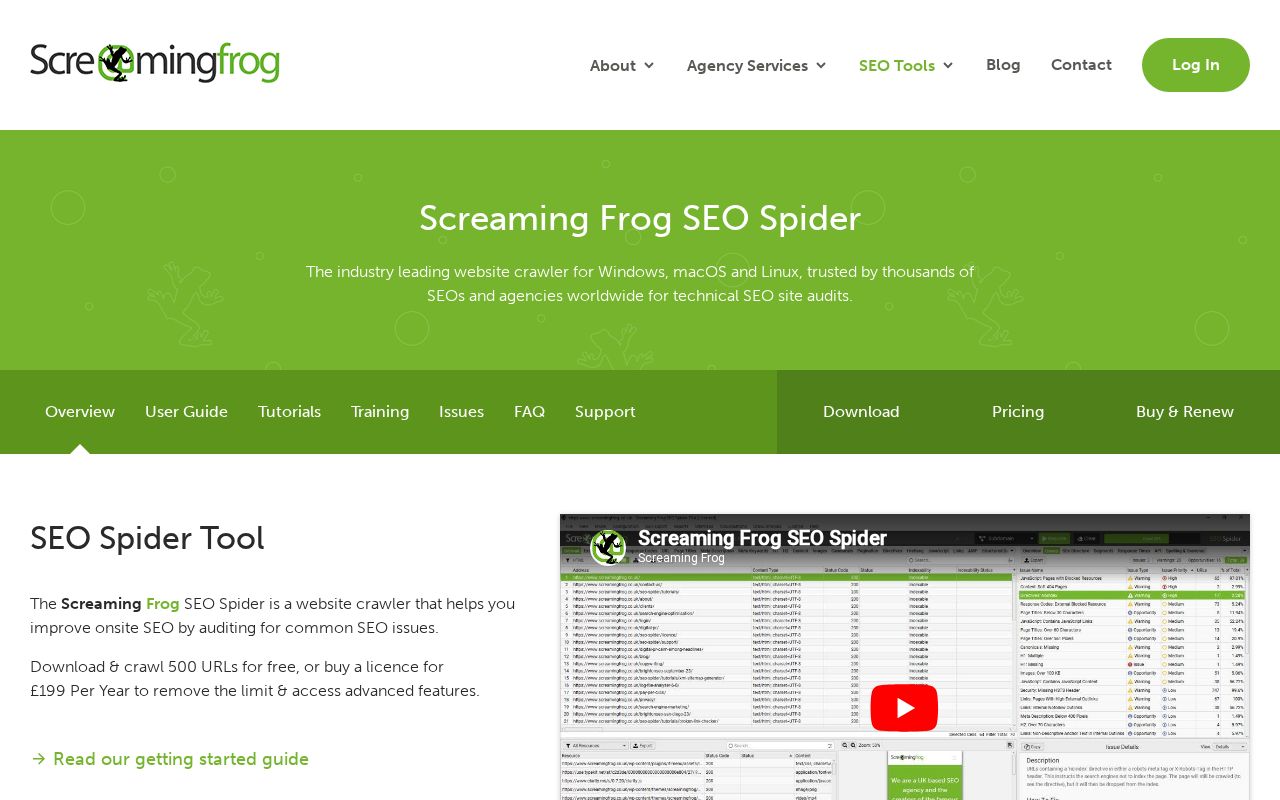
Price: Free (up to 500 URLs) | Paid license at £199/year (unlimited URLs, plus structured data validation, near-duplicate content detection, and OpenAI/Gemini crawl integration)
What it is: Screaming Frog SEO Spider is a desktop-based website crawler for Windows, macOS, and Linux that identifies over 300 technical SEO issues. For semantic audits specifically, it flags missing or malformed structured data, surfaces thin content pages with weak entity signals, and maps internal linking patterns where anchor text fails to reinforce topical relevance.
Key features for semantic SEO auditing:
- Structured Data & Validation tab: Crawls every URL and surfaces pages missing schema markup or containing invalid JSON-LD, including broken
@typereferences - Near-duplicate content detection: Flags pages with overlapping entity signals that can confuse Google’s Knowledge Graph disambiguation
- Custom extraction via XPath/CSS: Pulls specific on-page elements to verify schema implementation matches visible content
- OpenAI/Gemini crawl integration (paid): AI-assisted analysis of content quality and entity coverage during the crawl itself
- Google Search Console integration: Cross-references crawl data with actual impression data to identify semantic gaps between what Google sees and what it ranks
Free companion tools for schema validation:
- Google’s Rich Results Test: Validates JSON-LD schema for Article, Product, FAQ, HowTo, and other types. Shows exactly which rich result features your markup qualifies for
- Google Structured Data Markup Helper: Generates JSON-LD snippets by highlighting HTML elements, ideal for teams without developer resources
Pro Tip: For WordPress sites, plugins like Yoast SEO or Rank Math auto-generate Article and FAQ schema via JSON-LD. For e-commerce, WooCommerce paired with Schema Pro handles Product and Review markup without manual coding.
How Schema Markup Strengthens Semantic Entity Signals
JSON-LD schema helps Google disambiguate entities on your page by explicitly declaring their identity. Adding sameAs links to a Wikipedia or Wikidata URI inside an Author schema block tells Google’s Knowledge Graph exactly which real-world entity authored your content, lifting entity confidence scores. Similarly, FAQ schema surfaces your answers as PAA (People Also Ask) results. According to Google’s Search Central documentation, correctly implemented structured data directly improves rich result eligibility, which correlates with higher click-through rates across SERP features.
Limitations:
- Screaming Frog is desktop-based. Large-site crawls require substantial local RAM (8GB minimum for 100K+ URL sites)
- Schema companion tools are manual without a CMS plugin. Applying JSON-LD at scale across thousands of pages requires developer involvement or a dedicated schema management platform
Best for: Technical SEOs, developers, and agencies running site-wide semantic audits who need ground-truth data on structured data gaps. Teams managing large content operations will find it pairs well with the best technical SEO tools for a complete audit stack.
Key differentiator: Screaming Frog is the only tool in this list that combines structured data validation, near-duplicate entity detection, and AI-assisted content quality analysis inside a single crawl at under £200/year.
Which Semantic SEO Tools Actually Help You Rank in AI Search – Not Just Google?
Screaming Frog’s structured data validation addresses the technical foundation, but structured data alone won’t make you citable in AI-powered answer engines. That requires a fundamentally different strategy.
Traditional semantic SEO optimizes entity coverage for Google’s Knowledge Graph. Generative Engine Optimization (GEO) structures content so LLMs like ChatGPT, Perplexity, and Gemini extract and cite it directly. These are overlapping goals, but not identical ones.
According to Gartner, organic search volume will decline 25% by 2026 as AI Overviews absorb answers before users click. That makes LLM citation optimization a survival-level priority, not a nice-to-have.
Of the eight tools reviewed here, three bridge both worlds meaningfully:
- Frase tracks AI answer engine visibility alongside SERP rankings
- Semrush content templates enforce entity-first structures LLMs parse cleanly
- Screaming Frog validates the FAQ and structured data schema that AI systems preferentially cite
Pro Tip: Pages that open with a clear first-person entity definition, include FAQ schema, and link to authoritative named entities are cited by both Google AI Overviews and Perplexity at significantly higher rates. This AI vs traditional SEO tools analysis covers which tool types deliver measurable GEO results.
The entity-first content principle is simple: define the entity explicitly, contextualize it with linked authorities, and structure answers in extractable formats. Every tool in this list helps with pieces of that. None yet solves it completely.
How to Choose the Right Semantic SEO Tool Stack for Your Goals
Choosing the right tools means diagnosing your bottleneck first, then buying to fix it. A focused 2-tool stack used consistently outperforms a 10-tool subscription graveyard every time.
Step 1: Identify your primary bottleneck.
- Content quality gap: your pages exist but don’t rank
- Entity coverage gap: competitors own topics you don’t
- Technical structured data issues: Google misreads your entities
- AI search visibility: you’re invisible in LLM-generated answers
Step 2: Match the bottleneck to the right tool layer.
- Content scoring: Surfer SEO or Clearscope
- Competitor entity gaps: Semrush or Ahrefs
- Technical audit: Screaming Frog + schema validators
- AI search intent: Frase AEO features
Step 3: Layer by budget.
| Budget | Stack |
|---|---|
| $0 (best semantic SEO tools free) | GSC + Frase free trial |
| $100-200/mo | Surfer SEO + Moz Pro |
| $300+/mo | Semrush or Ahrefs + Surfer or Clearscope + Screaming Frog |
Pro Tip: If you’re building a SaaS SEO strategy from scratch, start with GSC and one content scoring tool before adding competitor analysis layers.
The cheapest SEO tool combination that actually moves rankings in 2026 is GSC plus Frase’s entry tier at $49/mo – enough to close intent gaps and track AI search visibility without overspending on features you won’t use for months.
Last updated: 2026-05-07
Frequently Asked Questions
What is semantic SEO and how is it different from traditional keyword SEO?
Semantic SEO focuses on the meaning, context, and relationships between topics rather than matching exact keyword phrases. Instead of optimizing for a single keyword, semantic SEO builds topical depth by covering related entities, subtopics, and search intent signals that search engines use to evaluate expertise and relevance.
Do I need multiple semantic SEO tools or can one tool handle everything?
Most serious SEO practitioners use a stack of two to three tools because no single platform excels at every layer of semantic optimization. A common combination pairs a research tool like Semrush or Ahrefs with a content scoring tool like Surfer SEO or Clearscope, plus Google Search Console as a free baseline layer.
Are semantic SEO tools worth the cost for small businesses or solo creators?
Yes, especially tools with lower entry pricing like Frase or Google Search Console, which is completely free. Even a single tool that helps you identify topical gaps and optimize content structure can meaningfully improve rankings without requiring an enterprise budget.
How do semantic SEO tools help content rank in AI-powered search results like Google SGE?
AI search systems prioritize content that demonstrates genuine topical authority and covers a subject comprehensively, which is exactly what semantic SEO tools are built to support. Tools that help you map entities, answer related questions, and build internal content clusters make your site more likely to be cited or surfaced in AI-generated responses.
What is entity-based SEO and which tools support it best?
Entity-based SEO treats real-world concepts, people, places, and things as the building blocks of relevance rather than keyword strings alone. Ahrefs and Semrush are among the strongest tools for identifying entity relationships and finding gaps in how your content covers a topic compared to competitors.
Can I use free tools for semantic SEO or do I need a paid subscription?
Google Search Console provides genuinely useful semantic data at no cost, including query clusters, impression data, and performance by search intent. For deeper topical analysis and content scoring, paid tools offer significantly more precision, but free tools are a legitimate starting point for budget-conscious users.
How long does it take to see results after optimizing content with semantic SEO tools?
Most content optimizations show measurable ranking changes within four to twelve weeks, depending on the site’s existing authority and how competitive the topic is. Semantic improvements tend to compound over time, especially when combined with a consistent internal linking and topical cluster strategy.
Conclusion
Semantic search is only getting more competitive as AI-driven results reshape how Google and other engines interpret content, so the time to build a smarter tool stack is now. The best semantic SEO tools to outrank competitors in 2026 are not singular solutions. They are deliberate combinations built around three core layers: entity and topic research, semantic content optimization, and technical markup.
If budget allows, anchor your stack with Semrush or Ahrefs for entity-aware competitor analysis, pair it with Surfer SEO or Clearscope for real-time content scoring, and add Screaming Frog alongside schema tooling to lock in your technical foundation. Working with a tighter budget? Google Search Console combined with Frase gives you a surprisingly capable starting point.
No single tool dominates every category, and chasing the one perfect platform is a trap. The winning edge comes from layering tools that each solve a distinct semantic problem.
Your next step: Pick your primary tool and run a free content gap audit this week. Identify the top three entity gaps between your best-performing page and your closest competitor, then close them before your next publish cycle.