AI platforms now generate over 1 billion referral visits per month, yet roughly 90% of ChatGPT citations pull from sources outside the top 20 Google results. That single fact reframes everything: LLM SEO, the practice of optimizing content to get cited by ChatGPT, Gemini, and Claude, operates by a completely different rulebook than traditional search engine optimization.
Table of Contents
- What Is LLM SEO and How Is It Different from Traditional SEO?
- How Do ChatGPT, Gemini, and Claude Each Decide What to Cite?
- Step 1: Make Your Site Technically Accessible to AI Crawlers
- robots.txt Configuration for AI Bots
- Step 2: Structure Content So AI Models Can Extract and Cite It
- Which Content Formats Get Cited Most Often by AI Models?
- Step 3: Build the Authority Signals LLMs Use as Trust Proxies
- Why Being ‘Cited’ by an LLM Doesn’t Always Mean Getting Credit — And What to Do About It
- How Do You Measure Whether AI Models Are Citing Your Brand?
- Frequently Asked Questions
- What is LLM SEO?
- Is LLM SEO replacing traditional SEO?
- How long does it take to get cited by ChatGPT or other AI models?
- Do I need to be on the first page of Google to get cited by AI models?
- Can small or newer websites get cited by AI chatbots?
- Does having a Wikipedia page help you get cited by LLMs?
- How is getting cited by Gemini different from getting cited by ChatGPT?
- Conclusion
LLM SEO (also called Generative Engine Optimization, or GEO) is a distinct discipline where citation is earned through authority signals, structured content, and entity recognition, not keyword density or backlink volume alone. Each major model, ChatGPT, Gemini, and Claude, uses its own retrieval logic, training data weighting, and real-time browsing behavior to decide which sources get quoted and credited.
The brands winning AI citations in 2026 are not necessarily the ones ranking on page one. They are the ones building content that large language models recognize as credible, structured, and that definitely answers the queries their audiences are asking.
TL;DR: LLM SEO (also called Generative Engine Optimization) is the practice of optimizing your content so AI models like ChatGPT, Gemini, and Claude cite your brand in their responses, and it requires a different strategy than traditional search optimization. Each AI system uses distinct retrieval methods, meaning technical accessibility, structured content formatting, and off-site authority signals all play a role in whether your pages get cited. Key recommendations include ensuring AI crawlers can access your site, structuring content so models can easily extract and quote it, and building trust signals like authoritative backlinks and consistent entity recognition. Measuring your citation presence across AI platforms is essential, as answer visibility is quickly becoming as important as Google rankings.
Key Takeaways
- LLM SEO (also called Generative Engine Optimization) is distinct from traditional SEO because each major AI model, including ChatGPT, Gemini, and Claude, uses a different retrieval mechanism, so optimizing for one platform does not guarantee visibility across all five major AI systems.
- Technical accessibility is a prerequisite for AI citation: if AI crawlers are blocked by your robots.txt, missing structured markup, or slow load times, no content or authority strategy will compensate for the gap.
- According to the 2024 Princeton/Georgia Tech GEO study, how you structure content directly determines whether LLMs extract and cite it, making formatting choices like clear headers, defined entities, and quotable factual statements critical optimization levers.
- LLMs cannot evaluate content quality directly, so they rely on external authority signals as trust proxies, meaning third-party mentions, backlinks from credible sources, and consistent entity recognition across the web significantly influence citation likelihood.
- Being cited by an LLM does not always mean receiving visible brand credit, as research by Ann Smarty and Kevin Indig shows citation frequency is a misleading proxy for actual brand visibility without tracking attributed mentions specifically.
- Most practitioners lack a structured GEO measurement framework, which means citation gains or losses go undetected for months. Actively querying AI models with target prompts and tracking answer presence is the recommended baseline measurement approach.
What Is LLM SEO and How Is It Different from Traditional SEO?
LLM SEO, also called Generative Engine Optimization (GEO), is the practice of optimizing your content and brand presence so that large language models like ChatGPT, Gemini, and Claude select your content as a source when generating AI-powered answers. It is a distinct discipline from traditional SEO, with different ranking signals, different retrieval mechanics, and a fundamentally different end goal.
Traditional SEO targets the crawl-index-rank pipeline: you optimize keywords, earn backlinks, and compete for positions in a search results page that a human then clicks through. LLM SEO targets two separate pathways:
- Parametric knowledge: What the model absorbed during training. If your brand, claims, and content were present in high-quality training corpora, the model may surface them without any live web lookup at all.
- RAG retrieval (Retrieval-Augmented Generation): Real-time web lookups used by ChatGPT Browse, Perplexity, and Gemini. Here, the model fetches live pages and synthesizes an answer, selecting sources based on authority, semantic relevance, and entity recognition, not keyword match scores.
The critical distinction: LLMs do not rank pages. They synthesize answers and attribute sources based on trustworthiness and topical depth, which means your Google ranking position is largely irrelevant to AI citation. According to a 2024 study published by Seer Interactive, roughly 90% of ChatGPT citations fall outside Google’s top 20 search results, confirming that AI citation optimization is a separate discipline that demands its own strategy.
Both retrieval pathways reward overlapping signals: clear entity definitions, authoritative backlinks, structured content, and consistent brand mentions across the web. But the tactics differ enough that conflating traditional SEO vs AI SEO approaches will leave gaps in either strategy.
Key differentiator: Traditional SEO wins you a ranked position. Generative Engine Optimization wins you inclusion in the answer itself, which increasingly is where user attention ends.
The 90% stat alone makes the case: if your entire strategy targets Google’s top 10, you are invisible to the AI answers layer by design.
How Do ChatGPT, Gemini, and Claude Each Decide What to Cite?
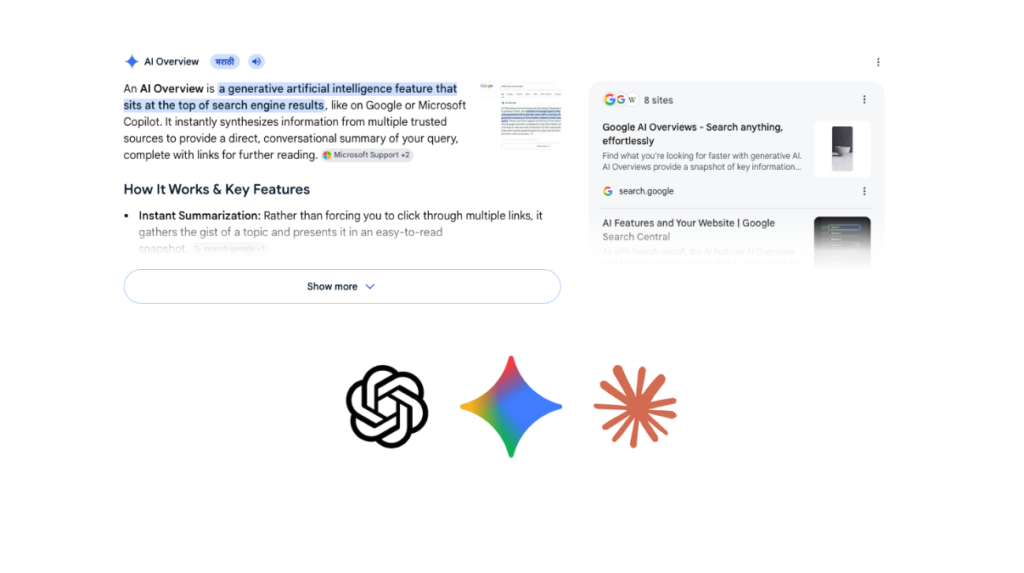
Being invisible to Google’s top 10 is one problem. Being invisible across five distinct AI retrieval systems is another entirely. Each major LLM uses a different mechanism to decide which sources get surfaced, and optimizing for one platform does not guarantee citation on another.
According to a 2024 study by Seer Interactive, the overlap between sources cited by ChatGPT, Gemini, and Perplexity is surprisingly low, meaning platform-specific optimization is not optional for brands serious about AI visibility.
| Platform | Retrieval Method | Key Citation Signals | Optimization Priority |
|---|---|---|---|
| ChatGPT | Bing index (Browse mode); parametric training data (standard mode) | Bing domain authority, clear authorship, structured content, HTTPS | Bing optimization for ChatGPT: build Bing authority, structured markup, bylines |
| Gemini | Google Knowledge Graph + AI Overviews integration | Entity recognition, structured data, Wikipedia/Wikidata presence | Establish Knowledge Graph entity; structured data schema |
| Claude | Training data + Anthropic-curated sources; limited real-time retrieval | E-E-A-T signals, high-authority publisher mentions, editorial credibility | Earn coverage in top-tier publications; demonstrate expertise signals |
| Perplexity | Real-time web search with high citation transparency | Fresh content, answer-first structure, clear sourcing, Reddit presence | Perplexity real-time indexing: publish frequently, lead with direct answers |
| Grok | X (Twitter) firehose + real-time trending content | Social signal velocity, X engagement, topical relevance | Build X presence; publish content that earns rapid social amplification |
The RAG vs parametric distinction matters here. Perplexity and ChatGPT’s Browse mode use Retrieval-Augmented Generation (RAG), pulling live web content at query time. Claude relies more heavily on parametric knowledge baked into training weights, which makes its Claude source selection harder to influence in real time but highly responsive to sustained publisher authority.
Pro Tip: If Perplexity is part of your AI visibility strategy, tracking which sources it actually cites is essential. The best Perplexity rank tracking tools can surface exactly where your content appears and where competitors are edging you out.
To get cited by ChatGPT, optimize for Bing and use structured, authoritative content. For Gemini, build entity presence in Google’s Knowledge Graph. For Claude, prioritize training-data authority through high-quality publisher mentions and E-E-A-T signals. Each platform uses different retrieval mechanisms requiring tailored tactics.
Key differentiator: Gemini’s deep integration with the Google Knowledge Graph means that brands with Wikipedia presence and structured entity markup have a measurable citation advantage that brands without it simply cannot replicate through content volume alone.
Step 1: Make Your Site Technically Accessible to AI Crawlers
Structured entity markup gives Gemini a citation edge, but none of that matters if AI crawlers cannot reach your pages in the first place. Before any content or authority strategy can work, your site needs a clean technical foundation that explicitly permits AI retrieval bots to crawl and index your content.
According to Originality.AI’s 2024 crawler research, roughly 25% of the top 1,000 websites were blocking GPTBot within months of its launch, often unknowingly cutting off ChatGPT’s Browse citations alongside training access. That distinction matters enormously.
robots.txt Configuration for AI Bots
The single most important distinction in AI crawler configuration is training bots vs. retrieval bots. Training bots collect data to improve the model itself. Retrieval bots fetch pages in real time to answer user queries. Blocking a retrieval bot kills your citation potential. Blocking only the training bot protects your content from being used as training data while keeping you citable.
Here is the exact robots.txt syntax to allow all four critical retrieval crawlers:
# Allow AI retrieval/search bots (enables citations)
User-agent: GPTBot
Allow: /

User-agent: OAI-SearchBot
Allow: /

User-agent: Google-Extended
Allow: /

User-agent: ClaudeBot
Allow: /
If you want to block training use while staying citable, you can disallow GPTBot (training) while keeping OAI-SearchBot (retrieval) active. Google-Extended controls both Gemini and AI Overviews indexing. ClaudeBot handles Anthropic’s retrieval layer for Claude.ai citations.
Important: Blocking GPTBot entirely does not just opt you out of OpenAI’s training data. It also blocks ChatGPT’s Browse mode from reading your pages during live queries, removing you from real-time citation consideration.
Beyond robots.txt, two baseline requirements apply. First, submit a fresh XML sitemap. AI crawlers, like Google’s own bots, prioritize recently updated sitemaps, so keeping your sitemap current is non-negotiable. Second, page speed and mobile responsiveness remain hard requirements. A page that loads slowly or breaks on mobile signals low quality to both traditional and AI crawlers.
Finally, consider adding an LLMs.txt file at yoursite.com/llms.txt. Analogous to robots.txt but purpose-built for LLM guidance, this plain-text file summarizes your site’s most authoritative content and points AI crawlers directly to your key pages. Bing Webmaster Tools is also worth prioritizing, since ChatGPT’s Browse mode pulls from Bing’s index when no live retrieval is available.
Key differentiator: Sites that explicitly allow OAI-SearchBot separately from GPTBot give themselves retrieval coverage in ChatGPT’s Browse mode even if they choose to block OpenAI’s training crawler, a nuance most technical SEO configurations still miss.
Step 2: Structure Content So AI Models Can Extract and Cite It
Permitting crawlers to reach your pages is the entry requirement. What determines whether those pages get cited is how you structure the content itself. The Princeton/Georgia Tech GEO study, published in 2024, is the most rigorous benchmark available on this question: content formatted with statistics increased AI citation visibility by ~22%, expert quotations by ~37%, and well-structured comparison tables by ~47%. Those are not marginal gains.
The underlying mechanism is retrieval chunking. LLMs do not read full pages the way a human researcher would. They retrieve discrete content segments, score them for relevance and authority signals, and assemble responses from those fragments. A well-written 2,000-word article with poor internal structure often loses to a 400-word section that is self-contained, answer-first, and richly formatted.
Follow these steps to make your content chunk-ready:
- Apply BLUF (Bottom Line Up Front). State the direct answer in the first 1-2 sentences of every section. AI models disproportionately extract from opening text; according to the GEO researchers, 41% of citations come from a section’s opening sentences.
- Mirror user query phrasing in your H2/H3 headings. A heading like “How does FAQ schema help LLMs?” signals topical relevance to the exact query pattern a user types into ChatGPT, making the chunk easier to match.
- Write self-contained sections. Every H2 or H3 block should make sense without surrounding context. If a reader (or retrieval model) lands on it cold, the key point must be clear.
- Cite primary sources inline. LLMs systematically favor content that references government data, peer-reviewed research, and named experts. Linking to the Princeton GEO study directly, for instance, signals source quality.
- Implement structured schema markup. FAQ schema, HowTo schema, and Article schema with author markup give AI parsers explicit signals about content type and authority. This is especially important for semantic SEO coverage across topical clusters.
Which Content Formats Get Cited Most Often by AI Models?
According to the GEO study by Aggarwal et al. (2023), citation lift by format type breaks down as follows:
| Content Format | Estimated Citation Lift |
|---|---|
| Comparison tables | ~47% |
| Expert quotations | ~37% |
| Statistics with source citations | ~22% |
| Numbered step lists | ~15% |
| Direct-answer paragraphs | ~11% |
Comparative formats, particularly “best X for Y” structures and ranked lists, appear persistently in AI-generated responses. This is partly why programmatic SEO quality standards matter so much: thin comparative pages get retrieved but not cited, because LLMs detect low informational density.
Pro Tip: Semantic density outperforms keyword frequency for AI citation. A single 200-word chunk that defines a concept, cites a source, and answers a follow-up question will outperform a 1,000-word keyword-optimized section with no internal structure.
The single most actionable takeaway: treat every H2 section as a standalone document that must earn its citation independently.
Step 3: Build the Authority Signals LLMs Use as Trust Proxies
Structuring content for extraction is necessary but not sufficient. LLMs cannot evaluate content quality the way a human editor can, so they rely on external authority signals as trust proxies. The stronger those signals, the more confidently a model attributes a claim to your brand rather than hallucinating a competitor’s name instead.
Build these six signals systematically:
E-E-A-T signals on every page. Add explicit author bylines with credentials, link each byline to a dedicated author page, and include that author’s topic-relevant experience (years in field, publications, certifications). For AI models, an uncredited article carries no more authority than an anonymous forum post.
Entity disambiguation via Wikidata. Create or claim a Wikidata entry for your brand and key authors. Keep your entity information (legal name, industry, founding date, description) identical across LinkedIn, Crunchbase, Google Business Profile, and your own About page. Inconsistent entity data is the primary cause of LLM brand hallucinations: the model encounters conflicting signals and fills in gaps with plausible-sounding fiction.
Brand mention velocity over raw backlink count. According to research cited by SparkToro, the ratio that moves the needle for LLM visibility is roughly 3:1 brand mentions to backlinks. Co-citation signals from Tier 1 publications (Forbes, the New York Times, industry journals) signal authority to AI retrieval systems just as PageRank signaled authority to Google crawlers. For a deeper look at how off-page signals translate into search authority, see off-page SEO strategies that still work.
Reddit participation. Perplexity and ChatGPT Browse both frequently retrieve Reddit threads for product and comparison queries. Authentic contributions to relevant subreddits create retrievable, community-validated mentions that no amount of on-site optimization can replicate.
G2 and Capterra profiles for B2B SaaS. Review platforms are disproportionately cited in product comparison queries. A complete, actively maintained G2 profile with recent reviews creates a high-recall retrieval target.
Content freshness with visible timestamps. Fresh content receives 28% more citations than equivalent stale content, according to the Princeton/Georgia Tech GEO study. Add “last updated” dates to key pages and refresh statistics quarterly. Fixing content decay before it ages out of AI retrieval is one of the highest-ROI maintenance tasks available.
Pro Tip: Treat your Wikidata entry and author pages as living documents, not one-time setup tasks. Quarterly audits to catch entity inconsistencies prevent the hallucination drift that builds silently over time.
Key differentiator: Brands that pair strong on-page E-E-A-T for AI with consistent entity recognition across third-party platforms get cited more accurately and more often than brands that optimize content structure alone.
Why Being ‘Cited’ by an LLM Doesn’t Always Mean Getting Credit — And What to Do About It
Consistent entity recognition builds citation frequency, but citation frequency alone is a misleading proxy for actual brand visibility. Research by Ann Smarty and Kevin Indig identifies four structurally different citation types that LLMs produce, and conflating them distorts your entire GEO strategy.
The four types break down like this:
- Grounded citations: The LLM retrieves your URL, displays it to the user, and your content directly informs the answer. This is the outcome most marketers assume they are optimizing for.
- Ungrounded (reverse) citations: The model generates an answer from training data, then appends a URL post-hoc. That URL may have no causal relationship to the answer. According to The New York Times’ 2024 reporting on Gemini, this behavior is especially frequent in Google’s AI Overviews, where citations function more as decorative sourcing than evidence.
- Invisible citations: Your content is retrieved and genuinely influences the model’s output, but your URL never surfaces in the response. The user benefits from your expertise; your brand gets nothing.
- Ghost citations: Your URL appears in the source list, but your brand name never appears in the generated answer text. Kevin Indig’s data suggests roughly 60% of LLM citations fall into this ghost category, making it the single most common citation outcome.
The strategic implication is direct: optimizing for citation count is the wrong metric. The real goal is answer presence, defined as your brand name, product name, or a specific claim appearing inside the AI-generated text itself, regardless of whether your URL is shown.
Pro Tip: Weave your brand name and product names into the answer-worthy sentences of your content, not just into metadata or title tags. If your brand name doesn’t appear in the paragraph an LLM is likely to extract, it won’t appear in the answer either.
LLM hallucination correction deserves equal attention. When models misrepresent your brand, the remedy is publishing tightly structured, authoritative content that directly addresses the misrepresentation with specific facts, named figures, and dated data. Vague corrections don’t displace hallucinated claims; precise ones do.
For teams tracking whether this effort is working, pairing these citation-quality benchmarks with the right AI performance KPIs will reveal whether you’re gaining answer presence or just accumulating invisible influence no one can measure.
The core insight: A ghost citation inflates your citation count while contributing zero brand recall. Answer presence, not citation volume, is the metric that maps to actual business impact.
How Do You Measure Whether AI Models Are Citing Your Brand?
Answer presence is the metric that matters, but you cannot optimize what you cannot measure. Most practitioners still lack a structured GEO measurement framework, which means citation progress (or regression) goes undetected for months.
Three approaches build a complete picture:
Manual query testing. Prompt ChatGPT, Gemini, Claude, and Perplexity with your target queries: “best [category] tools for [use case]”, “what is [your brand]”, and “[problem] solutions.” Record each result in a spreadsheet, logging date, platform, query, and citation type (named mention, linked citation, or absent). Run this cadence weekly for any priority query set.
AI monitoring platforms. Tools like LLMrefs, Peec AI, and Profound automate Share of Voice tracking across multiple LLMs at scale, surfacing which queries cite your brand, which cite competitors, and how citation rates shift over time. These platforms eliminate the manual sampling bias that makes spreadsheet-only tracking unreliable at volume.
Referral traffic segmentation. In Google Analytics, create dedicated segments for referral traffic from
chat.openai.com,claude.ai,gemini.google.com, andperplexity.ai. This captures grounded citations that drove actual clicks. According to Virayo, AI referral traffic converts at significantly higher rates than organic search, particularly for B2B pipelines, making this channel worth tracking even at low volume.
Important: A 0% citation rate on your target queries is a baseline red flag, not a neutral starting point. Industry practitioners report 40-70% citation rates are achievable within 90 days of focused optimization, making it a reasonable short-term benchmark.
For teams already investing in AI-powered SEO platforms, many of these measurement capabilities are beginning to appear as native features alongside traditional rank tracking.
Quotable summary: The gap between ghost citations and genuine answer presence only becomes visible when you measure citation type, not just citation count, across every major LLM simultaneously.
Last updated: 2026-05-07
Frequently Asked Questions
What is LLM SEO?
LLM SEO is the practice of optimizing your content so that large language models like ChatGPT, Gemini, and Claude reference or cite your brand in their responses. Unlike traditional SEO, which targets search engine ranking algorithms, LLM SEO focuses on becoming a trusted source within the training data and retrieval systems that AI models draw from.
Is LLM SEO replacing traditional SEO?
LLM SEO is not replacing traditional SEO, but it is becoming a necessary complement to it. Many users now turn to AI chatbots instead of search engines for answers, which means brands that only optimize for Google rankings may miss a growing slice of discovery traffic.
How long does it take to get cited by ChatGPT or other AI models?
There is no guaranteed timeline, since LLMs cite sources based on a combination of training data, retrieval indexing, and authority signals that update on different schedules. Building consistent citations typically requires months of sustained effort across content quality, technical accessibility, and third-party mentions.
Do I need to be on the first page of Google to get cited by AI models?
Not necessarily. LLMs pull from a broader range of sources than just top-ranked pages, and factors like content clarity, structured formatting, and authoritative backlinks can influence AI citations even for pages that rank modestly in traditional search.
Can small or newer websites get cited by AI chatbots?
Yes, smaller sites can earn AI citations, but they need to work harder on authority signals such as mentions from credible third-party sources, clear authorship, and well-structured content. Niche expertise and specific, factual answers often give smaller sites an advantage over broader, general-purpose content.
Does having a Wikipedia page help you get cited by LLMs?
Having a Wikipedia page is one of the stronger authority signals that LLMs treat as a trust proxy, since Wikipedia is heavily represented in most AI training datasets. However, it is not a requirement, and brands can build similar credibility through consistent coverage in reputable industry publications and databases.
How is getting cited by Gemini different from getting cited by ChatGPT?
Gemini is more tightly integrated with Google’s search index and real-time web retrieval, making traditional SEO signals like page authority and indexing more directly relevant. ChatGPT with browsing and Claude each use their own retrieval approaches, so a well-rounded strategy targets technical accessibility and content quality rather than optimizing for any single model’s behavior.
Conclusion
The brands that earn consistent visibility in AI-generated answers over the next few years will be the ones that treated LLM SEO as a two-track discipline early: technical accessibility paired with genuine content authority.
Getting cited by ChatGPT, Gemini, and Claude is not a single tactic. It requires confirming that AI crawlers can actually reach your content, structuring that content so models can extract clear, quotable answers, and building the third-party authority signals that LLMs use as trust proxies when deciding what to surface.
If you take one action today, start with your robots.txt file. Confirm that GPTBot and OAI-SearchBot are not blocked. Then open ChatGPT, Gemini, and Claude and query your target brand questions directly. That manual check gives you an honest citation baseline to measure against as you execute the full strategy outlined in this guide to LLM SEO: how to get cited by ChatGPT, Gemini, and Claude.